

1. Background and Rationale
Evaluation plays an important role in generating evidence, informing decision-making, and supporting accountability and learning. However, conventional evaluation approaches often prioritise externally defined indicators, reporting requirements and predetermined measures of success, which may not adequately capture the complexity of local contexts, relationships and living systems.
Regenerative-focused evaluation offers an emerging approach that seeks to move beyond measuring outcomes to consider how evaluation itself can contribute to the well-being, resilience and regeneration of people, communities and ecosystems.
Grounded in living systems thinking, relational practices and transitions our practices from place-based to Place-sourced knowledge, Regenerative-focused Evaluation approaches encourage evaluators to reconsider how evidence is generated, whose knowledge is valued and how evaluation processes can strengthen relationships between people and the environments in which they live and work.
The emerging concept of Place-sourced Evaluation further emphasises the importance of grounding evaluation theory and practice in the unique cultures, histories, relationships and knowledge systems of specific places.
In this context, the webinar will introduce the foundational principles of Regenerative-focused Evaluation and explore their implications for evaluation practice, with particular emphasis on their relevance and applicability to food security, environmental sustainability, agriculture and rural development.
The session will provide an opportunity for evaluators, researchers, development practitioners and other stakeholders to reflect on how regenerative approaches can contribute to more participatory, context-responsive and life-affirming evaluation practices across these sectors.
2. Objectives
The webinar aims to introduce participants to Regenerative-focused Evaluation and explore how its principles and emerging approaches can contribute to more inclusive, relational and transformative evaluation practices.
Specifically, the session will seek to:
- Introduce the foundational principles of Regenerative-focused Evaluation and its potential to contribute to the well-being of people and the planet.
- Explore the relationship between living systems thinking, power-conscious approaches and systems-aware evaluation practice.
- Examine the emerging concept of place-sourced evaluation practice, highlighting the importance of local knowledge, cultures and relationships in generating and interpreting evidence.
- Discuss the individual and collective capabilities required to integrate regenerative principles into evaluation practice.
- Share emerging resources, experiences and opportunities for continued learning and collaboration through the Regenerative Evaluation Community of Practice.
3. Expected outcomes
By the end of the webinar, participants are expected to have:
- Gained an understanding of the foundational concepts and principles of regenerative-focused evaluation.
- Explored how place-based knowledge, relationships and living systems perspectives can inform evaluation design and practice.
- Reflected on how evaluation processes can contribute to strengthening reciprocity, community well-being and ecological resilience.
- Identified opportunities to integrate regenerative principles and approaches into their respective evaluation contexts.
- Become familiar with the Regenerative Evaluation Living Paper and opportunities for further engagement through the global Regenerative Evaluation Community of Practice.
Speakers
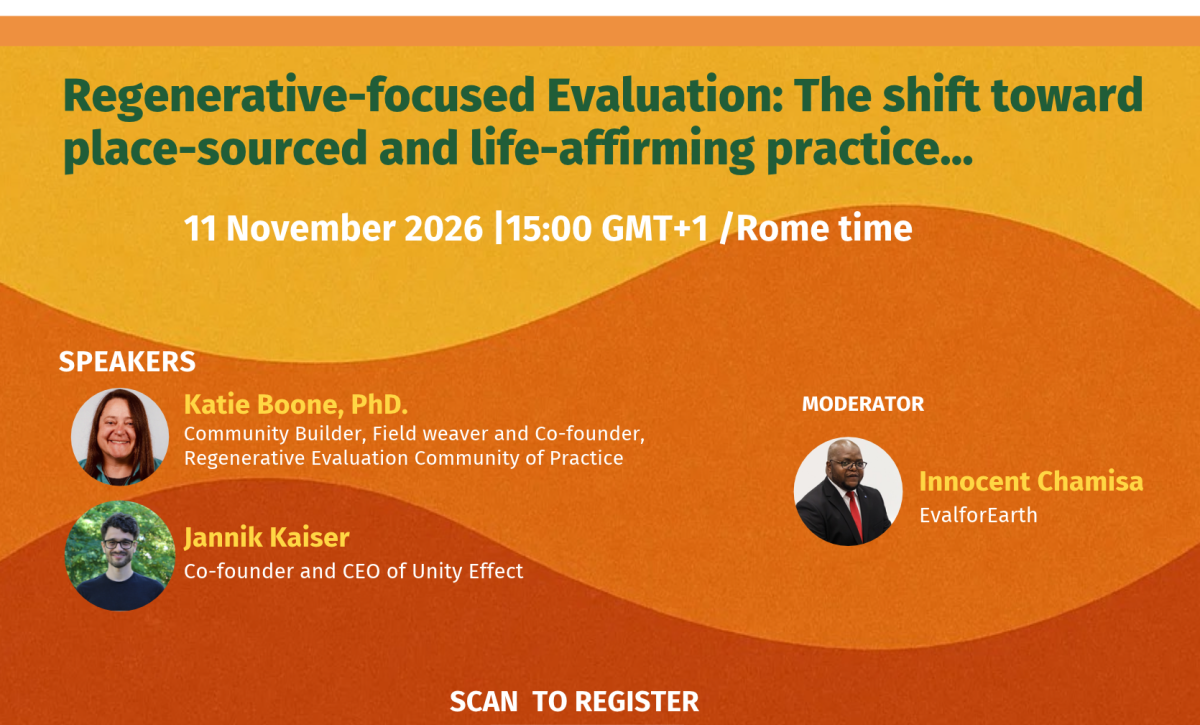
Dr. Katie Boone – Community Builder, Field Weaver and Co-founder of the Regenerative Evaluation Community of Practice
Jannik Kaiser – Co-founder and CEO of Unity Effect; Co-founder of the Regenerative Evaluation Community of Practice