
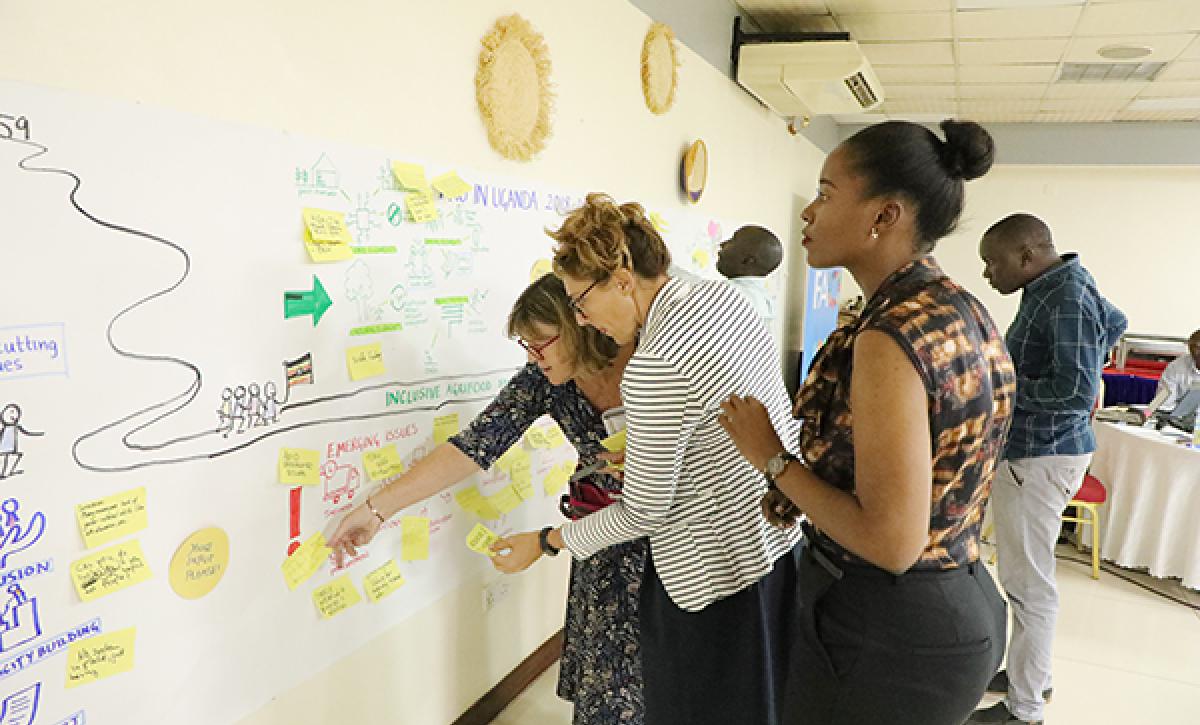
Evaluation realizes its greatest value when its findings inform learning, decisions, and action. Across the international development landscape, evaluation offices invest substantial resources in producing rigorous evidence, yet findings are still too often overlooked or left unused. The communication challenge lies in closing the gap between producing findings and ensuring they are understood, engaged with, and used.
This blog brings together perspectives from the evaluation offices of IFAD, FAO, WFP, CGIAR, and the Global Environment Facility (GEF) to reflect on a shared question: what are we missing in how we communicate evaluation findings effectively? Each office shares an approach it has tested, from modular reports and community videos to digital learning platforms and AI-assisted search. Together, these experiences show how communication can become part of an evaluation’s pathway to use rather than an activity added at the end. From modular report formats and video storytelling to immersive digital platforms and AI-powered search tools, the contributions below illustrate that there is no single formula, but there is a common principle: communication must be designed with the user in mind, not as an endpoint but as a bridge between evidence and action.
IFAD IOE: Matching communication to users
Do the communication and outreach efforts increase the of use of evaluation reports and uptake of recommendations? The relationship is difficult to isolate, particularly because communication is only one of several factors influencing evidence use. Yet, these efforts are extremely important, now more than ever. Even without a simple causal measure, communication remains essential. When it is treated as an afterthought, evaluation findings are less likely to reach the audiences, discussions, and decision points they were intended to inform. Unfortunately, too often, communication remains an afterthought, limiting the reach, relevance, and influence of evaluation when in fact it has the potential to make a real difference.
So, is this ‘afterthought’ approach only the result of the difficulty of pinpointing the causal impact of outreach activities? Probably not. There is more that we are missing. IFAD IOE addresses this problem through what it calls the “communication puzzle.” The puzzle is composed of four main elements, namely stakeholders, evaluation reports, communication tools, and dissemination platforms. To analyse these four dimensions in a synergistic fashion, IFAD IOE developed the communications cube. The tool helps teams examine how the four dimensions interact and identify the combination most likely to make each communication product useful.
This is not a one-off process; it requires continuous fine-tuning. For this reason, IFAD IOE periodically monitors the performance of its communication products and periodically reviews how audiences use and engage with them. It then adjusts the connections between audiences, evaluation reports, communication tools, and dissemination platforms within the communications cube. . This iterative process has helped IOE to significantly improve the targeting and reach of its communication efforts. According to IFAD IOE, the results include stronger readership and engagement, achieved without the need for any additional resources.
FAO OED: Rethinking report design
If communication depends on the right mix of stakeholders, products, tools and platforms, what does this mean for the way evaluation products are designed?
UN reports, including evaluations, are getting longer. Yet greater length does not translate into greater use and in some cases, it may even reduce accessibility and uptake. For FAO, the assessment of the Ukraine emergency response made this tension particularly visible and created an opportunity to design evaluation products differently.
In fast-moving contexts, such as emergency responses, decision-makers and operational teams need evidence that is timely, easy to navigate and credible. To respond to this challenge, FAO adapted not only what the evaluation communicated, but also how it communicated. A long, linear report would have been less suited to that environment. FAO therefore tested a lighter, more modular format, where each finding was presented on one page and supported by visuals, data and field perspectives.
What appeared to be a simple design choice had important implications for the writing process. It required the team to be more selective, simplify the narrative and sharpen the messages. The final report was about half the usual length, while still allowing readers to scan the main findings quickly or go deeper into the supporting analysis.
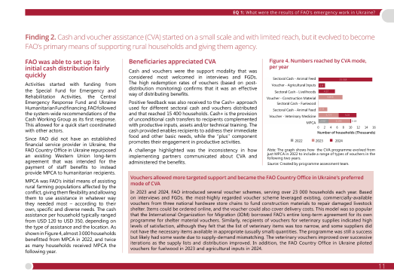
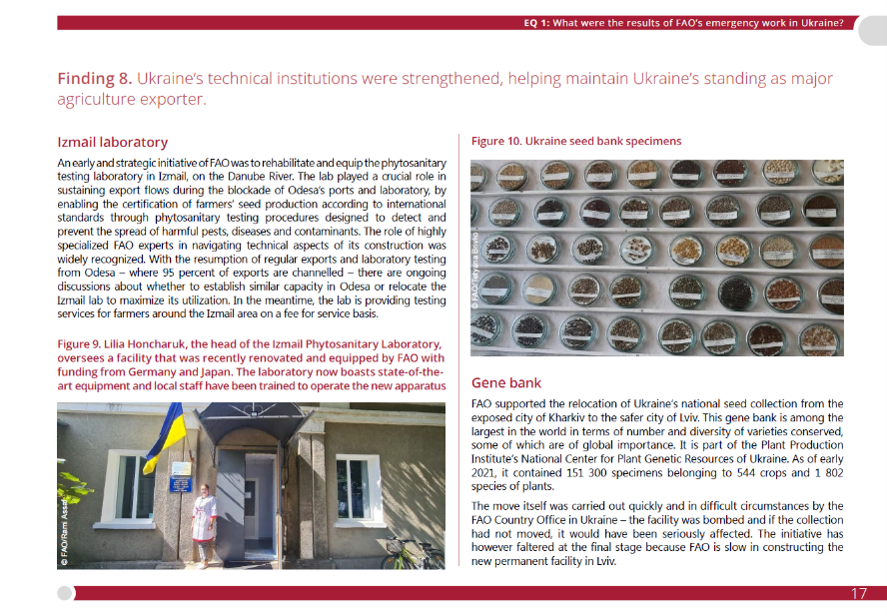
FAO also developed a short video to accompany the report. The video brought in voices from colleagues working on monitoring, emergencies and programmes in Ukraine, helping audiences connect the findings with the realities behind them. It also provided a concise, ready-to-use product for meetings and presentations.
The early response has been encouraging. The report received more than 500 downloads during its first four months, performing well compared with similar FAO evaluation products, and stakeholders appreciated its concise, visual format. Still, the experience raised questions: was the uptake linked to the format, to the visibility of the Ukraine crisis, or to both? And how can evaluation offices better understand whether communication efforts contribute to evidence use? Format matters, but it is only one part of the equation. Timing, audience needs, and follow-up all shape whether evaluation findings are understood and ultimately used.
WFP OEV: Communication as a Strategic Tool
WFP’s Office of Evaluation views communication as a strategic tool for supporting evidence use. Drawing on the inverted pyramid model used in journalism, the office applies the 5W&H: Why, Who, What, Where, When and How to plan communication and engagement that support the use of evaluation findings.
A case study from a school feeding impact evaluation in Jordan illustrates how evaluation evidence supported by targeted communication and engagement contributed to decision-making.
The Government of Jordan allocated USD2 million in domestic resources and secured an additional US$4 million in partnership with the World Bank and the Government of the Netherlands to scale up the school feeding program.
Another effective approach was the use of video to communicate with an often-overlooked audience group: those who benefited from the programme. In October 2025, the WFP Jordan country office shared a video summarizing the evaluation findings with kitchen workers who prepared the schoolchildren’s daily meals (read more in WFP's accompanying blog on communicating evaluation findings to beneficiaries).
The video’s screening at ten Healthy Meal kitchens across Jordan elicited an immediate and personal response. Participating kitchen workers expressed pride and renewed motivation on seeing how their daily work contributed to the program.
Ultimately, the case study emphasized that communication strategies to support evidence use only when the broader institutional culture and context are conducive to evidence-informed policymaking. If decision-makers are not open to learning, adapting and acting on evidence, even the most targeted communication efforts are unlikely to lead to meaningful use.
CGIAR IAES: Connecting evaluation evidence with decisions
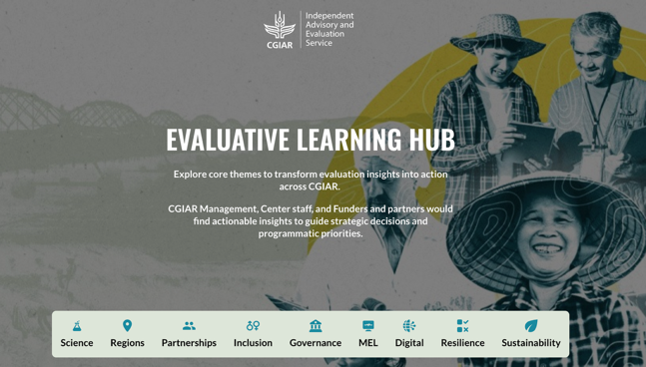
For CGIAR’s Independent Advisory and Evaluation Service (IAES), strengthening evaluation communication means moving beyond dissemination and treating communication as an integral part of the evaluation’s pathway to use. IAES's current work focuses on three complementary areas. First, identifying the decision moments and audiences that evaluation evidence needs to inform. Second, designing products and engagement formats that make findings timely, accessible, and relevant. Third, developing narratives that use storytelling to connect evidence with the people, decisions, and institutional learning they are intended to influence. In a research-for-development system such as CGIAR, this also means developing tailored products and platforms for different users, including the Evaluative Learning Hub. The Hub is organized around themes such as Science, Regions, Partnerships, Inclusion, Governance, Monitoring, Evaluation and Learning, Digital, Resilience, and Sustainability, making it easier for scientists, research teams, decision-makers and partners to access relevant evidence and learning products.
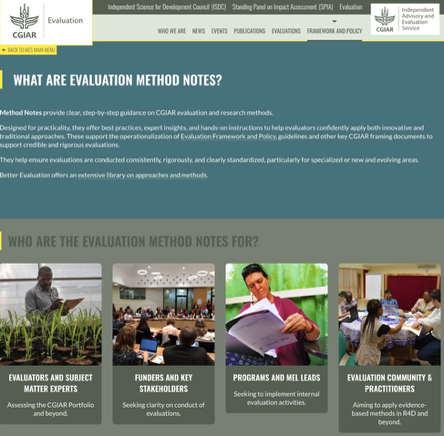
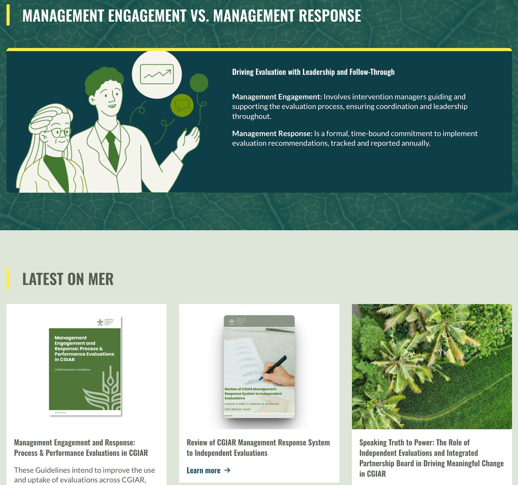
Alongside these thematic areas, IAES has developed dedicated resource spaces, including the Evaluation Method Notes Resource Hub and the Management Engagement and Response (MER) Resource Hub.
Method Notes provide clear, step-by-step guidance on CGIAR evaluation and research methods, providing practical guidance, expert insights and hands-on instructions to support evaluators in applying both innovative and traditional approaches.
Similarly, the MER Resource Hub supports key stakeholders in CGIAR evaluation processes by improving access to engagement and response materials easier to access and use. Together with spaces such as the Learning on CGIAR’s Ways of Working portal and the Evaluability Assessment portal. Together, these resources improve the accessibility and organization of evaluation evidence, making it easier for users to locate relevant knowledge and apply it to institutional learning and decision-making.
GEF IEO: Building evidence ecosystems
One of the central questions in evaluation today is whether communication is actually leading to evidence use. For evaluation offices, communication serves a different purpose from traditional corporate or institutional communications. The goal is not simply visibility, awareness, or engagement it is to help evidence reach the right people, at the right time, in forms that support learning, decision-making, and action. In this sense, communication also becomes a knowledge management function, with products and platforms serving as tools to connect evidence with users and facilitate the uptake of evaluation findings.
At the GEF Independent Evaluation Office, this perspective has increasingly shaped how the office packages and shares evaluation evidence. Rather than relying solely on lengthy reports, the office has expanded its use of diverse formats designed to meet different audience needs and learning preferences. This includes EvalVision videos that distill complex findings into concise visual stories. It also includes immersive WebVR experiences, such as the Oaxaca Evaluation Mission that allow audiences to virtually explore project realities, and interactive products like the Uzbekistan Country Evidence Story Map, which combines geospatial information, evaluation findings, and storytelling to make evidence more accessible and engaging.
The same thinking informed the development of the IEO’s new website and the OPS8 eReader. The website was designed not simply as a repository of reports, but as a gateway to evaluation knowledge. Alongside multimedia content, thematic navigation, and improved search functionality, it includes an AI-powered search assistant that allows users to discover relevant evaluation findings, lessons, and evidence from across the IEO portfolio. Similarly, the OPS8 eReader presents the Eighth Comprehensive Evaluation of the GEF from a traditional report into an interactive digital experience featuring visualizations, summaries, and navigable content tailored to different audiences. The IEO is also developing a dynamic recommendations tracker, which will bring Management Action Record (MAR) information into an interactive interface, enabling users to explore evaluation recommendations, management responses, and implementation progress more easily. Together, these innovations reflect a broader shift from producing evaluation products to building ecosystems that enable evidence discovery, understanding, and use.
Yet even the most innovative communication products do not guarantee uptake. Evidence use depends on understanding users' needs, decisions, and institutional contexts. This requires moving beyond dissemination and analytics toward a deeper focus on influence, relevance, timing, and knowledge brokering. As evaluation organizations continue to experiment with new communication approaches and technologies, the challenge is not only communicating better, but ensuring that communication helps evidence travel the final mile from findings to action. Ultimately, success depends not only on what is published, but also on how evidence is understood and used.
Conclusion
The experiences shared by IFAD, FAO, WFP, CGIAR, and the GEF show that effective communication of evaluation findings is not a single intervention, but a system of interconnected choices about audience, timing, platforms, and follow-through. Several common lessons emerge.
First, format matters. FAO's modular report and WFP's video for program beneficiaries demonstrate that rethinking how evidence is presented can broaden its reach and strengthen engagement.
Second, communication must be strategic rather than incidental. IFAD's communications cube and WFP's 5Ws-and-H approach show the value of planning communication alongside not after evaluation design.
Third, technology can expand access to evaluation evidence. GEF's digital tools and CGIAR's knowledge platforms illustrate how communication can make evidence more discoverable, accessible, and useful for different audiences.
Finally, communication strategies are most effective when institutional cultures support learning and evidence-informed decision-making.
A common challenge nevertheless remains understanding how understanding how communication contributes to evidence use use. Establishing a direct causal link between communication efforts and evaluation impact is difficult but that should not prevent evaluation offices from continuing to test, refine, and learn from new approaches. As these five organizations continue to experiment and learn from one another, the shared objective remains the same: to help evaluation findings move from evidence to informed decisions and meaningful action. After all, the true measure of an evaluation is not what it finds, but what it changes.