
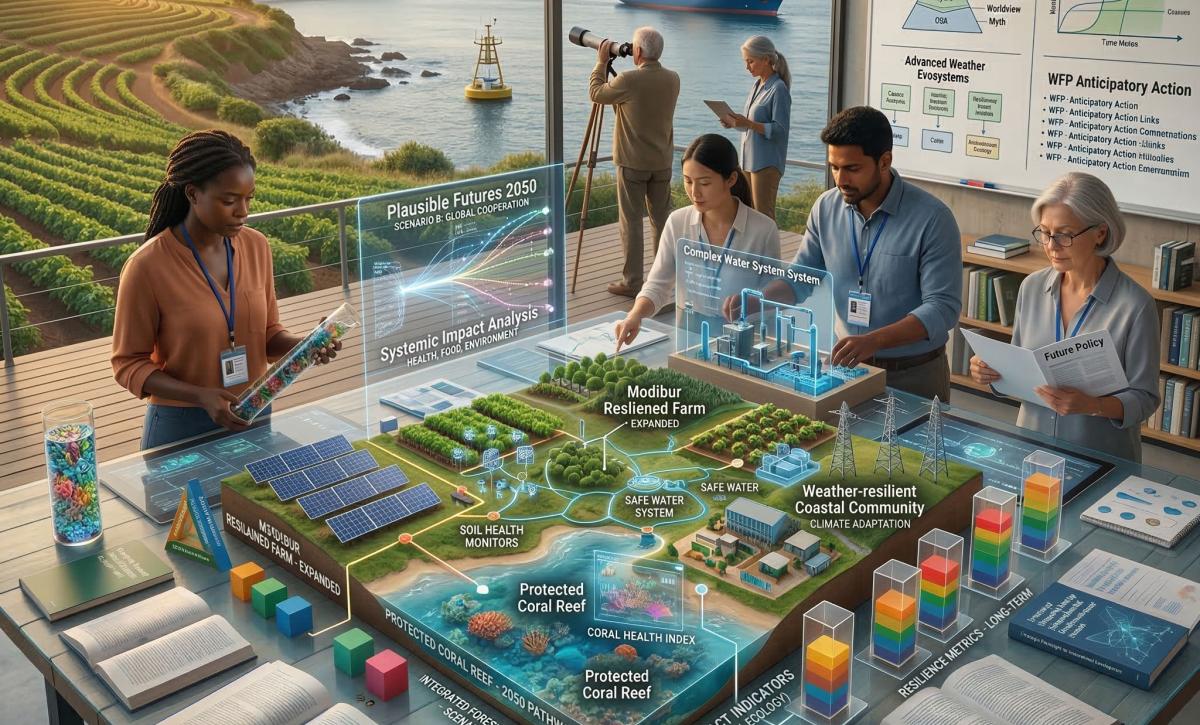
Evaluation has always been good at looking back. It helps us ask what happened, what worked, what did not, for whom, under what conditions, and why. These are essential questions. Without them, development, humanitarian, environmental, and food systems work would be left with stories, assumptions, and good intentions rather than evidence.
But in a world of climate volatility, food insecurity, ecological disruption, conflict, fiscal pressure, and rapid technological change, looking back is no longer enough.
The central question emerging from the EvalforEarth discussion was not whether evaluation should abandon its accountability or learning. It was whether evaluation can remain useful if it only explains the past after key decisions have already moved on. For many participants, the issue was not prediction. It was relevance. Decisions in agriculture, food security, climate resilience, and environmental governance are made in unstable conditions shaped by climate shocks, political shifts, market volatility, technological change, and social adaptation. Evaluation cannot remain useful if it only explains the past once decisions have already hardened into policy and practice.
If evaluation is to remain relevant in these contexts, it must help decision-makers ask not only “What did we learn?” but also “What might be changing?” “What assumptions are becoming fragile?” and “What choices would remain robust across different possible futures?”
The Limits of Backward-Looking Evaluation
A traditional evaluation cycle often begins after a program has already been designed, funded, and implemented. By the time evaluators arrive, many of the most important assumptions have already been locked in. The theory of change has been approved. The indicators have been selected. The budget has been allocated. The intervention logic has become the frame through which success or failure will be judged.
This can produce useful evidence, but it can also narrow the imagination. Evaluation becomes a process of assessing whether the program did what it said it would do, rather than questioning whether the original assumptions still make sense in a changing world.
In relatively stable contexts, this may be sufficient. But many food, agriculture and environmental interventions operate in conditions where the ground is constantly shifting. A climate-smart agriculture project may be overtaken by drought, conflict or market collapse. A food systems intervention may be affected by changing trade patterns, input prices or consumer behaviour.
A conservation program may be disrupted by land-use pressures, political change or community mistrust. A resilience initiative may be designed around yesterday’s risks while tomorrow’s vulnerabilities are already emerging. In these conditions, evaluation cannot only be a rear-view mirror. It also needs side mirrors, headlights and, at times, a map of alternative routes.
Foresight is Not Prediction
One concern raised in discussions was that foresight can sometimes sound speculative or disconnected from the evidence-based practice of evaluation. Evaluators are trained to work with evidence, not imagination. They are expected to make credible claims, not predict the future. But foresight is not prediction. It is not about claiming to know what will happen. It is a structured way of exploring uncertainty, testing assumptions and helping people think more carefully about decisions being made today. This distinction matters. Evaluation asks what can be learned from evidence. Foresight asks whether that learning still holds up under changing conditions. When brought together, they strengthen each other.
A future-informed evaluation does not replace evidence with speculation. It broadens the questions evaluation is willing to ask. It asks whether past performance is a reliable guide to future relevance. It tests whether recommendations would still make sense under different future conditions. It examines whether current strategies are flexible enough to respond to uncertainty. It raises questions about whose risks, priorities and knowledge shape how change is understood and planned for. For evaluators working in food security, environmental and agricultural development, this is not a luxury. It is increasingly central to the work.
From Findings to Future Readiness
Most evaluations end with recommendations. These are often framed as improvements to program design, implementation, coordination, efficiency, sustainability, or scaling. Some are immediately useful. Others are technically sound but fragile because they assume that conditions will remain broadly stable.
A foresight-informed approach asks a different set of questions about recommendations. Some examples include:
- Would this recommendation still make sense if climate shocks become more frequent?
- Would it hold if public financing declines?
- Would it remain viable if local institutions face political turnover?
- Would it support communities under different migration, livelihood or market conditions?
- Would it reinforce existing power imbalances or open space for more inclusive futures?
- Would it help the program adapt, or simply improve the current model?
These questions do not weaken evaluation. They make it more useful. They shift recommendations from static advice to strategic options. They help decision-makers see which actions are urgent, which are conditional, which require monitoring, and which may need to be abandoned if the context changes.
This is especially important in food systems, where interventions rarely succeed through linear pathways. Change depends on relationships among farmers, communities, markets, extension systems, ecosystems, governments, private actors, funders, and consumers. Evaluation findings that ignore this complexity may be technically correct but strategically useless.
What Foresight Adds to Evaluation
One important thread in the discussion was the difference between using foresight tools and practising foresight thoughtfully. Many evaluation teams can add a scenario exercise, a horizon scan, a risk matrix or a trends table. These tools can be useful. But foresight is not only a toolkit. It is also a professional practice that requires judgement about timing, depth, participation, power, and purpose. For example, a superficial scenario exercise may generate four generic futures that do little to change program thinking. A stronger foresight process tests the assumptions that matter most to decision-makers. It examines weak signals that may not yet appear in formal data. It engages different ways of knowing, including local, Indigenous, youth, farmer, and community perspectives. It also helps participants surface what they assume is inevitable, what they fear, what they hope for, and what they are still unwilling to discuss.
This is where foresight can deepen evaluation. It helps move beyond the “litany” of visible problems into the systems, worldviews, and narratives that shape how programs are designed and judged. In food and environmental systems, these deeper layers matter. A program may fail, not because the activities were poorly delivered, but because it was built on outdated assumptions about land, growth, resilience, markets, gender, technology, community agency or the relationship between humans and nature. Evaluation can identify these assumptions retrospectively. Foresight can help test them before they become tomorrow’s failures.
What This Looks Like in Practice
Bringing foresight into evaluation does not require every evaluation to become a major futures exercise. It can start with practical shifts. Evaluation questions can include future relevance, not only past performance. For example:
- Theories of change can be treated as living hypotheses rather than fixed diagrams. Evaluators can ask which assumptions have held, which have weakened, and which new assumptions are emerging.
- Horizon scanning can be incorporated early in evaluation design to identify trends, weak signals, and uncertainties that may affect the program’s future relevance.
- Scenario thinking can be used to test findings and recommendations against different possible operating environments.
- Causal Layered Analysis can help evaluators examine not only visible outcomes and system dynamics but also the deeper worldviews and narratives that shape intervention logic.
- Wind-tunneling can help decision-makers assess whether recommendations are robust, risky, or context-dependent across multiple plausible futures.
- Participatory futures methods can bring communities, local actors, and marginalised groups into conversations about what resilience, sustainability, and transformation mean to them.
None of these approaches replaces rigorous evaluation. They add another layer of usefulness and critical analytical lenses.
A Shift in Evaluation Culture
The deeper challenge is cultural. Many evaluation systems are still designed around compliance, reporting and retrospective accountability. They are built to assess what happened after decisions have already been made, not to help institutions think through uncertainty while change is still unfolding. This creates a real tension. Organisations increasingly talk about resilience, transformation, systems change, and adaptive management, but they often commission evaluations that are too late, too narrow, or too backward-looking to support those goals in practice.
A future-informed evaluation culture would require a broader understanding of what evaluation is for. It would value early learning alongside the final judgement. It would create space for uncertainty rather than forcing false confidence. It would reward honest reflection on assumptions and treat negative findings as strategic intelligence. It would involve local actors not only as data sources, but as interpreters of change and co-creators of possible futures. This is particularly important in the EvalforEarth community because food security, agriculture, and environmental development are already future-facing fields. Every seed system, watershed plan, climate adaptation strategy, nutrition intervention, circular food system initiative or biodiversity program carries assumptions about the future. Evaluation should make those assumptions visible, testable, and open to revision.
The Next Frontier: Evaluation as Anticipatory Learning
The discussion suggests that the future of evaluation is not simply more data, faster dashboards or better reports. These matter, but they are not enough on their own. The deeper shift is about how evaluation is used. At its best, evaluation helps people learn from the past, make sense of the present and think more carefully about what may be coming next. In a period shaped by climate instability, economic pressure, environmental stress and institutional uncertainty, that role becomes increasingly important.
This does not mean every evaluator must become a futurist. But it does mean evaluation teams may need new partnerships, broader facilitation skills and greater comfort with uncertainty. It also means that institutions commissioning evaluations may need to ask for more than retrospective judgement alone. They may conduct evaluations that help them reflect, adapt, and respond before conditions shift too far ahead of existing plans.
For food security, environmental and agricultural development programs, this shift is particularly urgent. The systems being evaluated are changing faster than many evaluation cycles can keep up with. The question is not whether the future will affect evaluation. It already does. The real question is whether evaluation will help us see change early enough to respond to it.