
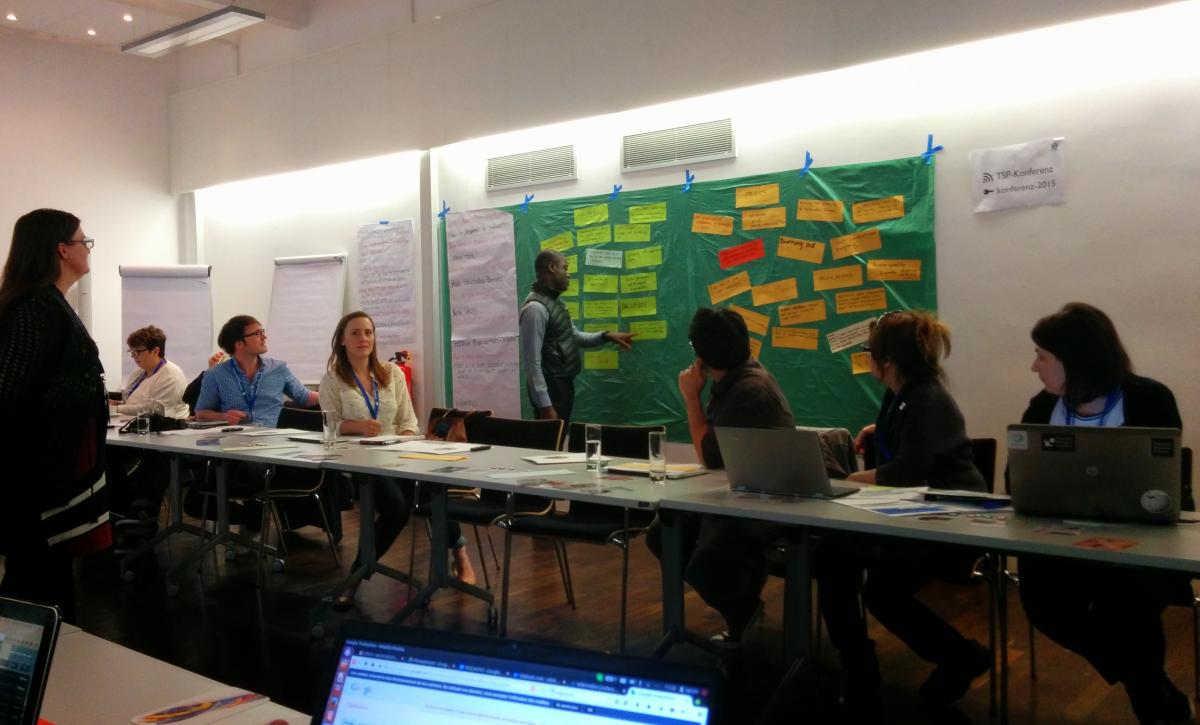
Across the international humanitarian, development, and peacebuilding sectors, organizations are facing increasing financial pressure due to shifting donor priorities, competing domestic priorities, and rising operational costs. Many are expected to maintain or expand programme delivery and associated accountability and learning activities despite declining or uncertain resources. These pressures are also affecting evaluation functions at international, national, and local levels. As resources become more constrained, evaluators face growing expectations to generate timely and useful evidence while safeguarding evaluation quality, independence, and credibility. This raises important questions about how evaluation systems, approaches, and methods can adapt to changing institutional priorities and operational realities.
Rationale for the discussion
While funding constraints affect organizations across sectors, their implications for evaluation vary depending on institutional mandates, operational contexts, and the populations served. Drawing on the complementary focus areas of EvalforEarth and ALNAP, this discussion will examine these implications across climate action, food security, resilience, humanitarian emergencies, and peacebuilding, with particular attention to the challenges of sustaining credible evidence and accountability in resource-constrained settings.
The discussion will also consider the risks associated with reducing investment in evaluation or failing to incorporate evaluative evidence into strategic and operational decisions, particularly where resources are limited and the consequences of ineffective interventions may be significant.
Purpose of the discussion
The discussion seeks to draw on the experiences of EvalforEarth and ALNAP members to identify practical lessons and recommendations for sustaining effective evaluation systems under financial and operational constraints.
Specifically, it aims to:
- Examine how financial uncertainty is affecting evaluation practice, accountability, organizational learning, and evidence use across different sectors and institutional contexts.
- Identify practical adaptations, innovations, and approaches that can help maintain evaluation quality, independence, and usefulness with limited resources.
- Explore how evaluators and organizations can better demonstrate the value of evaluative evidence and strengthen its use in strategic and operational decision-making.
Guiding discussion questions
Week 1: Implications of funding constraints: How have funding or resource constraints affected evaluation, learning, and accountability processes in your organization or context?
Week 2: Adaptations and practical solutions: How have you or your organization adapted evaluation and learning practices to respond to these constraints?
Week 3: Risks of limited evidence use: What are the risks of excluding evaluative evidence from strategic and operational decision-making, particularly in resource-constrained environments?
Week 4: Looking ahead: What needs to change to sustain credible, independent, and useful evaluation in increasingly resource-constrained environments?
The online discussion will remain open for contributions until 12 November 2026.
This discussion is now closed. Please contact info@evalforearth.org for any further information.
Nigeria
Dr. Uzodinma Akujekwe Adirieje
CEO
Afrihealth Optonet Association (AHOA) - CSOs Network
Posted on 25/10/2026
AHOA Response to "Rewiring the Evaluation Marketplace for a Changing World" (MacPherson, Kelly & Kumar, JMDE 22(53), 2026)
-by Dr. Uzodinma Akujekwe Adirieje;
CEO/Programmes Director, Afrihealth Optonet Association (AHOA)
📞 🟢 +234 803 472 5905 | ✉️ afrepton@gmail.com| 🌐 https://www.afrihealthcsos.org
AHOA welcomes this timely and candid article. It argues that evaluation is shaped as much by market incentives as by methods and theory, and that a field built on accountability-driven demand will struggle to stay relevant as aid gives way to investment-led models. This matches what we see from the Global Majority side. AHOA has worked since 1995 as a civil society network, now spanning 100+ countries, with UN ECOSOC consultative status. We have received evaluation demands set elsewhere, and we have also produced evidence for decisions on our own terms. We offer our reflections from that vantage point.
Where AHOA agrees
Accountability-driven demand narrows learning. Our experience supports this. Much of the evaluation done in our contexts, including Global Fund-financed HIV and TB work, serves donor reporting first. AHOA's own oversight work in Nigeria, such as monitoring Global Fund projects for the CCM, showed us how little of that evidence returns to communities or local decision-makers in usable form.
Tied aid and concentrated buyers constrain local capacity. Small and mid-sized Global South evaluation providers face the reputational catch-22 the authors describe: no major-donor experience, so no contracts, so no experience. We agree that procurement and accreditation reform is the most practical lever.
Intermediaries must change roles. Proposition 6 resonates with how AHOA positions itself. We act as a convener and network, and also as a direct implementer. Our strategy rests on partnerships, advocacy, research, capacity development, outreach, and monitoring and evaluation (PARCOM). Evaluation is built into the programme cycle and is not an external audit bolted on at the end.
What AHOA would add
1. Civil society is a market actor and an evidence producer, not only a client.
The article names philanthropy, social enterprise and impact investors as the innovators outside the mainstream. It says little about civil society networks and community organisations, which generate much of the real-time, context-rich evidence in low-resource settings. Our Sustainable Citizen Participation work in the Niger Delta, the Nigeria Malaria Matchbox projects and the Life & Health Dialogue Series all produce community-grounded evidence and communiqués with specific resolutions. These are rarely counted as part of the "evaluation market" because they sit outside formal commissioning.
2. Speed and voice can be organised collectively.
The authors ask why evaluators could not respond within days to the USAID disbanding. Networks can. AHOA's African Civil Society Statement and Clarion Call to COP31, issued in August 2026 from our 31st Life & Health Dialogue Session, gathered 373 endorsements from 29 countries within weeks. It is not a formal evaluation. It shows that a distributed network can convert shared evidence into a unified, politically aware position quickly, which is exactly the capability Proposition 1 calls for.
3. Politically astute evaluation needs structured pathways, not individual heroics.
We support the call to train evaluators to read power and advocate for evidence. In practice this needs institutional mechanisms: observer and accredited status in UN processes (UNEA, the plastics INC, the chemicals and wastes OEWG, UNOG), delegation to COP-type forums, and standing technical working groups. A civil society evaluator who can brief negotiators directly has influence that a report on a shelf does not.
4. Localisation must include evaluation ownership, not only programme delivery.
Proposition 4 is right that Global Majority evaluation markets are underdeveloped. We would go further. Governments and funders should commission locally led evaluation by default, with domestic public-sector budgets for evaluation, and not only subcontract local firms under international prime contractors. Nigeria's health, malaria and HIV systems already generate large demand for M&E, for example national M&E plans and costing work. That demand should be met by qualified Nigerian and African professionals, with international partners in supporting roles.
5. Evaluating in fragile and displaced-population contexts.
The article focuses on the "polycrisis" in general terms. Refugees and displaced persons are among its most acute expressions, and standard OECD-DAC framing and short contract cycles fit them poorly. Through the African Refugee Council (ARC) and AHOA’s Pan-African Refugee and Displaced Persons Integration and Support Programme (PRISP), we see the need for participatory, rights-based and rapid-feedback evaluation approaches that include displaced people as evidence holders, not only as subjects.
6. AI and indigenous knowledge belong in the rewiring.
The authors mention AI and foresight only briefly, as capabilities the field lacks. AHOA's position is that artificial intelligence must serve equity, justice and sustainable development, not replace human dignity. For the evaluation market this means three things:
Response to the six propositions
Proposition
AHOA response
1. Politically astute presence
Strongly support. Build advocacy and political-analysis skills into evaluator training, and use accredited civil society platforms to carry evidence into decision forums.
2. Integrated, diverse market
Support. Include civil society networks and community-based evidence producers alongside private sector, social enterprise and impact investors.
3. New geographic alliances
Support. Alliances with African, Asian and Gulf actors should be built on partnership terms agreed up front, so Global Majority evaluators are co-designers and not only data collectors.
4. Regional and local markets
Strongly support. Priorities are procurement reform, domestic evaluation budgets, and support for small and mid-sized African firms and CSOs.
5. Mergers, coalitions, new combinations
Support. Coalitions of evaluators, civil society networks, and health and climate specialists would respond more flexibly than any single firm. Management consultancies should be engaged as partners without being allowed to dominate regional markets.
6. Reconfigured intermediaries
Strongly support. Funders should set clear transition plans for Global North intermediaries, including direct funding windows for Global Majority networks.
Respectful critique
Closing call
The question the authors pose, whether evaluation can change fast enough, is one the Global Majority is already answering through networks, coalitions and locally led evidence work. AHOA invites the authors, the evaluation associations and funders to treat African civil society networks as partners in rewiring the marketplace. Concretely, we propose:
Zimbabwe
Wilbert Marimira
MEAL Specialist
CARE International
Posted on 13/10/2026
Adapting, Navigating, and Owning - Safeguarding Evaluation Integrity, Accountability, and Learning in Lean Times
“If you want to go fast, go alone. If you want to go far, go together.” — African Proverb
In times of financial crisis, shrinking aid budgets and sudden donor cuts often tempt organizations to "go fast and alone" relying on top-down, rapid internal assessments and cutting local participation to save time and money. However, if evaluation is to remain relevant, ethical, and sustainable amid growing funding constraints, we must choose to "go far together." Reduced resources do not have to mean compromised quality or silenced local voices; rather, they present a vital opportunity to strip away bloated, extractive evaluation practices and return to what truly matters: actionable learning, technical integrity, and genuine, community-led accountability.
Building directly on this principle, operational experience across Southern Africa, specifically in the, Education, Social Protection, Climate Resilience, and Livelihoods sectors, teaches a clear lesson: funding shocks do not have to destroy evaluation quality, but they do demand that we adapt. Managing emergency MEAL systems in drought-prone districts such as Gokwe North, Mutare Rural, Bikita, and Chiredzi showed how field realities, practical missteps, and localised adaptations serve as our best teachers for protecting evaluation integrity under pressure.
I also noted that in resource-constrained settings, traditional, expensive evaluation models, such as heavy, stand-alone quantitative surveys at the end of every project cycle, are financially unsustainable. To maintain evidence, use without compromising technical rigor, here are some key practical experiences we employed:
Also, demonstrating true professional integrity means owning operational missteps, reflecting on the friction between ideal textbook methodologies and field realities, and adapting to serve communities better. Here are two practical mistakes from my journey in Zimbabwe and beyond, the core lessons they taught me:
Mistake 1: "Data Hoarding" in Emergency Livelihoods & Food Security
The Experience: During an emergency response project in drought-affected wards, I was determined to capture everything. I designed a statistically exhaustive sampling frame with a 45-page questionnaire covering detailed household demographics, livelihood assets, and granular food consumption scores across multiple districts. The data collection somewhat drained our transport budget, exhausted our small field team, and generated a massive backlog of raw data. The Lesson: Collect only what you will use. Integrity is not about generating the largest dataset; it is about delivering timely, actionable evidence when decision-makers and communities actually need it. High-pressure evaluation requires radical prioritization around "Must-Know" vs. "Nice-to-Know" metrics. Using targeted cluster sampling, lean digital survey platforms (such as KoBoToolbox or ODK), and concise indicators protects both project resources and community time.
The Experience: Faced with a sudden 15% budget cut midway through a Longitudinal education and social protection project, our team worked to absorb costs by trimming internal staffing without compromising quality, travel stipends, and administrative overhead. However, seeking further savings to preserve the core quantitative survey for the donor, we initially canceled formal, hotel-based validation workshops. Recognizing that target communities, school heads, and local leaders were at risk of being left in the dark, we quickly pivoted to ensure local stakeholders remained our top priority.
The Human Reality: In earlier project phases, failing to return findings promptly had led community leaders to express deep frustration at feeling treated as mere data sources rather than equal partners. Learning from that initial friction, we realised that maintaining trust/accountability required putting local leaders, school heads, and community members first, even when formal budgets were depleted.
The Lesson: Accountability is not an optional overhead line to be trimmed; it is the core of project ethics. When funding is tight, prioritizing communities, school heads, and local leaders means localising accountability rather than abandoning it. Instead of expensive hotel venues, hosting low-cost ward dialogues under a tree using indigenous language summaries ensured that local stakeholders were prioritized as true co-owners of evaluation findings without financial strain.
Practical Questions & Adaptive Approaches for Lean Evaluation
To maintain evaluation usefulness, rigor, and ethical standards when budgets are tight, grounding evaluation design in strategic questions and adaptive methods is essential:
Core Guiding Questions to Ask Early:
Here are some practical approaches that worked for us:
Funding constraints force us to strip away unnecessary complexity and focus on what truly matters: actionable learning, community agency, and genuine accountability. When we ground our evaluation approaches in local realities, whether in Southern Africa or elsewhere across the globe, we ensure that evidence remains a vital tool for positive change, regardless of budget size.
I look forward to hearing how other colleagues across the Eval4Earth community are adapting their systems to stay effective and resilient!
https://www.linkedin.com/in/wilbert-marimira-b7321b80
Ghana
Janet Awopole Yepakeh Tiah
Project Coordinator
University of Ghana
Posted on 13/10/2026
Aid Cuts and the Deprioritization of M&E: Lost Evidence, Lost Learning, Wasted Capacity, and Looming Implementation Errors
Aid is being cut. At the same time, monitoring and evaluation is being pushed down the priority list. The result is a multiple burden: fewer resources to deliver interventions, less ability to know what those resources achieved, wasted M&E capacity, and a looming cycle of costly mistakes because we lack the knowledge to streamline future projects.
Part of the problem is that donors are no longer demanding M&E as part of reporting on the limited funds that remain. When M&E is not a reporting requirement, it is the first thing implementers drop to protect service delivery. Without that demand, there is little incentive to keep systems running or to show results.
Our Loses:
What we can do:
Zimbabwe
Wilbert Marimira
MEAL Specialist
CARE International
Posted on 13/10/2026
Thank you, Janet, for sharing such a critical and timely piece!
Cutting M&E during a funding crisis to save money is like throwing the ship’s radar overboard during a severe storm to lighten the load. You might keep afloat a few miles further today, but you guarantee steering straight into the rocks tomorrow.
I completely agree with your analysis, dropping M&E requirements when aid contracts creates a dangerous false economy. When evidence systems are dismantled, we don't just lose project indicators; we lose years of invested local capacity, community trust networks, and contextual intelligence. Without data, we are left counting immediate inputs while remaining blind to long-term impact, practically guaranteeing that costly implementation mistakes will be repeated in future cycles.
To break this cycle, we must advocate for radical prioritization rather than total abandonment. Donors must recognize that ring-fencing even 2% to 3% of reduced grant budgets for M&E is not administrative bloat, it is essential risk insurance to ensure scarce funds are not squandered. At the same time, implementers can transition to lean, localized mechanisms, such as Community-Led Monitoring, routine administrative data synthesis, and a strict core set of non-negotiable indicators. As you powerfully stated, limited funds make evidence more important, not less; we cannot afford to navigate these lean times completely blind.
Kenya
JACKLINE MUSUYA
Monitoring and Evaluation Lead
Hewatele Limited
Posted on 21/10/2026
Thank you, Janet. You have captured the risk clearly: when M&E is deprioritised, organisations lose evidence, learning, and capacity at the same time. Maintaining core indicators and documenting lessons before programme closure can help prevent scarce resources from being spent without understanding what worked.
Italy
Anoop sharma
Corporate Evaluation, AI and Data Specialist
IFAD
Posted on 13/10/2026
Shrinking humanitarian and development funding is putting increasing pressure on evaluation offices, which are expected to deliver more with fewer resources. But I also see an opportunity here: to rethink how we conduct evaluations and make better use of the evidence we already have.
In our joint blog, Doing More with Less: AI for Humanitarian, Environmental & Development Evaluation, we explored how AI could help evaluation offices respond to these pressures. For example, AI can support the synthesis of large volumes of documents, help identify evidence gaps, analyse evaluation portfolios and facilitate translation. Used responsibly, it could reduce time spent on some analytical tasks and allow evaluators to focus more on interpreting findings, understanding context and exercising professional judgement.
There is also an opportunity to look beyond efficiency gains in individual evaluations. Better use of existing evidence could help evaluation offices identify where new evaluations are most needed and avoid duplicating work where sufficient evidence already exists.
Of course, doing more with less cannot come at the expense of evaluation quality, independence or inclusiveness. AI-generated outputs need to be validated, and appropriate safeguards must be in place. Ultimately, the question is not simply whether we can produce evaluations faster or at lower cost, but whether we can use our resources more strategically to generate credible evidence that informs decisions and strengthens accountability and learning.
Zimbabwe
Wilbert Marimira
MEAL Specialist
CARE International
Posted on 13/10/2026
Thank you for sharing these crucial insights!
Your blog post highlights a vital turning point for our field: when financial pressure mounts, our greatest asset isn’t just working faster, but thinking and synthesizing smarter. Embracing AI as an analytical partner is like having a tireless research assistant, one that can sift through mountains of past reports in seconds, but still relies entirely on human wisdom, field empathy, and contextual judgment to make sense of the big picture. You identified that responsible AI adoption isn't about replacing the evaluator’s voice or cutting corners on quality; it’s about freeing our time and mental energy from repetitive data sorting so we can engage more deeply in what truly matters: listening to communities, interpreting nuance, and exercising professional oversight.
To add another layer to this momentum, leveraging AI to synthesize existing evidence offers an unprecedented opportunity to democratise localised learning while firmly maintaining a Human-in-the-Loop approach. AI can identify patterns, but it cannot feel field realities or understand cultural nuances; human judgment remains the irreplaceable bridge between raw data outputs and ethical, context-driven decision-making. In many field contexts, years of rich community feedback and local monitoring reports remain trapped in buried PDFs because small MEAL teams lack the hours to analyze them manually. By applying human-guided AI workflows to harvest and map these qualitative insights, with rigorous human validation at every step, we can prevent evaluation fatigue in vulnerable communities, honor past local contributions, and safeguard evaluation rigour when resources are tightest.
Kenya
JACKLINE MUSUYA
Monitoring and Evaluation Lead
Hewatele Limited
Posted on 21/10/2026
I agree that AI’s greatest value may be not only faster analysis, but also helping evaluation offices synthesise existing evidence, identify gaps and prioritise where new evaluations are most necessary.
However, efficiency must be matched by institutional readiness, human validation and contextual judgement. The real test is whether AI-supported evidence improves decisions and learning without weakening quality, inclusion or accountability.
South Africa
Sibongile Sithole
Evaluation Consultant
Posted on 26/10/2026
Indeed, the real value of AI isn’t just doing the same work faster, but freeing up evaluators’ time for context, interpretation and judgement. Whilst this may be ideal, AI remains exclusive in many cases. Most grassroots and development communities, where donor-funded programmes are usually situated, lack access to AI, yet they are often the same people most affected by funding cuts. It is therefore important to consider how we can avoid their marginalisation, because the very same AI that can be useful could further widen the divide. If AI-supported evaluations draw mostly on documents and datasets produced by donors and implementing agencies, community voices risk being even further removed from the evidence base.
Nigeria
Dr. Uzodinma Akujekwe Adirieje
CEO
Afrihealth Optonet Association (AHOA) - CSOs Network
Posted on 05/11/2026
A Rejoinder to the UNEG Evaluation Practice Exchange Takeaways on AI in Evaluation
- By Dr. Uzodinma Akujekwe Adirieje, FAHOA
CEO and Programmes Director, Afrihealth Optonet Association (AHOA)
I thank the Evaluation Offices of IFAD, WFP and GEF for convening this exchange and for sharing the six takeaways so openly. I write from civil society in Africa, where evaluation is often done with limited resources and the cost of getting AI wrong falls on communities. I agree with the direction of the six messages. I want to press on four points.
a. "DOING MORE WITH LESS" MUST NOT BECOME "EVALUATING LESS."
Takeaway 1 is right that AI can shift effort from mechanics to meaning. In low-resource settings, though, efficiency gains tend to be absorbed as budget cuts. If AI-assisted desk reviews and report drafting become the reason to shrink field budgets, community consultations and evaluator fees, the promise is reversed. The capacity AI frees must be reinvested in interpretation, ethics and relationships, and commissioners should say so in their budgets.
b. HUMAN INSIGHT DEPENDS ON WHO THE HUMANS ARE.
Takeaway 3 makes human insight a defining feature of quality, and I agree. The human in the loop must also come from the context being evaluated. A verifier who cannot read the local language, or who has never sat with a community, cannot validate an AI output about that community. I have seen this as Chair of the Community Advisory Board for the VERDI Mpox study in Nigeria’s Bayelsa, Lagos and Rivers States. Legitimacy there came from people accountable to the participants. AI can support that work, but it cannot supply it.
c. LOCAL RELEVANCE MUST INCLUDE LOCAL OWNERSHIP.
Takeaway 5 calls for co-design, locally relevant data and sustained capacity. I would go further. National and civil society evaluators should co-design and co-own AI-supported methods and not only be trained in tools built elsewhere. Otherwise "capacity building" repeats the dependency it claims to end. Multilingual resources matter, because mainstream tools perform unevenly across African languages. Data sovereignty matters too, especially for refugees and displaced people, whose data is the most sensitive and who are the most easily left out of the evidence base. I raised these themes in my EvalforEarth blog, "Reimagining Evaluation for Climate Action in Africa: Indigenous Knowledge, Inclusion, Fragile Contexts and Artificial Intelligence."
d. GOVERNANCE OBLIGATIONS MUST RUN IN BOTH DIRECTIONS.
Takeaway 6 asks consultants and service providers to disclose, verify and use AI responsibly. I accept this fully, and AHOA holds itself to it. We disclose AI use, verify every output, protect data and keep a named human accountable for each conclusion. The same standard should apply to commissioners, who should also disclose how AI shapes their evidence mapping and commissioning decisions. Civil society networks should help design these governance rules and not only comply with them.
CONCLUSION
We hold that artificial intelligence must serve equity, justice and sustainable development and never replace human dignity. The six takeaways point the same way. What remains is to make them binding: in terms of reference, in budgets, in contracts and in who sits at the table. AHOA offers its network of more than 3,000 organisations across 113 countries, together with its experience in community engagement and M&E, to help turn these takeaways into practice.
Dr. Uzodinma Akujekwe Adirieje, FAHOA
CEO and Programmes Director, Afrihealth Optonet Association (AHOA)
2026 EvalforEarth Champion | President, African Refugees Council (ARC)
Abuja, Nigeria | afrepton@gmail.com | ceo@afrihealthcsos.org | www.afrihealthcsos.org
+234 80 347 25 905
Côte d'Ivoire
JEAN EUDES NGUESSAN BEUGRE
Consultant
Posted on 13/10/2026
Funding constraints now pose a major challenge for humanitarian and development organisations, particularly in contexts where people’s needs continue to grow.
On the ground, reduced resources can lead to less frequent assessments, less in-depth data collection and difficulties in ensuring regular monitoring of beneficiaries and the outcomes of interventions. However, in the fields of food security, climate resilience, agroecology and disaster management, reliable data is essential for guiding decisions and ensuring that available resources genuinely meet the needs of communities.
In my view, the solution does not lie in eliminating or weakening evaluation functions, but in promoting approaches that are more strategic, participatory and tailored to the resources available. This involves, in particular, strengthening local capacities, using accessible digital tools for data collection and analysis, pooling resources between organisations, and integrating monitoring, evaluation and learning right from the project design stage.
It is also essential to prioritise relevant indicators, to value communities’ knowledge, and to ensure that evaluation findings are actually used to improve interventions.
Ultimately, evaluation should not be viewed as an additional cost, but as a strategic investment that improves programme effectiveness, accountability to communities and the sustainable impact of actions, even in times of financial constraints.
Philippines
Mae Albiento
Research Officer
ALNAP
Posted on 14/10/2026
Thanks for sharing your reflection, Jean. You are right! With limited resources, organisations need to be even more strategic and thoughtful about what they evaluate and what information is most needed to make better decisions. And I guess the bigger challenge here is making sure that, even if we are trying to do more with less, we don't lose sight of the people and communities the programmes are meant to serve. As you said, their knowledge and perspectives should shape what we evaluate and also the decisions we make after.
I am curious to know how organisations have continued to center local actors, especially people and communities affected by crisis, in their evaluations in these challenging times. Please share your experiences, challenges and lessons.
Kenya
JACKLINE MUSUYA
Monitoring and Evaluation Lead
Hewatele Limited
Posted on 21/10/2026
In my context, organisations increasingly use community feedback forums, participatory monitoring and validation meetings to retain local perspectives when stand-alone evaluation budgets are limited.
The challenge is that local actors may contribute information without influencing the evaluation questions, interpretation or final decisions. Centring communities therefore requires more than collecting their views. It means involving them in defining what matters, making sense of findings and tracking whether agreed actions are implemented.
Kenya
JACKLINE MUSUYA
Monitoring and Evaluation Lead
Hewatele Limited
Posted on 13/10/2026
In my experience working in monitoring, evaluation and learning (MEL) across health and development programmes, funding constraints rarely eliminate the need for evidence. Instead, they often change how organisations generate and use it.
One of the most noticeable effects is the growing emphasis on accountability over learning. When resources are limited, organizations understandably prioritize donor reporting and compliance requirements. While these functions are important, learning activities such as reflection sessions, outcome assessments and evaluations are often postponed or scaled back. As a result, organizations may become better at reporting results than at understanding why those results were achieved and how performance can be improved.
Beyond learning, funding constraints can also affect accountability. When resources for evaluation and reflection are reduced, organizations may have fewer opportunities to systematically assess whether programmes are meeting the needs and priorities of the communities they aim to serve.
Funding constraints can also reduce the scope of evaluation. In many cases, organizations rely more heavily on routine monitoring data and conduct fewer in-depth studies. While this may provide sufficient information for reporting purposes, it can limit deeper insights into effectiveness, sustainability and unintended outcomes.
At the same time, financial pressure can create an opportunity to rethink evaluation practice. Rather than collecting more data, organizations are often compelled to make better use of existing information. This can encourage more focused evaluations, stronger integration of learning into routine management processes and greater attention to evidence that directly informs decisions.
In my view, the greatest risk is not conducting fewer evaluations. It is losing the space for reflection and learning that enables organizations to adapt. In resource-constrained environments, evidence becomes more valuable, not less, because decisions about priorities, investments and programme design carry even greater consequences.
Zimbabwe
Chamisa Innocent
EvalforEarth CoP Facilitator/Coordinator
EvalforEarth CoP
Posted on 13/10/2026
Thank you Jackline, for sharing your experience and reflections. You raise an important point about the shift from learning to compliance and reporting when resources are limited. I agree that the challenge is not necessarily conducting fewer evaluations but losing opportunities for reflection and learning.
I would be interested to hear more about how organisations in your context are balancing donor reporting requirements with learning needs under these constraints.
We also continue to invite other colleagues to contribute to our Week 1 discussion, as highlighted by Mae: How have funding or resource constraints affected evaluation, learning and accountability processes in your organisation or context?
We welcome your experiences, examples and reflections from different contexts.
Kenya
JACKLINE MUSUYA
Monitoring and Evaluation Lead
Hewatele Limited
Posted on 21/10/2026
Thank you, Chamisa. Organisations in my context are using several practical approaches to balance accountability and learning:
The main constraint is that reporting has fixed deadlines and contractual consequences, while learning is often treated as optional. Leadership must therefore protect time for reflection and ensure that evidence is discussed before major programme decisions are made.
Zimbabwe
Wilbert Marimira
MEAL Specialist
CARE International
Posted on 13/10/2026
Thank you for articulating this crucial reality so clearly!
Your point on how funding shocks quietly shift the balance from transformative learning to rigid, compliance-heavy accountability hits at the very core of our sector's challenge. Drawing from my work leading MEAL systems across Education, Humanitarian Response, Social Protection, Climate Resilience, and Livelihoods in Southern Africa & beyond, I resonate deeply with your conclusion, in lean times, evidence doesn't become less valuable, it becomes our primary risk insurance against squandering scarce resources.
The path forward isn't choosing between compliance and learning, but embedding Participatory Monitoring, Evaluation, Reporting, and Learning (PMERL) directly into routine operations. True sustainability and accountability happen when we put community voices at the forefront and shift their voices, influence, and decision-making closer to the people who understand their realities, engaging local leaders, school heads, and target populations from project design and baseline planning right through to closeout. When stand-alone evaluation budgets shrink, donors and implementers must invest in localized, high-trust mechanisms like Community-Led Monitoring (CLM), Participatory Scorecards, and human-in-the-loop AI evidence synthesis. By transforming routine community feedback into continuous reflection spaces, we ensure that every dollar spent is not only accounted for, but actively driving community-owned impact.
Kenya
JACKLINE MUSUYA
Monitoring and Evaluation Lead
Hewatele Limited
Posted on 21/10/2026
I strongly agree that the solution is not choosing between accountability and learning, but embedding both into routine practice. Community-led monitoring, participatory scorecards and continuous feedback can help protect learning while keeping decisions grounded in community realities.
Philippines
Mae Albiento
Research Officer
ALNAP
Posted on 09/10/2026
Hello everyone,
I am Mae Albiento, a researcher at ALNAP, the global network for advancing humanitarian learning. We are delighted to collaborate with EvalforEarth for this timely and important discussion. I am looking forward to co-facilitating this conversation and to learning with and from all of you.
Over the next few weeks, we will be exploring the impacts of funding constraints on evaluation, learning and accountability, and what these changes mean for our work as evaluators. We know many of you are navigating difficult choices so this is a valuable opportunity to exchange experiences and learn from one another. This space is intended to be open, informal and collaborative and so we encourage you to share your reflections, examples from your context, questions or uncertainties.
To get us started for the first week, we invite you to reflect on our first discussion question:
How have funding or resource constraints affected evaluation, learning and accountability processes in your organisation or context? What has changed in practice, particularly regarding evaluation scope, methods, staffing, frequency, evidence use or engagement with local and national actors?
Please feel free to share a concrete example, experience or reflection from your own work. If possible, please also briefly introduce yourself and indicate your sector or area of work, as this will help us better understand the range of perspectives represented in the discussion.
Thank you for you joining us. We’re looking forward to a thoughtful and rich exchange of ideas and perspectives!