
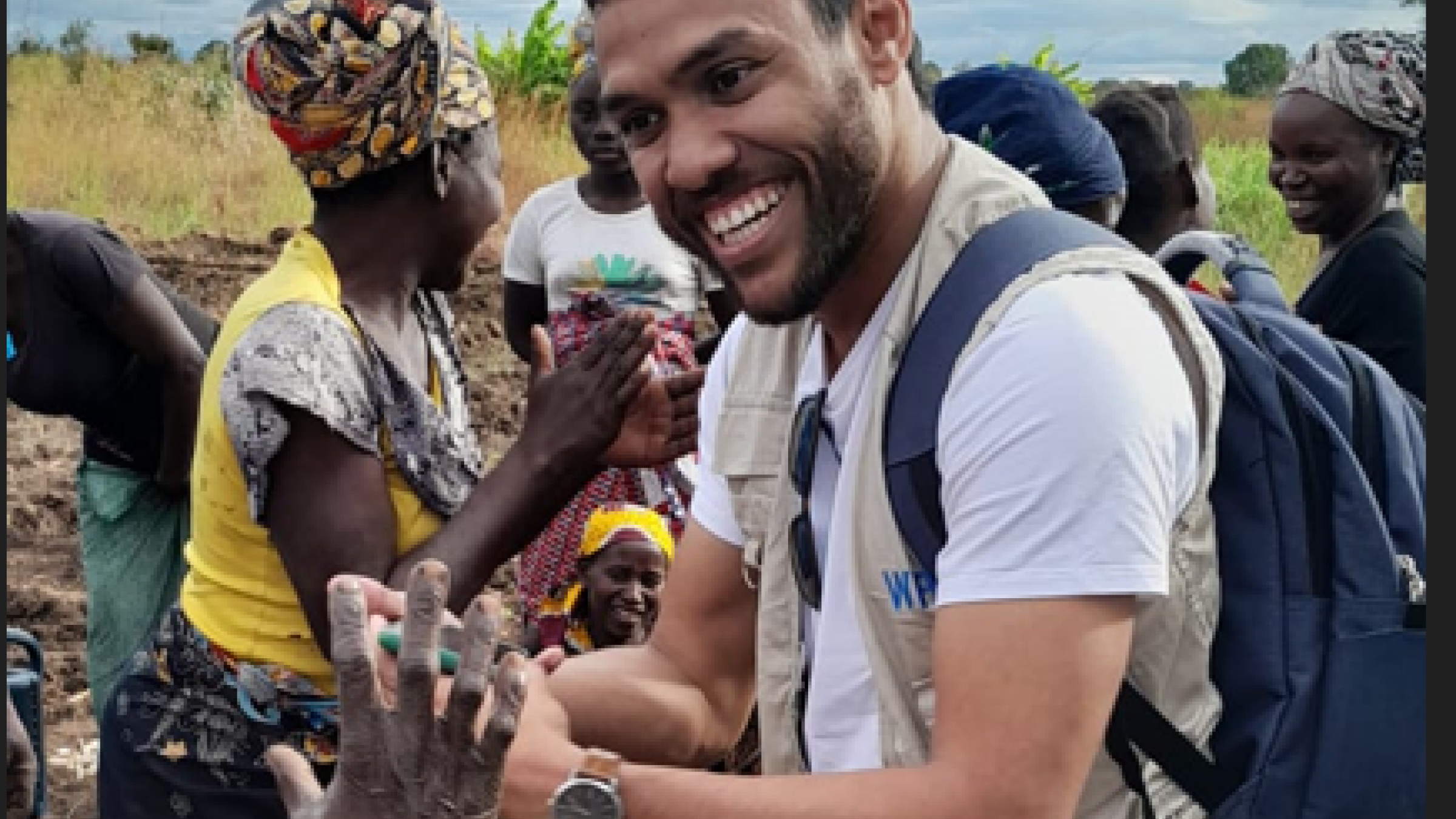
I am Lucia Landa Sotomayor, evaluation analyst from the World Food Programme Office of Evaluation. I recently spoke with Joao Lima, Monitoring & Evaluation Officer with WFP serving as the Special Assistant to the Director of Evaluation and contributing to M&E functions, on his reflections about his experience as a young and emerging evaluator (YEE) transitioning into more senior evaluation roles, linking expertise in programme work and strategic thinking. Joao takes stock of his journey with YEE networks and with communities of practice, their contributions to his career in evaluation and shares some advice for young professionals in evaluation.
Could you briefly tell us about your experience with the Young and Emerging Evaluators Network?
Joao: I’d like to divide my experience into three evaluation networks I have been involved with: the Global Eval Youth Network, the Brazilian Network of Young and Emerging Evaluators, and the UNEG Working Group for YEEs. I initially learned about the Eval Youth Network thanks to my supervisor at UNITAR back in Geneva. My involvement with them led me to explore and discover the evaluation landscape in Brazil, where I connected with professionals with whom I engaged informally through Whatsapp but later decided to institutionalize into a formal group now knows as Eval Youth Brazil.
Last year, I joined the UNEG Working Group for YEEs, which gave me a chance to see how evaluation is articulated between the headquarters of different UN agencies and the field, and to support capacity-building efforts in partnership with UN Volunteers.
So, search for a community and then turn it into something bigger and connect also with your work. It’s great to hear how your personal initiative helped institutionalize a community. In terms of membership, who can join these networks?
Joao: Eval Youth Global is free and openanyone can register on their website to receive newsletters and opportunities. For the audience in Brazil, Eval Youth Brazil is connected to the Brazilian M&E Association, so while it’s encouraged to join the association, you can also participate in the YEE group.
The UNEG Working Group is limited to UN professionals. Membership opens around April or May every year, and work plans are presented in the annual UNEG meetings where memberships are also renewed.
Looking back at your journey with these networks from Geneva to Brazil and now Rome what impact have you observed in your career?
Joao: It’s hard to measure impact precisely, especially in the short term. But being part of these networks has significantly expanded my professional connections. Every single time that I exchange information, it opens the door for new contacts and new people interested in better understanding what I do and the networks I am a part of. I regularly engage with people I’ve never met in person, through LinkedIn for instance, to learn about working at a UN agency or the evaluation field, to discuss and share best practices and even to join forces for events planning. This year, for example, I organized an event during gLocal Evaluation Week, where YEEs from different sectors government, UN, NGO came together virtually to share their perspectives on being young professionals in the field. These exchanges are impactful.
What would you say are the main benefits of joining a professional network?
Joao: Not being part of a network risks isolation and limited exposure of what goes on outside our roles. Networks, such as EvalforEarth, offer horizontal experience they allow you to work with peers and to learn diverse global and cultural perspectives; and vertical experience interacting with professionals at different levels of seniority. For example, during my engagement with the UNEG working group, I collaborate with other YEEs, but I also learn from senior evaluators in networks like Eval SDGs. These interactions broaden your understanding and prepare you for leadership roles.
That’s a great segue into my next question. As someone transitioning into a more senior role, what advice would you give to young evaluators or those in transition?
Joao: I’m still in transition, but I’ve learned that combining field experience with data analysis and a strong grasp of normative frameworks is key for preparing for leadership positions in the future. Many technical experts struggle when they move into managerial roles because they’re not used to delegating or quality assurance. Conversely, those focused on strategy need to understand aspects, such as data reliability. A balanced skill set is essential. My vision at the moment is to integrate both perspectives to ensure effective evaluation functions, let’s see how things evolve in two to three years.
What do you think evaluation networks can do better to meet the needs of young evaluators, especially in today’s uncertain world?
Joao: That’s a great question. Based on my experience, something I observed over the years is that national YEEs are not always aware of international networks, like Eval Partners or Eval SDGs. Engagement often happens by chance rather than through deliberate outreach. I raised this point during the launch of EvalforEarth that networks should not just wait for YEEs to find them. Simply making resources or platforms available is not enough networks and YEE groups need to proactively engage with each other, to increase visibility and outreach. This can enable perspectives are included into discussion and that skills are tailored to current needs.
That’s an important message for both sides, but before we finish, can you tell me, now that you’re transitioning out of the YEE space, what are your plans ahead, and how do you see your experience integrating into your future leadership role?
Joao: A key responsibility for leaders in evaluation is capacity development identifying skill gaps within their teams and finding ways to address them. This is seen as a foundational part of leadership, regardless of region, and aligns with strategies from organizations like UNEG and various M&E networks. Another important aspect is engaging directly with governments to ensure that UN agencies and partners are aligned with national priorities and not operating in isolation. This involves strengthening national evaluation capacities and making sure everyone shares a common understanding and language around monitoring and evaluation.
Personally, I’m not sure where I’ll be reassigned but I expect to go back to field. For now, my roadmap includes combining the many learning regarding normative frameworks - including assurance, understandings around risk frameworks and means of implementation - with field realities to deliver meaningful evaluation outcomes. For my future team, I would like to ensure my team understands these principles and that we build strong evaluation functions together.
That sounds exciting, Joao. Thank you so much for sharing your journey and insights. I’m sure the EvalforEarth community will find this interview inspiring and informative.