
- Capacity Development
- Evaluation methods
- Evaluation process
- Evaluation results
- Monitoring & Evaluation
Over the years, I have worked on many projects that required the development of a Theory of Change (ToC). Yet in practice, I have rarely seen one that truly explains how change unfolds within the complex systems where development interventions operate.
Like many evaluation practitioners, I have spent long hours refining causal diagrams, debating arrows, articulating assumptions, and attempting to show how activities will lead to outcomes and, eventually, impact. Despite their technical polish, these ToCs often feel incomplete, not because they are poorly designed, but because they are asked to do something fundamentally unrealistic.
The limits of prediction in complex systems
Traditional ToCs are often built on an implicit assumption that change across a complex system can be mapped in a reasonably complete and predictive way. They suggest that specific actions can be traced to outcomes through a clear chain of results, with assumptions articulated at each step. However, much development and environmental work takes place in complex, adaptive systems shaped by multiple actors, competing interests, and shifting political and economic conditions. In such contexts, prediction is inherently limited, and causal pathways rarely unfold as neatly as diagrams suggest (Patton, 2011; Rogers, 2008).
Despite these limitations, ToCs remain central to project design and evaluation. This conceptual tool carries strong rhetorical appeal, suggesting rigor, foresight, and control, and it aligns well with donor expectations for clarity, accountability, and linear reporting. Yet when we look closely at how ToCs are actually used in practice, a different picture emerges. In many cases, they describe what a project plans to do rather than explain how change unfolds across a system.
What we are really producing
Across many projects, several patterns recur. Entire systems of change are not mapped. Multiple causal pathways are not fully articulated. Assumptions are listed but rarely tested or revisited. There is limited time or data to validate a comprehensive causal theory.
At the same time, interventions often focus heavily on individual-level change, such as training participants, raising awareness, building skills, or providing information. While these actions may be necessary, they are rarely sufficient to produce sustained outcomes on their own.
In my experience, lasting change requires engagement at a more macro level, including policies, institutional incentives, sector governance, market dynamics, power relations, and the behavior of influential actors. Without influencing these wider systems, individual-level gains often remain isolated or short-lived. For example, a project may invest heavily in training farmers on climate-smart practices yet see little sustained change if market incentives, private-sector demand, access to larger markets, or regulatory conditions remain unchanged. In such cases, the issue is not implementation failure, but the absence of activities designed to influence change at scale.
Attribution challenges in these contexts further undermine the predictive validity of traditional ToCs (Mayne, 2012). As a result, many ToCs function less as explanatory theories and more as planning tools.
Why “Theory of Action” may be a better fit
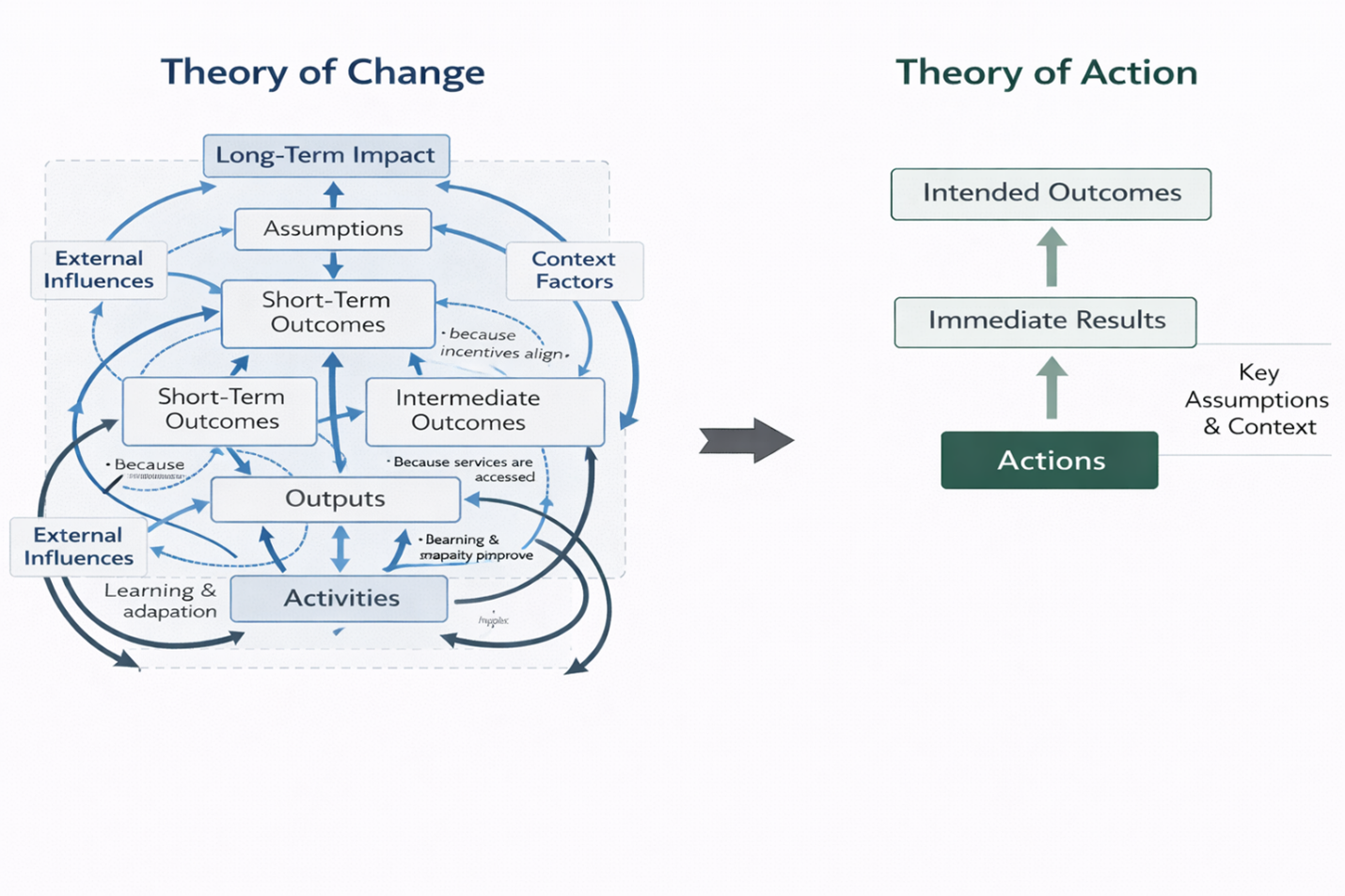
When compared with formal definitions, it becomes clear that what is being developed in many projects is not a ToC in the strict sense, but rather a Theory of Action. A ToC aims to explain how and why change occurs within a system. A Theory of Action focuses on how a specific intervention intends to act within that system.
A Theory of Action does not attempt to describe the entire system of change. Instead, it clarifies what actions are being taken, why those actions were selected, and how they are expected to contribute to improved outcomes. Crucially, it forces a more honest discussion about scale.
Here, I propose a shift in practice. In many projects, activities are designed primarily at the individual or local level, even when objectives are stated at a sector or national level. A well-articulated Theory of Action should make explicit whether activities are intentionally oriented toward scale, and if so, how. This means specifying how actions are expected to influence policies, institutions, markets, partnerships, or decision-making processes, rather than assuming that individual-level change will aggregate upward on its own.
This distinction is not new. Foundational guidance has long recognized the difference between explaining how change happens and articulating a program’s strategy for contributing to that change (Taplin & Clark, 2012). In practice, however, project teams are far more often engaged in the latter, even when they continue to label their work as a ToC. Naming this more accurately as a Theory of Action is not a rejection of ToCs, but an invitation to be more transparent about what we are actually producing and using.
Reframing our work as Theory of Action offers several advantages. It is simpler to communicate, more honest about uncertainty, operational and decision-oriented, and better suited to adaptation as contexts evolve. Most importantly, it creates space to ask whether activities are designed to influence systems at scale, rather than only individuals.