
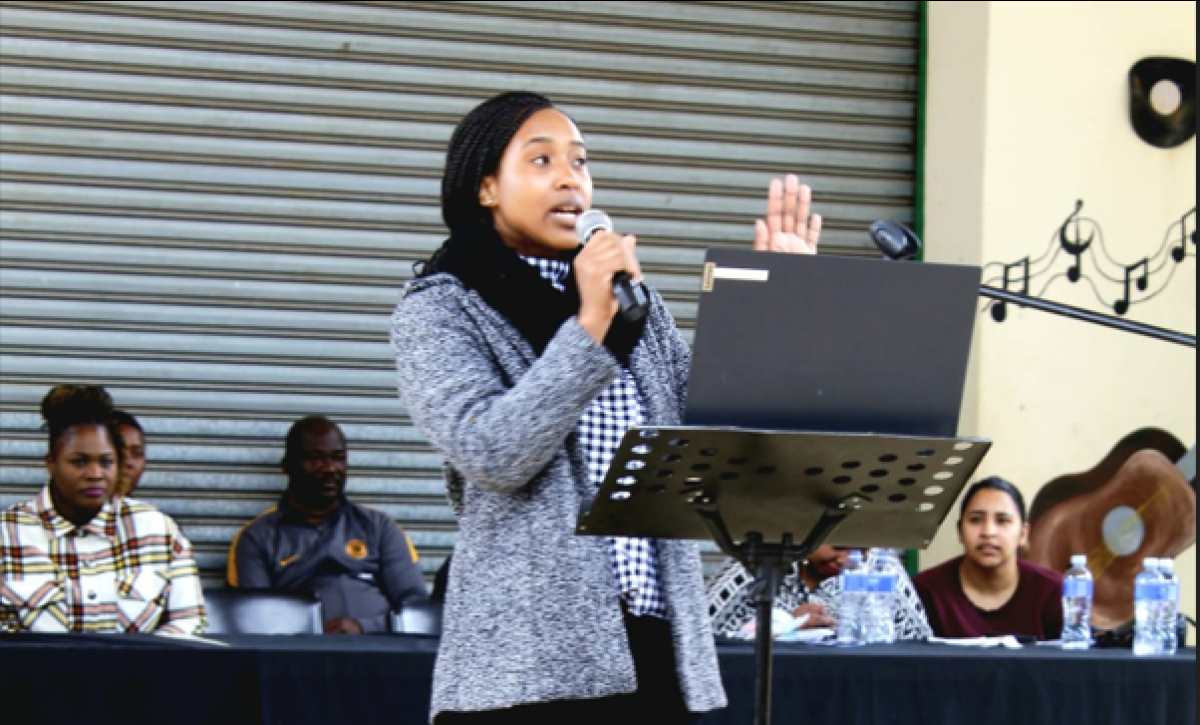
Interviewer: Innocent Chamisa, Coordinator of EvalforEarth
Guest: Sibongile Sithole, Evaluation Specialist
Intro
Innocent:
Welcome to this EvalforEarth Q&A, a space for conversations, ideas, and shared learning across the EvalforEarth community of practice, with a focus on evaluation for food security, agriculture, environment, and rural development.
Our guest today is Sibongile Sithole, recipient of the inaugural 2025 EvalforEarth Outstanding Contributor of the Year Award. She is an evaluation specialist based in Southern Africa, whose work focuses on economic and social development, particularly youth livelihoods, education systems, and equity in evaluation practice.Sibongile has actively contributed to EvalforEarth through webinars, blog writing, and community engagement, making her a valued member of the community.
In this conversation, she reflects on what evaluation often overlooks, why context cannot be treated as a variable, and what it takes to make evidence actually matter in practice.
Q1: Sibongile, congratulations once again on receiving the inaugural EvalforEarth Outstanding Contributor of the Year Award!
How did you feel when you learned about your nomination and selection?
Sibongile: Thank you so much. When I was informed of the nomination, I was genuinely excited. It came as a complete surprise to me. Being selected as the Contributor of the Year Award recipient was something I never imagined for 2025. I’ve never approached my work with the expectation of recognition, so receiving this award is both humbling and deeply encouraging. It reminds me that the work matters, even when most of it happens quietly, without visibility.
Q2: Can you tell us about your professional journey and what inspired you to focus on Evaluation?
Sibongile:I hold a Bachelor’s degree in Economics and a Master’s in Finance, and my initial goal was to pursue a career as an economist or within the investment space. That was the path I had envisioned for myself, but the reality of the context I was entering pushed me in a different direction.
Graduating into a context of high unemployment meant I had to remain open-minded. I used to apply broadly, without being too particular or fussy about the role, and that’s how I came across an opportunity to join a newly established NPO as an M&E Officer. They gave me a chance, and that marked the beginning of my journey in this field.
In that role, I focused mainly on data collection and analysis. I was close to the data, but not yet shaping how it was interpreted or communicated. However, a pivotal turning point came when I was selected to participate in the Emerging Evaluators Programme run by SAMEA. As part of the programme, experienced evaluators were encouraged to include emerging evaluators in rapid evaluations and that is where the shift happened.
My first evaluation, focused on an after-school programme in a township in Johannesburg. It was a defining experience for me. I found myself fully engaged in every aspect of the process, from conducting KIIs and FGDs, to contributing to report writing and helping to develop the theory of change. I thoroughly enjoyed it. Since then, I have contributed to over 20 evaluations, continuously building my experience and deepening my commitment to work that drives learning, accountability, and meaningful impact.
What draws me to this work is not the report at the end, but everything that happens before it. The conversations, the tensions, and the moments where assumptions begin to shift when you engage directly with people. That is where evaluation becomes meaningful, and where it has the potential to influence decisions beyond the document itself.
Q3: Within EvalforEarth, you’ve contributed to webinars, blog writing, and community discussions. What makes a Community of Practice like EvalforEarth valuable for evaluators worldwide?
Sibongile: Reflecting back to the COVID-19 pandemic, it was a significant wake-up call for many of us. While human interaction remains incredibly important, it also showed us that when in-person engagement isn’t possible, virtual spaces can be just as powerful and meaningful. In many ways, it redefined how we connect, learn, and collaborate across borders.
I think platforms like EvalforEarth really embody that shift. It creates a space where evaluators from across the world can come together to engage on critical topics, particularly those at the intersection of evaluation, sustainability, and environmental change. It’s more than simply sharing knowledge. It’s about testing ideas across different contexts and understanding what holds.
One of the aspects I truly value is the accessibility. The webinars, workshops, and discussions are free, which removes a real funding barrier for many practitioners, especially those from under-resourced settings. It provides opportunities to learn and grow in ways that might otherwise not be possible.
What stands out for me is the opportunity to contribute. Sharing my blogs on the platform has given me a space to reflect on my work and put my thinking out there.
It has also opened up conversations with people I would not have connected with otherwise, many of whom are working through similar questions in very different contexts. That exchange is what makes EvalforEarth valuable. It is not just about access to learning, but about being part of a space where ideas are tested, challenged, and taken further.
Q4: You’ve also written about decolonising evaluation practice in the Global South. Why is this conversation important today, and how can evaluators ensure their work is inclusive and contextually grounded?
Sibongile: I’ve had the opportunity to co-author several journal articles, and the conversation around decolonising evaluation, particularly in the Global South, feels both timely and necessary. At its core, it asks us to confront something we often overlook: many evaluation approaches are still treated as if they can be applied universally. In practice, they cannot. Context shapes everything, from how programmes are experienced to how outcomes are understood.
For evaluators in the Global South, this means moving beyond imported frameworks that do not fully reflect local realities. It is not only about adapting them but sometimes questioning their underlying assumptions. In some cases, this also means developing approaches that are grounded in local contexts and lived experiences. The Transformative Equity and Climate and Ecosystems Health (CEH) Guidelines by the Department of Planning, Monitoring and Evaluation (DPME) in South Africa are a useful example. They do not to replace widely used frameworks such as the OECD DAC criteria, but extend them by bringing in dimensions such as equity, inclusion, and sustainability that are particularly relevant in our context.
In another piece of work, we looked at gender from a Global South perspective. What became clear is that experiences of gender are not universal. They are shaped by context, culture, and systems of power. This includes how power dynamics and intersectionality influence how inequalities are experienced and addressed. It also means being deliberate about whose perspectives are being prioritised, and whose voices may be missing.
Ultimately, decolonising evaluation goes beyond frameworks and tools. It shows up in how we approach the work, the questions we ask, and the way we engage with the people we are working with. It means taking local knowledge seriously, working more closely with communities, and making sure the findings reflect what people are actually dealing with on the ground. By doing so, we not only make our work more inclusive and contextually grounded, but also acquires more weight and it is far more likely to be used.
Q5: What advice would you give to Young and Emerging Evaluators (YEE) who are just starting their journey in evaluation?
Sibongile: In my home language, we say “Kudzidza hakuperi”, which translates to “learning never ends”. Evaluation does not stand still, and staying relevant takes a consistent effort to keep learning as the field changes.
We are working in a context: the Fourth Industrial Revolution(4IR), where technology is reshaping how evidence is produced and used. There is a strong focus on AI at the moment, and emerging evaluators need to understand how these tools can support their work, whether in analysis, synthesis, or in how they manage information. The aim is not to replace core evaluation skills, but to use these tools in ways that strengthen them.
Beyond technical skills, being part of professional networks such as VOPEs and CoPs like EvalforEarth makes a real difference. These spaces give you exposure to how others are working in different contexts, and that helps you see your own work differently. Over time, those exchanges can shape how you think and open up opportunities to collaborate in more practical ways.
It also comes down to being visible in your work. Sharing your ideas and engaging in discussions helps you think things through more clearly and understand where you stand. Whatever resources or opportunities you have access to, make the most of them. Eventually, it’s a process that shapes how you approach the work and helps you develop your own way of thinking within the field.
Q6: How do you see the role of evaluators evolving in the age of AI and emerging technologies, especially in supporting decision-making in areas such as food systems and sustainable development?
Sibongile: There is growing concern about the potential for AI replacing jobs, and evaluation is no exception. In practice, however, I see the role of evaluators not as being replaced, but as becoming even more critical in the age of emerging technologies. What matters is how they are applied. AI can support analysis, help manage large volumes of information, and improve efficiency, but it does not replace judgement. That remains a core responsibility of the evaluator. When used carefully, these tools can strengthen how evidence informs decision-making and support more timely and responsive processes.
At the same time, we need to remain aware of where these technologies are developed and whose perspectives they reflect. Much of the AI development is concentrated in institutions in the Global North, which logically shapes the data, assumptions, and approaches that underpin these systems. As a result, they may not fully capture the realities of contexts in the Global South. The same applies to the broader knowledge ecosystem, which is still largely influenced by Northern perspectives, which can unintentionally skew insights, recommendations, and policy directions. This is where evaluators play a crucial role as critical thinkers. It involves examining evidence more closely, questioning underlying assumptions, and ensuring that findings are grounded in local realities.
For example, in the context of food systems, an AI-driven model might recommend scaling up high-tech, large-scale agricultural solutions based on productivity data from industrialised countries. While this may appear efficient, it can overlook the realities of smallholder farmers in many Global South contexts, where access to infrastructure, land, finance, and technology is limited and where livelihoods are closely tied to local ecosystems and practices. If applied without scrutiny, such recommendations could lead to policies that unintentionally marginalise vulnerable groups or weaken more sustainable approaches. An evaluator can approach this differently by bringing in contextual evidence, engaging with local communities, and considering the broader social, environmental, and economic implications. This helps ensure that decision-making is grounded in context, rather than driven by data alone.
Innocent: Thank you, Sibongile, for sharing your reflections and inspiring message with the community.
At EvalforEarth, we see evaluation practice evolving through dialogue and exchange across different contexts, institutions, and sectors. And it is conversations like this that help us reflect on how evaluation can continue to support better decisions for people, food systems, and the environment.