

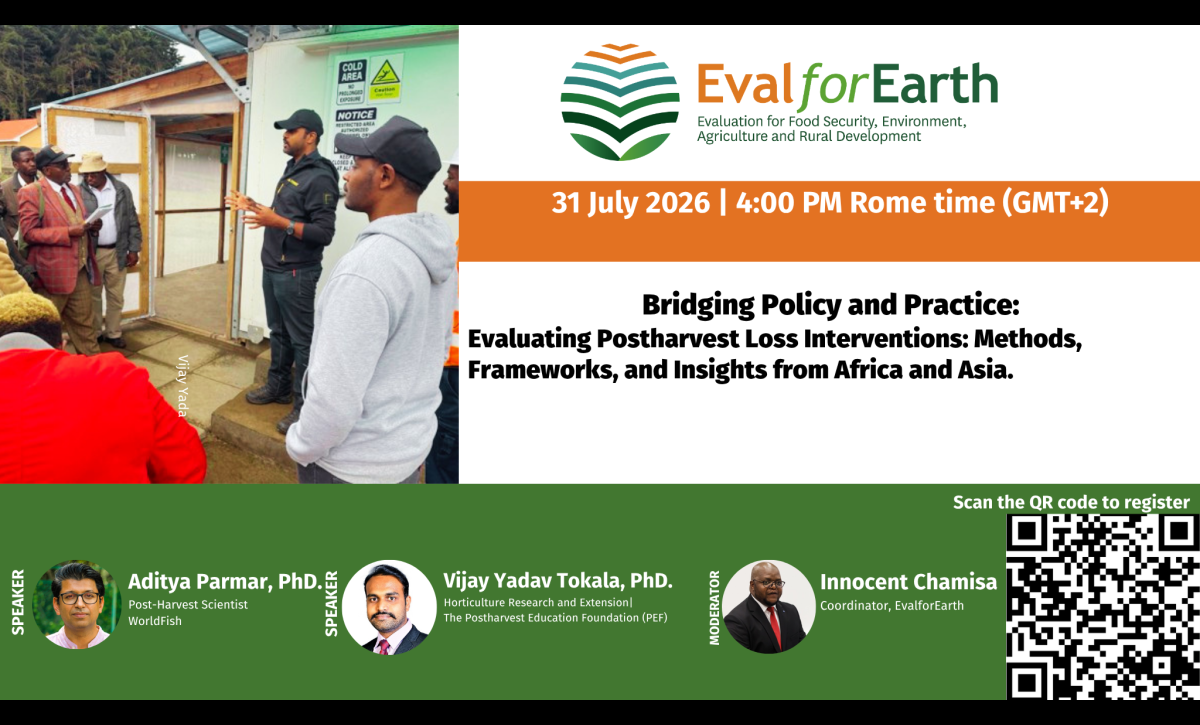
SESSION OVERVIEW
Reducing food loss required more than identifying where losses occurred. It also required monitoring and evaluation systems capable of determining whether post-harvest interventions were relevant, effective, equitable, cost-effective, and sustainable. This session examined how assessment methods, capacity-building models, and monitoring and evaluation frameworks generated evidence for programme improvement, policy decisions, and action at the community level.
The session brought together two complementary perspectives.
Dr Vijay Yadav Tokala drew on the Postharvest Education Foundation's experience in designing and delivering capacity-building programmes across Africa and Asia. Since 2011, PEF had developed into a global network engaging practitioners in more than 30 countries across five continents. The presentation examined how PEF's model, combining assignments, fieldwork, and mentoring, could be assessed and adapted to bridge the gap between policy commitments and implementation.
Vijay introduced tools from the PEF E-Learning Manual, including its 14 assignments covering commodity systems assessment, post-harvest extension, cost-benefit analysis, and training programme design. Particular attention was given to how these tools supported needs assessments, baseline development, indicator selection, monitoring of capacity development, and evaluation of programme results.
Dr Aditya Parmar focused on assessing and reducing post-harvest loss in small-scale fisheries and aquaculture in Africa. Drawing on experiences from Mozambique, Madagascar, Namibia, and Tanzania, the presentation examined how handling practices, limited cold-chain infrastructure, market access, gender inequalities, and power imbalances contributed to food loss.
The presentation introduced the six-stage Prepare, Train, Explore, Quantify, Validate, and Act framework and related methods, including the Exploratory Fish Loss Assessment Method, Gender-Responsive Fish Loss Assessment Method, and Load Tracking and Questionnaire Loss Assessment Method. It demonstrated how these methods could be used to establish baselines, identify and monitor loss hotspots, collect quantitative and qualitative evidence, validate findings with stakeholders, and assess changes resulting from post-harvest interventions.
Together, the presentations connected assessment, monitoring, evaluation, and learning with policy and implementation. The session demonstrated how evidence could be used not only to measure food loss but also to improve intervention design, assess results, and support decisions on what worked, for whom, and under which conditions.
OBJECTIVES
- Presented assessment methods and monitoring and evaluation frameworks for food loss and post-harvest interventions.
- Demonstrated how evaluation could connect policy commitments with implementation and results at the community level.
- Examined how PEF's capacity-building model and tools supported needs assessment, programme monitoring, cost-benefit analysis, and evaluation.
- Introduced methods for establishing baselines, identifying loss hotspots, and measuring change in small-scale aquatic food systems.
- Explored how gender, market access, infrastructure, and power relations could be integrated into the evaluation of post-harvest interventions.
- Shared lessons on strengthening the link between evaluation findings, programme improvement, policy decisions, and action.
WHAT PARTICIPANTS LEARNED
- How to develop evaluation questions and indicators for food loss and post-harvest interventions.
- How to select and adapt assessment methods to different commodities and local contexts.
- How to establish baselines and monitor changes in food-loss levels and intervention performance.
- How to apply commodity systems assessment and cost-benefit analysis in programme evaluation.
- How to use quantitative, qualitative, and gender-responsive methods to understand why losses occurred and who was most affected.
- How to identify and monitor food-loss hotspots across value chains.
- How to engage stakeholders in data collection, validation, and interpretation of findings.
- How to develop monitoring and evaluation plans for post-harvest projects and capacity-building programmes.
- How to use evaluation evidence to improve interventions and inform policy and investment decisions.