
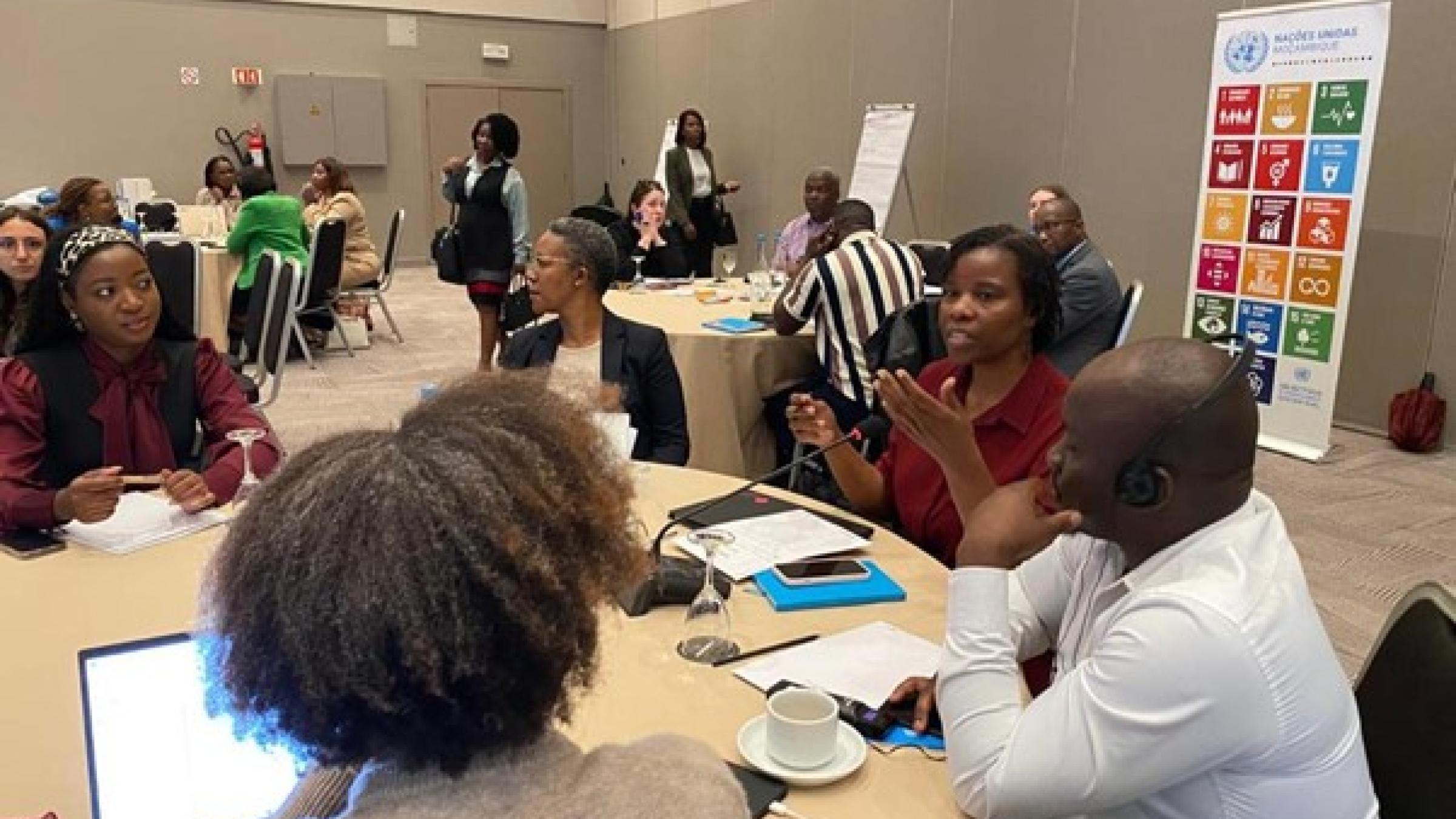
"For the first time, I have understood what ToC is about." — Participant, Mozambique training.
Introduction
Development is complex, uncertain, and rapidly evolving. Practitioners often focus on immediate problems and solutions, addressing urgent needs while missing the systemic drivers that shape long-term outcomes. Flipping a problem tree into a solution tree can generate ideas, but it often overlooks the critical pathways needed for transformative change. Frequently, gender equality, human rights-based approaches, and leaving no one behind (LNOB) principles are not fully integrated, and connections between Theory of Change (ToC) and measurable results remain unclear. Traditional Results-Based Management frameworks, while essential, often fall short in helping teams link short-term interventions to medium- and long-term systemic impact.
To address these challenges, I recently facilitated a high-level training for UN and senior government officials in Mozambique on reimagining results-based management to design coherent, inclusive, and adaptive United Nations Sustainable Development Cooperation Frameworks. The training explored how the Three Horizons framework can guide development from urgent needs to long-term, systemic transformation, embedding gender equality, human rights, and LNOB at every stage. Participants developed integrated ToC and Results Frameworks that map development pathways from immediate interventions to long-term transformational outcomes, including an intermediate Horizon 1.5 (H1.5) to address urgent priorities while advancing short- and long-term objectives. Emphasis was placed on translating foresight-informed ToCs into clear, measurable, and transformative results, demonstrating practical pathways for inclusive, future-ready development.
The Approach
The Three Horizons framework provides a powerful structure for designing ToCs by mapping actions and outcomes over time, linking immediate interventions to medium- and long-term transformational results. A critical component of this approach is explicitly articulating assumptions and risks at each horizon, while mainstreaming gender equality, human rights, and LNOB throughout the process.
| Horizon 1 (H1) – Current System / Status Quo | Analyze existing challenges, bottlenecks, and gaps in policies, practices, and systems. Identify which groups are currently marginalized or excluded and how current systems may perpetuate inequities. Clearly articulate assumptions about current practices and risks if systemic barriers remain unaddressed. |
| Horizon 1.5 (H1.5) – Urgent Needs | Prioritize critical interventions that address immediate gaps, stabilize programs, and protect vulnerable populations. Ensure all urgent actions are gender-responsive, rights-based, and inclusive. Document assumptions underpinning these interventions and potential risks if urgent needs are not adequately addressed. |
| Horizon 2 (H2) – Transition / Emerging Innovations | Identify and test pilot programs, adaptations, and innovations that move the system from current realities toward long-term transformation. Assess how these strategies strengthen gender equality, human rights, and LNOB, and ensure risks are mitigated. Capture assumptions about innovation effectiveness and potential barriers to scaling or sustainability. |
| Horizon 3 (H3) – Future-Ready / Transformative Outcomes | Define the long-term vision for a fully inclusive, human rights-based, and gender-transformative system aligned with SDGs. Clearly articulate assumptions about systemic change and identify risks that could hinder the achievement of these transformative outcomes. Ensure the pathway explicitly leaves no one behind. |
This approach ensures that results-based management and ToC are not just linear frameworks, but dynamic, foresight-informed tools that integrate short-term problem-solving, medium-term innovation, and long-term transformative goals while embedding human rights-based approaches, gender equality, and LNOB principles at every step.
Lessons from the Mozambique Training
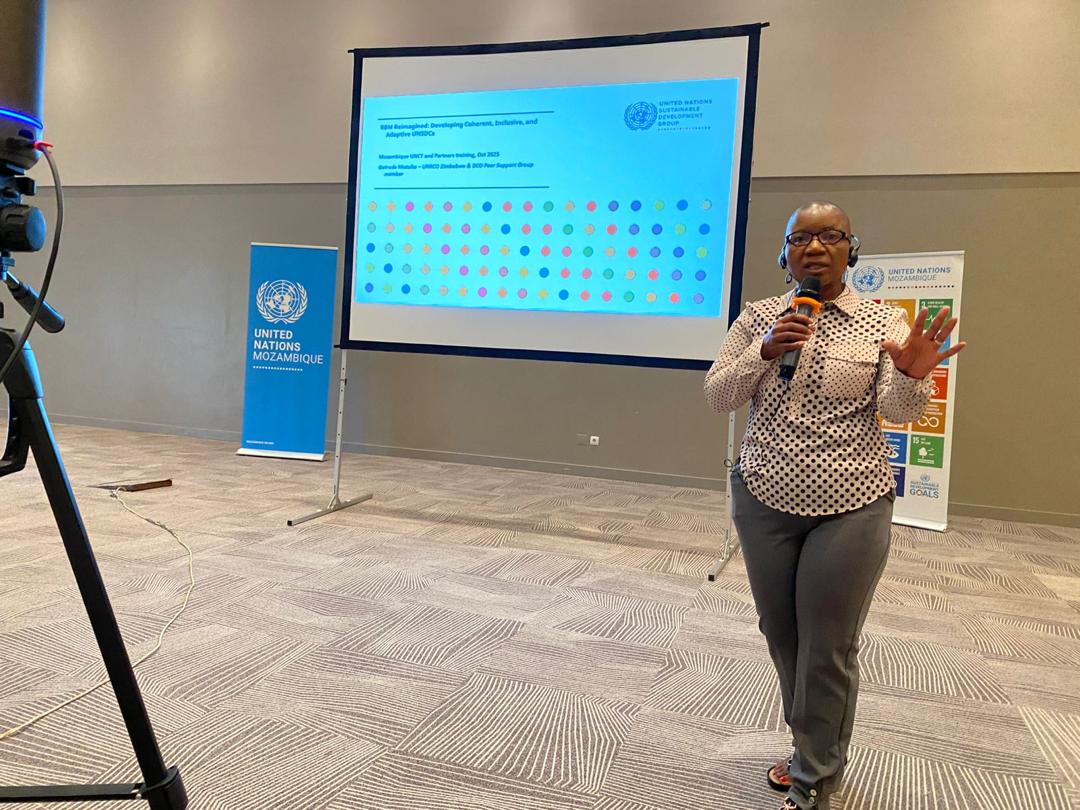
©Amelia Tunzine/RCOMozambique
Several critical lessons emerged from the training, demonstrating the value of the Three Horizons framework in designing transformative, inclusive development results:
- Deep understanding of current realities (H1): Successful ToC design requires a thorough analysis of existing challenges, bottlenecks, and systemic issues, ensuring interventions target the root causes of problems.
- Stakeholder engagement and consensus-building: Engaging government, UN agencies, and relevant stakeholders is essential to define the problem, agree on priorities, and co-create pathways for change.
- Clarity on problem definition and assumptions: Understanding the sociocultural ad political dynamics that shape how problems are defined is critical, as these influence both the pathway to change and the assumptions underpinning the ToC.
- Iterative, reflective process: Developing a ToC is not a linear exercise or a “straightjacket” process; it requires continuous reflection, adaptation, and testing of assumptions across the horizons.
- Horizon-linked thinking: Applying H1–H1.5–H2–H3 helps teams structure interventions from urgent needs to long-term transformative outcomes, ensuring gender equality, human rights, and LNOB are embedded at every stage.
These lessons underscore the importance of combining foresight, participatory approaches, and iterative thinking to create inclusive, adaptive, and sustainable development pathways.
Why It Matters
In today’s rapidly evolving development landscape, emerging global challenges such as climate change, food insecurity, pandemics, and socio-political instability require approaches that are both responsive and forward-looking. Integrating the Three Horizons framework with Theory of Change (ToC), including H1.5 for urgent needs, transforms Results-Based Management into a strategic tool that balances immediate priorities with long-term systemic transformation.
This approach enables practitioners to:
- Anticipate and respond to emerging challenges while maintaining focus on long-term objectives
- Innovate responsibly through adaptive, foresight-informed strategies
- Translate complex visions into measurable, transformative results that are inclusive, gender-responsive, and rights-based
- Embed human rights, gender equality, and LNOB throughout all stages of planning and implementation
For practitioners and policy makers driving sustainable, transformative development, this approach offers a practical pathway to move from urgent interventions to long-term systemic change, ensuring initiatives are resilient, adaptive, and future-ready amid evolving global challenges.
Log in to post a commentNot yet a member? Register here
Italy
Silva Ferretti
Freelance consultant
Posted on 08/03/2026
1/2 A very useful exercise, and the 3H framework is indeed powerful! Well done for engaging with it!
I’m not fully convinced, though, that a Theory of Change and measurable results really “belong” in Horizon 3. :-)
The spirit of Three Horizons is not a gradual improvement trajectory. It helps us see when the world we live in (H1) is intrinsically faulty and calls for a strong shift rather than a better‑managed status quo. H3 is not a “nicer version of today” reached through a linear, incremental pathway. Its role is to name the tension between where we are now and an alternative, desirable future based on different assumptions and a different logic. It is about naming the gap and making the transformation evident, not about designing the pathway.
Italy
Silva Ferretti
Freelance consultant
Posted on 08/03/2026
2/2 Between H1 and H3 there is not a neat sequence of steps but a messy space of competing logics, actors and ideas. In that in‑between space (H2), every innovation can either become “more of the same” (reinforcing H1) or contribute to an alternative. A truly alternative future may require letting go of the idea that all the changes we need are fully measurable and neatly governed in advance through a results framework.
RBM mostly belongs to Horizon 1. Feminist and transformative spaces require different ways to support change, and a constant awareness of the risk that important ideas and processes like this one (which live in H2, as spaces that shape the future) are captured and domesticated by H1 logics. I am sure that some of this surfaced in your work, and it would be fantastic to see more about the gaps and tensions, rather than mostly the progression
Zimbabwe
Getrude Nyashadzamwari Matsika
Data Management, Results Monitoring and Evaluation
UN RCO
Posted on 08/03/2026
1/2 Thank you, Silva, for the reflections. Indeed, the original Three Horizons framework was never meant to imply a neat, linear pathway to a “better version” of today. Its strength lies in revealing the limits of H1 and pointing to the fundamentally different logic required for H3.
Where I extend the discussion is within the development and humanitarian space. Here, we are not only imagining alternative futures we are co‑creating and implementing strategies that shape them. In such dynamic and fragile environments, frameworks like 3H inevitably become both diagnostic and design lenses. The aim is not to turn 3H into a traditional planning tool but to use it to question our assumptions so we don’t reproduce the very systems we hope to transform.
Adapting the three Horizons to complex realities is essential. While it is not a linear roadmap, it pushes us to ask: Are our interventions opening space for transformation or reinforcing H1 or keeping people in H1.5 survival mode? Do our strategies address structural drivers of vulnerability or optimize the current system? What assumptions, power dynamics, and institutional dynamics must shift for real change?
Zimbabwe
Getrude Nyashadzamwari Matsika
Data Management, Results Monitoring and Evaluation
UN RCO
Posted on 08/03/2026
2/2 On H3, ToC, and RBM, I agree that traditional RBM sits in H1 logics of predictability, control, and linearity. Yet abandoning measurement in H3 carries its own risks, especially in contexts where communities expect accountability and where power imbalances can easily be reproduced.
My proposal is not to squeeze H3 into an H1 results framework, but to reimagine RBM and ToC so they can meaningfully engage with transformation. This includes tracking shifts in power, agency, norms, and relationships; unintended effects; directionality of change; enabling conditions; system behaviours; and early signals of transformation.
In this way, RBM becomes a learning and sense‑making practice, and ToC becomes a living hypothesis about how structural change may emerge. The value of using Three Horizons lies in surfacing tensions between immediate needs and long‑term change, the risk of innovations reverting to the status quo, and the limits of linear planning in complex systems. These tensions should strengthen not dilute the transformative intent of H3.
Italy
Silva Ferretti
Freelance consultant
Posted on 08/03/2026
1/2 Thanks so much for sharing this – there is a lot to chew on, and I really see the ambition in re‑imagining the tools. My experience, though, is that H1 has a remarkable capacity to colonise spaces that were meant for change and to re‑domesticate imagination; right now that pull back to “business as usual” feels even stronger than before.
I totally understand why people want “the plan”. But there is real power, for me, in using the Three Horizons process to hold the tension rather than to fully map the pathway. H2 is a battlefield: a space where we name frictions, contradictions and possibilities and keep them visible, without immediately turning them into a managed trajectory, while still thinking about how we might respond to emerging options as they surface.
Italy
Silva Ferretti
Freelance consultant
Posted on 08/03/2026
I’m also wary of how easily H1 creeps in through language. Words like “results” or “measurement” are dangerous because they come with a whole logic attached. Maybe we need to experiment with other concepts: unpacking diverse achievements rather than just “checking results”, and talking about how we understand, gauge or sense change – not only how we “measure” it in supposedly objective, quantitative ways. Measurement is not the only, nor necessarily the main, route to accountability – especially in feminist and transformative spaces, where meaning‑making and reciprocity are themselves part of justice.
So I resonate deeply with your concerns about power and accountability, and I see why you want structure. I feel, instead, that we also need to resist the call to fixed pathways. On this we fully agree: the real value of 3H is precisely to keep those tensions visible so that H3’s transformative intent is not diluted – and, for me, that also means being careful about how far we “design” H3 into a results architecture.
I remain interested in seeing where this process leads you! Please keep on sharing!