
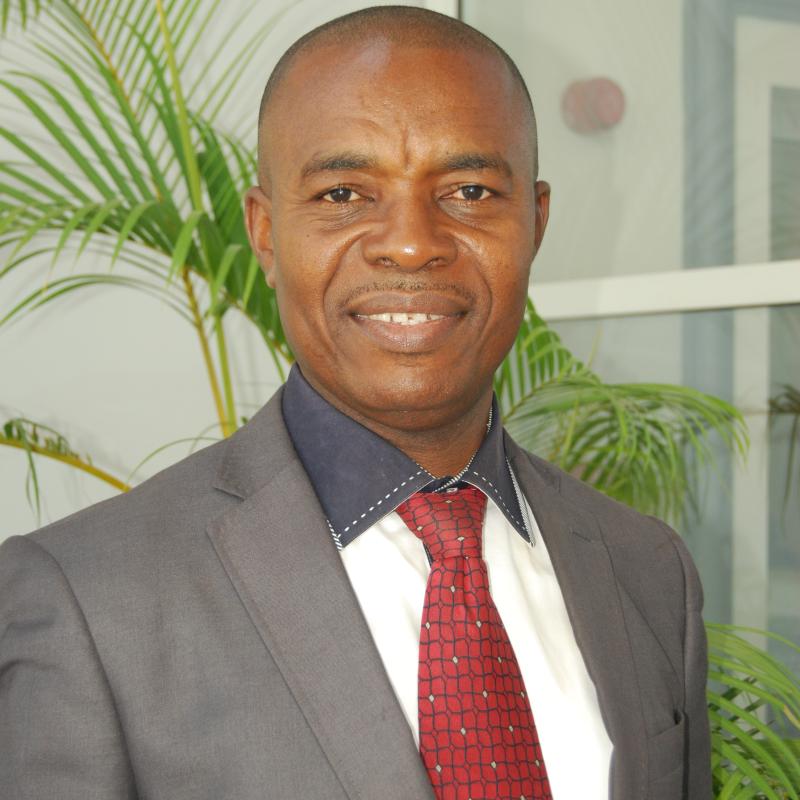
DETAILS OF THE FIELDS OF EXPERTISE AND WORK EXPERIENCE OF
DR. UZODINMA ADIRIEJE OF AFRIHEALTH OPTONET ASSOCIATION
FIELDS OF EXPERTISE
1. Health Systems, Public Health and Health Economics
a. Health Economist with World Bank training and deep experience in health systems strengthening, financing, and policy analysis.
b. Focus areas include Universal Health Coverage (UHC), Primary Health Care (PHC), maternal and child health, HIV/AIDS, TB, malaria, nutrition, and other infectious diseases.
c. Applies evidence-based approaches to health promotion, behavior change communication, and participatory learning in community health.
2. Monitoring and Evaluation (M&E) Specialist
a. Recognized as an M&E expert, including drafting the national Monitoring and Evaluation Policy of Nigeria.
b. Pioneer Fellow and former President of the Nigeria Association of Evaluators (NAE).
c. Deep experience in designing/implementing evaluation systems, program reviews, surveys, and quality assessments in health and development sectors.
3. Development, Sustainable Development and SDG Policy
a. Expertise in policy analysis, development strategy, and SDG implementation, including participation in national SDG evaluations.
b. National Chairman of the Civil Society Organizations Strategy Group on SDGs in Nigeria.
4. Advocacy, Communication and Social Mobilization
a. Strong track record in advocacy and community mobilization across health, governance, gender equity, climate, and human rights.
b. Works with government ministries, legislative committees, UN agencies, NGOs, and development partners to influence policy and resource allocation.
5. Climate, Environment and Energy
a. Advocate for climate action, biodiversity, renewable energy, and sustainable environmental policies.
b. As President of the Society for Conservation and Sustainability of Energy and Environment in Nigeria, he connects environmental issues with public health and development.
6. Project/Program Management and Leadership Training
a. Certified in Project/Programme Management, Facilitation, Leadership, Capacity Building, and Organizational Management.
b. Facilitates workshops, trainings, and mentorship in areas like M&E, leadership, proposal writing, advocacy, and gender mainstreaming.
7. Research, Writing and Knowledge Sharing
a. Active researcher and writer (blogs, journals, e-forums, newspapers) on topics ranging from health to development and social change.
b. Authored works on topics such as female circumcision/FGM and community health approaches.
WORK EXPERIENCE AND ROLES
1. Current and former Key Leadership Roles
a. CEO and Permanent Representative to the United Nations, Afrihealth Optonet Association (AHOA) — a global civil society network and think tank linking CSOs in health, climate, and development.
b. President, Society for Conservation and Sustainability of Energy and Environment in Nigeria (SOCSEEN).
c. Chairperson, Global Civil Society Consortium on Climate Change (GCSCCC).
d. National Chairman, Civil Society Organizations Strategy Group on SDGs, Nigeria.
e. National Coordinator roles in civil society coalitions focusing on vaccines, UHC, and SDGs.
2. International and Government Engagement
a. Consultant and advisor to UN agencies (e.g., UNICEF, UNDP, ILO, UNAIDS, UNICEF) and multi-lateral partners such as the Global Fund.
b. Worked with Federal and State Ministries of Health and legislative committees on health policy insight and health systems interventions.
c. Member of national technical working groups on M&E and Voluntary National Review (VNR) processes in Nigeria.
d. Member of the Presidential National Steering Committee on Alternate School Programme (ASP)
e. Chair/Moderator of the 2020 national Civil Society VNR Conference
PROGRAMME, PROJECT LEADERSHIP
1. Directed major civil society projects including sustainable citizen participation in the Niger Delta (UNDEF-funded).
2. Led national World Malaria Day committees and other high-impact health campaigns/events.
3. Organized and managed local and international conferences, workshops, and development events.
4. Served as the Technical Consultant to the Nigeria’s Ag Minister of Foreign Affairs, and as Conference Coordinator of the Global Women Network Africa conference in Abuja, Nigeria
5. National Team Supervisor for the Nigeria Malaria Matchbox Project (Global Fund / NMEP) in conflict‑affected States in Northeast Nigeria (2020–21),
PROFESSIONAL RECOGNITION
1. Awardee of international recognition for contributions to evaluation from the International Organization for Cooperation in Evaluation.
2. Received the Lifetime Achievement Award, CSR Reporters Nonprofit Excellence (2023)
3. Led initiatives that earned Afrihealth Optonet Association awards for SDG impact (e.g., SDG 3 Champion).
4. International Organisation for Cooperation in Evaluation (IOCE) Recognition Award (2022) for M&E contributions
SUMMARY
Dr. Uzodinma Adirieje is a multidisciplinary development leader with decades of experience across public health systems, monitoring and evaluation, policy and SDG frameworks, climate and environmental advocacy, program management, and civil society mobilization. His leadership at Afrihealth Optonet Association links global advocacy with community-centred health and sustainable development solutions, while his work with governments and international organizations reflects deep technical expertise and strategic influence.

Nigeria
Dr. Uzodinma Akujekwe Adirieje
CEO
Afrihealth Optonet Association (AHOA) - CSOs Network
Posté le 25/10/2026
AHOA Response to "Rewiring the Evaluation Marketplace for a Changing World" (MacPherson, Kelly & Kumar, JMDE 22(53), 2026)
-by Dr. Uzodinma Akujekwe Adirieje;
CEO/Programmes Director, Afrihealth Optonet Association (AHOA)
📞 🟢 +234 803 472 5905 | ✉️ afrepton@gmail.com| 🌐 https://www.afrihealthcsos.org
AHOA welcomes this timely and candid article. It argues that evaluation is shaped as much by market incentives as by methods and theory, and that a field built on accountability-driven demand will struggle to stay relevant as aid gives way to investment-led models. This matches what we see from the Global Majority side. AHOA has worked since 1995 as a civil society network, now spanning 100+ countries, with UN ECOSOC consultative status. We have received evaluation demands set elsewhere, and we have also produced evidence for decisions on our own terms. We offer our reflections from that vantage point.
Where AHOA agrees
Accountability-driven demand narrows learning. Our experience supports this. Much of the evaluation done in our contexts, including Global Fund-financed HIV and TB work, serves donor reporting first. AHOA's own oversight work in Nigeria, such as monitoring Global Fund projects for the CCM, showed us how little of that evidence returns to communities or local decision-makers in usable form.
Tied aid and concentrated buyers constrain local capacity. Small and mid-sized Global South evaluation providers face the reputational catch-22 the authors describe: no major-donor experience, so no contracts, so no experience. We agree that procurement and accreditation reform is the most practical lever.
Intermediaries must change roles. Proposition 6 resonates with how AHOA positions itself. We act as a convener and network, and also as a direct implementer. Our strategy rests on partnerships, advocacy, research, capacity development, outreach, and monitoring and evaluation (PARCOM). Evaluation is built into the programme cycle and is not an external audit bolted on at the end.
What AHOA would add
1. Civil society is a market actor and an evidence producer, not only a client.
The article names philanthropy, social enterprise and impact investors as the innovators outside the mainstream. It says little about civil society networks and community organisations, which generate much of the real-time, context-rich evidence in low-resource settings. Our Sustainable Citizen Participation work in the Niger Delta, the Nigeria Malaria Matchbox projects and the Life & Health Dialogue Series all produce community-grounded evidence and communiqués with specific resolutions. These are rarely counted as part of the "evaluation market" because they sit outside formal commissioning.
2. Speed and voice can be organised collectively.
The authors ask why evaluators could not respond within days to the USAID disbanding. Networks can. AHOA's African Civil Society Statement and Clarion Call to COP31, issued in August 2026 from our 31st Life & Health Dialogue Session, gathered 373 endorsements from 29 countries within weeks. It is not a formal evaluation. It shows that a distributed network can convert shared evidence into a unified, politically aware position quickly, which is exactly the capability Proposition 1 calls for.
3. Politically astute evaluation needs structured pathways, not individual heroics.
We support the call to train evaluators to read power and advocate for evidence. In practice this needs institutional mechanisms: observer and accredited status in UN processes (UNEA, the plastics INC, the chemicals and wastes OEWG, UNOG), delegation to COP-type forums, and standing technical working groups. A civil society evaluator who can brief negotiators directly has influence that a report on a shelf does not.
4. Localisation must include evaluation ownership, not only programme delivery.
Proposition 4 is right that Global Majority evaluation markets are underdeveloped. We would go further. Governments and funders should commission locally led evaluation by default, with domestic public-sector budgets for evaluation, and not only subcontract local firms under international prime contractors. Nigeria's health, malaria and HIV systems already generate large demand for M&E, for example national M&E plans and costing work. That demand should be met by qualified Nigerian and African professionals, with international partners in supporting roles.
5. Evaluating in fragile and displaced-population contexts.
The article focuses on the "polycrisis" in general terms. Refugees and displaced persons are among its most acute expressions, and standard OECD-DAC framing and short contract cycles fit them poorly. Through the African Refugee Council (ARC) and AHOA’s Pan-African Refugee and Displaced Persons Integration and Support Programme (PRISP), we see the need for participatory, rights-based and rapid-feedback evaluation approaches that include displaced people as evidence holders, not only as subjects.
6. AI and indigenous knowledge belong in the rewiring.
The authors mention AI and foresight only briefly, as capabilities the field lacks. AHOA's position is that artificial intelligence must serve equity, justice and sustainable development, not replace human dignity. For the evaluation market this means three things:
Response to the six propositions
Proposition
AHOA response
1. Politically astute presence
Strongly support. Build advocacy and political-analysis skills into evaluator training, and use accredited civil society platforms to carry evidence into decision forums.
2. Integrated, diverse market
Support. Include civil society networks and community-based evidence producers alongside private sector, social enterprise and impact investors.
3. New geographic alliances
Support. Alliances with African, Asian and Gulf actors should be built on partnership terms agreed up front, so Global Majority evaluators are co-designers and not only data collectors.
4. Regional and local markets
Strongly support. Priorities are procurement reform, domestic evaluation budgets, and support for small and mid-sized African firms and CSOs.
5. Mergers, coalitions, new combinations
Support. Coalitions of evaluators, civil society networks, and health and climate specialists would respond more flexibly than any single firm. Management consultancies should be engaged as partners without being allowed to dominate regional markets.
6. Reconfigured intermediaries
Strongly support. Funders should set clear transition plans for Global North intermediaries, including direct funding windows for Global Majority networks.
Respectful critique
Closing call
The question the authors pose, whether evaluation can change fast enough, is one the Global Majority is already answering through networks, coalitions and locally led evidence work. AHOA invites the authors, the evaluation associations and funders to treat African civil society networks as partners in rewiring the marketplace. Concretely, we propose:
Nigeria
Dr. Uzodinma Akujekwe Adirieje
CEO
Afrihealth Optonet Association (AHOA) - CSOs Network
Posté le 22/10/2026
ADAPTER L'ÉVALUATION FACE AUX CONTRAINTES BUDGÉTAIRES : « L'EXPÉRIENCE ET LE POINT DE VUE DE L'AHOA »
Face aux contraintes budgétaires, l'AHOA considère l'évaluation comme une fonction de gestion courante, en intégrant la responsabilité dans la mise en œuvre plutôt que de l'ajouter a posteriori. Deux projets menés par le Dr Adirieje illustrent cette approche.
CE QUI A FONCTIONNÉ
Dans le cadre du projet « Participation citoyenne durable » (SCP) financé par l’UNDEF (2017-2018), l’AHOA a mené des actions dans neuf États du delta du Niger et 81 zones de gouvernement local (LGA), en s’appuyant sur des partenaires locaux de mise en œuvre tels que l’ACERD dans l’État du Delta. Les citoyens et les dirigeants d’organisations de la société civile ont été formés à la production et à l’utilisation de données locales, et des visites de plaidoyer ont permis de rencontrer les gouverneurs des États. La couverture médiatique a rendu compte de l’engagement du gouvernement, notamment du partenariat entre l’État du Delta et l’AHOA, ainsi que de l’engagement de l’État d’Abia à soutenir la formation. Cela a permis de créer un bilan de responsabilité publique sans pratiquement aucun coût supplémentaire.
Dans le cadre de l’évaluation « Nigeria Malaria Matchbox » soutenue par le Fonds mondial (2020), le Dr Adirieje a occupé le poste de consultant national, tandis que les membres du réseau de l’AHOA ont apporté leur soutien au travail de terrain dans les États d’Adamawa, de Gombe, de Taraba et de Yobe. Des enquêteurs recrutés localement et travaillant dans les langues locales ont interrogé 809 personnes, dont plus de 60 % de femmes, en quatre semaines. Les résultats ont été validés lors d’un atelier réunissant les parties prenantes avant l’élaboration du plan d’action.
CE QUI N’A PAS FONCTIONNÉ
Le manque de temps et de ressources a empêché la transcription de tous les groupes de discussion, et KoboCollect n’a pas bien géré les données qualitatives volumineuses ; les équipes ont donc dû se rabattre sur les enregistrements et les notes. La participation a également souffert lorsque les personnes interrogées s’attendaient à une rémunération qui n’était pas prévue dans l’architecture du projet
TROUVER LE JUSTE ÉQUILIBRE
Les coûts ont été maîtrisés grâce aux capacités locales, sans pour autant renoncer à la rigueur : le consentement, la triangulation et la validation ont été maintenus. Je suis d’avis qu’il faut veiller à ce que l’apprentissage courant reste peu coûteux et interne, réserver l’évaluation indépendante aux questions cruciales et rendre compte ouvertement des limites.
Nigeria
Dr. Uzodinma Akujekwe Adirieje
CEO
Afrihealth Optonet Association (AHOA) - CSOs Network
Posté le 16/10/2026
CONTRIBUTION DE LA SEMAINE 1 : L’IMPACT DES CONTRAINTES DE FINANCEMENT SUR L’ÉVALUATION, L’APPRENTISSAGE ET LA RESPONSABILISATION EN AFRIQUE DE L’OUEST
Les contraintes de financement et de ressources ont considérablement affecté la portée, la fréquence, la profondeur et le caractère inclusif du suivi, de l’évaluation, de la recherche et de l’apprentissage (MERL) dans toute l’Afrique de l’Ouest. Au Nigeria, où de nombreuses organisations de la société civile dépendent du financement des bailleurs de fonds au cas par cas, l’incertitude liée au financement se traduit souvent par une réduction des budgets d’évaluation, une diminution du nombre de visites sur le terrain, des effectifs limités, une gestion des données inadéquate et une diminution des possibilités pour les communautés de participer de manière significative à l’évaluation des interventions destinées à leur bénéficier.
Du point de vue de l’Association Afrihealth Optonet (AHOA), ces défis revêtent une importance particulière dans les domaines du renforcement des systèmes de santé, de la couverture sanitaire universelle (CSU), de l’action climatique, de la réponse humanitaire et du développement mené par les communautés. L’évaluation est parfois considérée comme un coût secondaire du projet plutôt que comme une fonction essentielle de gestion et de responsabilité. Par conséquent, les organisations peuvent donner la priorité à la prestation immédiate de services tout en réduisant les investissements destinés à déterminer si les interventions sont efficaces, équitables, durables et adaptées aux besoins des bénéficiaires.
L’expérience de l’AHOA en matière de suivi citoyen des projets de développement, dans le cadre d’une initiative soutenue par le Fonds des Nations unies pour la démocratie dans le delta du Niger, en est un exemple concret. Le projet a mobilisé plus de 1 600 observateurs répartis dans 81 collectivités locales de neuf États du delta du Niger. Une couverture géographique aussi étendue démontre la valeur des données issues des communautés pour identifier les lacunes de mise en œuvre, renforcer la participation citoyenne et promouvoir la responsabilité publique. Cependant, la pérennité de cette approche nécessite des ressources pour la formation, le transport, la collecte de données, la vérification, la communication et le retour d’information aux communautés. Lorsque les ressources sont insuffisantes, la couverture du suivi, la qualité de la vérification et la rapidité des rapports peuvent en pâtir.
Des défis similaires se posent dans les programmes de lutte contre le paludisme et les évaluations de vulnérabilité impliquant des personnes déplacées à l’intérieur du pays et des réfugiés dans le nord-est du Nigeria. Dans les contextes fragiles et humanitaires, l’insécurité, la difficulté du terrain, la mobilité des populations et la vulnérabilité des communautés touchées rendent la production de données fiables particulièrement coûteuse. Réduire les ressources consacrées au suivi dans ces contextes risque d’exclure précisément les populations dont les besoins sont les moins visibles dans les données administratives courantes.
Les contraintes de financement affectent également l’apprentissage. Les organisations peuvent collecter des informations pour satisfaire aux exigences de rapport des bailleurs de fonds sans disposer de ressources ou de temps suffisants pour organiser des séances de réflexion, documenter les enseignements tirés, partager les conclusions ou traduire les recommandations en améliorations des programmes. La responsabilité peut par conséquent devenir principalement orientée vers le haut, axée sur les bailleurs de fonds plutôt que de répondre de manière égale aux communautés et aux institutions locales.
Mon observation principale est que les contraintes de ressources ne se limitent pas à réduire le volume des évaluations ; elles peuvent modifier fondamentalement quelles expériences sont prises en compte, quelles questions font l’objet d’une analyse et comment les données éclairent les décisions.
L’expérience de l’AHOA confirme la nécessité de préserver les fonctions essentielles de l’évaluation, de donner la priorité aux questions à forte valeur ajoutée, de renforcer les données générées par les communautés et d’intégrer le suivi et l’apprentissage dans la mise en œuvre des programmes. Même lorsque des évaluations exhaustives ne sont pas financièrement viables, les organisations doivent respecter des normes minimales d’indépendance, de crédibilité méthodologique, d’inclusion, de transparence et de retour d’information.
Le critère ultime n’est pas le montant qu’une organisation consacre à l’évaluation, mais la capacité des données qu’elle génère à améliorer les résultats, à utiliser les ressources de manière responsable et à rendre des comptes aux personnes qu’elle sert.