
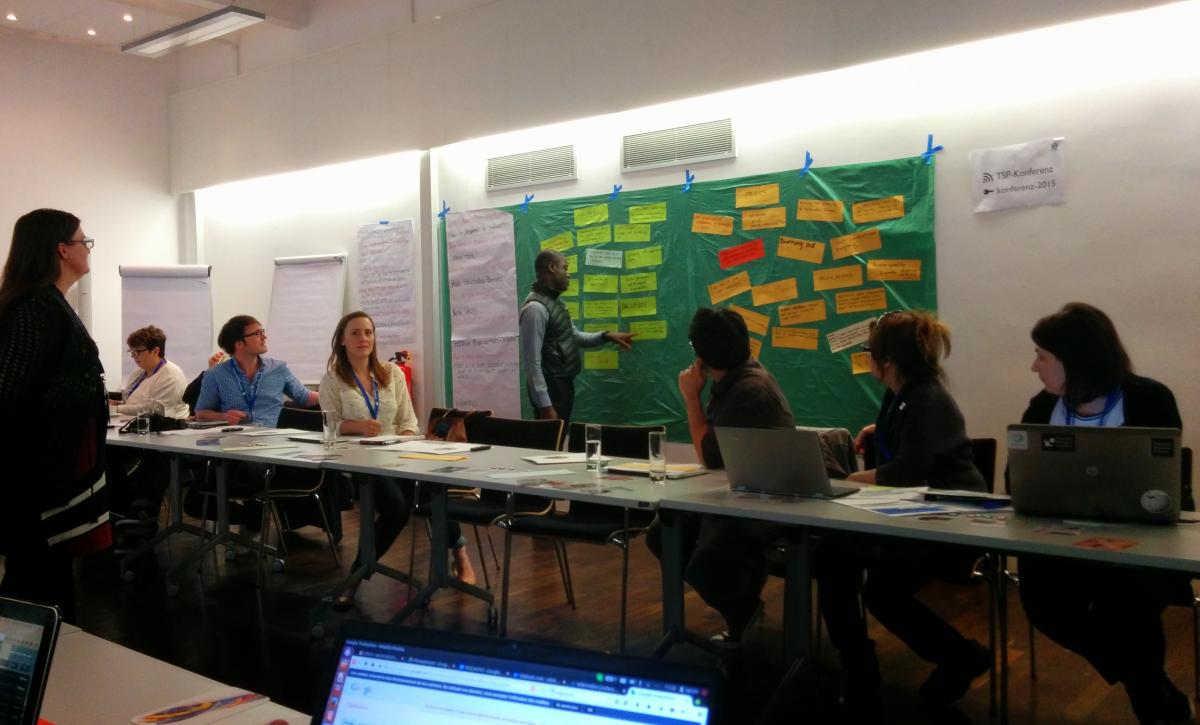
Across the international humanitarian, development, and peacebuilding sectors, organizations are facing increasing financial pressure due to shifting donor priorities, competing domestic priorities, and rising operational costs. Many are expected to maintain or expand programme delivery and associated accountability and learning activities despite declining or uncertain resources. These pressures are also affecting evaluation functions at international, national, and local levels. As resources become more constrained, evaluators face growing expectations to generate timely and useful evidence while safeguarding evaluation quality, independence, and credibility. This raises important questions about how evaluation systems, approaches, and methods can adapt to changing institutional priorities and operational realities.
Rationale for the discussion
While funding constraints affect organizations across sectors, their implications for evaluation vary depending on institutional mandates, operational contexts, and the populations served. Drawing on the complementary focus areas of EvalforEarth and ALNAP, this discussion will examine these implications across climate action, food security, resilience, humanitarian emergencies, and peacebuilding, with particular attention to the challenges of sustaining credible evidence and accountability in resource-constrained settings.
The discussion will also consider the risks associated with reducing investment in evaluation or failing to incorporate evaluative evidence into strategic and operational decisions, particularly where resources are limited and the consequences of ineffective interventions may be significant.
Purpose of the discussion
The discussion seeks to draw on the experiences of EvalforEarth and ALNAP members to identify practical lessons and recommendations for sustaining effective evaluation systems under financial and operational constraints.
Specifically, it aims to:
- Examine how financial uncertainty is affecting evaluation practice, accountability, organizational learning, and evidence use across different sectors and institutional contexts.
- Identify practical adaptations, innovations, and approaches that can help maintain evaluation quality, independence, and usefulness with limited resources.
- Explore how evaluators and organizations can better demonstrate the value of evaluative evidence and strengthen its use in strategic and operational decision-making.
Guiding discussion questions
Week 1: Implications of funding constraints: How have funding or resource constraints affected evaluation, learning, and accountability processes in your organization or context?
Week 2: Adaptations and practical solutions: How have you or your organization adapted evaluation and learning practices to respond to these constraints?
Week 3: Risks of limited evidence use: What are the risks of excluding evaluative evidence from strategic and operational decision-making, particularly in resource-constrained environments?
Week 4: Looking ahead: What needs to change to sustain credible, independent, and useful evaluation in increasingly resource-constrained environments?
The online discussion will remain open for contributions until 12 November 2026.
Log in to post a commentNot yet a member? Register here
Zambia
Njovu Tembo Njovu
Honorary Member
Zambia Monitoring and Evaluation Association
Posted on 12/11/2026
Here is my contribution to the topic 'Strengthening evidence use, accountability and learning amidst funding constraints
Noting the impact that donor dependence and funding constraints has had on the social sector across Africa, I believe we should be thinking of alternative sources of funding for M&E programmes and approach to capacity building. As an Indigenous Evaluator, I very much feel the impact of the closure of USAID on consultancy opportunities and stoppage of funding to some of the social projects here in Zambia.Further restrictions are making Zambians look inwards for resource mobilisation. I have seen mothers coming together to form clubs to generate income to solve their financial challenges in communities once served by USAID. E.g. the Women’s Club of St Charles Borromeo in Chamilala of Nyimba District that is now growing moringa for sale. Other donor agencies have also reduced their development assistance activities while challenges of communities are increasing. Civil society is struggling to find donors and many of the much visible critics of government have opted to become civil servants. Membership contributions are not enough unless you have a business side. A society that served as the voice of the people and keep the executive and legislature checked has been weakened by the appointments into government and diplomatic corp of some of its leaders.
We had a general election here in Zambia in August, and we felt the weakness of independent monitoring including the lack of visibility of our national VOPE. This is not just a case of Zambia, but many nations across the continent. The questions for me is not on the impact of evaluation during funding constraints but whether evaluation has been of service to the majority of citizens. Has the top-down approach in national evaluation capacity building not been empowering the majority and what needs to be done to empower them? Can we talk of democracy when election results cannot add up and be validated as the voice of the majority and choice of Ancestral Spirits and God? Does the glossy wrapping of the evaluation practice hide a western governance system that is not suitable to our African environments?
I believe expecting elevating change from entrenched systems favouring the elite could wishful thinking. The politics of religion and that of development assistance favour a powerful few. We talk of decolonisation of M&E but leave out the major stakeholders; the common citizens and indigenous communities and their sages and philosophers. 2030 is around the corner and yet we can see that the UN Development Era of ‘Not Leaving Anyone Behind’ is like any other past era. Good on paper but not cracking the chains that keep many citizens from fully fulfilling their human potential.
As Evaluators we need to start working more with grass root level (Community Based) organisations to reach the majority of citizens and empower them. In a democratic state the power lies in the big numbers; the majority of citizens. One may argue that the possibility for change lies not in commoners but in the hands of the youths. However, if past trends where youths have sparked violent actions in North and East Africa are to be observed, states have quickly regained control and increased the budget on surveillance systems and anti-riot gears and vehicles.
What else should evaluators, organisations, donors and evaluation networks do differently to make the biggest difference in the practice of evaluation?
1. VOPEs to actively search for alternatives of sustainability beyond reliance on subscriptions and donor funding. Donors should be flexible and allow part of their donations to be used for income generating activities to sustain VOPES.
2. VOPEs and African states to advocate for the African Union and African nations to include building national M&E in their budgets.
3. VOPEs to actively participate in developing national M&E capacity at grass root levels. Seeing that the top-down approach in national M&E capacity building has not had a major impact in reducing poverty in African states and improving governance, there is a need for a bottom up approach.
4. Initiators of development projects and programmes to incorporate indigenous evaluations (IE) in them and create spaces for continued participatory evaluation debates and learning.
5. Donors and states should support research in IE and its documentation. Colonial entrenched systems will probably resist the revival of IE and indigenous knowledge. Most royal establishments in Zambia were established by the appointment of chiefs by the British during the colonial era following a divide and rule policy to help them easily rule over the indigenous people and have access to the land and its minerals. However, the evidence to be provided of consensus community based decision making and evaluation should be adequate to convince them of the benefits on IE Decision Making Among the Nsenga people – Soaring Zambia).
6. They should also support the training of emerging evaluators in IE.
7. Develop a culture of volunteering going beyond making a professional curriculum vitae. Skilled and experienced evaluators should volunteer in the communities or sponsor to empower them with M&E skills. This is what I have been doing in building capacity at the grass root level (Reviving Indigenous Evaluation in Zambia – Soaring Zambia). It is one way of helping communities that can no longer depend on external funding.
8. Resource mobilisation should include approaching family members, indigenous communities, high-net worth members of the community, the diaspora and well meaning philanthropists and well-wishers. Family members and friends can provide transport, accommodation and food in the communities during workshops. People from different villages in the Nsenga chiefdom of Zambia have been able to use this old way of facilitating tribal assemblies to gather for meetings. However, be mindful of state restrictions on public gathering and obtain the required permits or meet in a venue that does not require them.
9. Evaluators and VOPEs embarking on fund raising ventures should include communities in planning and implementation.
10. Evaluators to actively participate in the running of their VOPEs and start ensuring there is accountability and transparency. States should enforce society regulations on VOPEs as self-regulation by members is poor. Otherwise, we shall have no tangible change in the service delivery of VOPEs and impact on national and continental level. Unchecked leadership in VOPEs has led to executive monopolies, cronies merry-go round during elections, the under-serving of members and lack of progress in building national development capacity. Enhancing the performance of VOPEs requires selfless professionals eyeing the bigger picture, the benefits to a global village.
Kind regards,
John T. Njovu
Indigenous Evaluator
Coordinator - African Chapter of the Global Network for Indigenous Evaluators (EvalIndigenous)
Cameroon
Ayuk James Ebot
Independent National Consultant
Independant Consultant
Posted on 11/11/2026
To sustain credible, independent, and useful evaluation under severe Funding contraints,we must transition from costly top-dowu extractive monitoring models towards agile pluralistic and future-ready frameworks..Drawing from the intersections of strategic foresight, epistemic diversity, and Social and Behovior Change SBCC.
Three key lessons and practical priorities must be carried forward :
Prioritize Epistemic Pluralisme over Expensive Bureaucracy.
Financial scarcity exposes the unsustainability of heavy external evaluation teams.We must leverage epistemic diversity by integrating localized, Low-Cost participatory methodologies and indigenous knowledge systems. Trusting local communities to co-evaluate interventions is not only ethical,it drastically lowers operational costs while increasing data cridibility and relevance
2) Embed inner and strategic foresight into rapide Evaluation :
Traditional evaluation looks backward which is an expensive luxury when resources are vanishing. Evaluation must adopt agile forward -looking methodologies such as horizon Scanning and rapid scenario tracking to provide reel-time adaptive insights . This ensures evaluation functions as an active survival tool that helps navigate polycrises rather than an administrative post-mortem
3) Utilize SBCC to bridge the evidence - to -action gab :
An evaluation is only useful if it is used.In resources -constrained environnents, technical evaluation reports must be translated through mass media (Radio TV) into culturally resonant narratives using SBCC Principles ensures that contrainted evaluation data is package into high-impact, bilingual public communication flows that drive-local behavior Change, transperent gouvernance and community ownership.
Cameroon
Juliana Adjem Anchang
Lead Consultant
Group for Research, Monitoring and Evaluation Consulting
Posted on 11/11/2026
Evaluation under pressure: Strengthening evidence use, accountability and learning amidst funding constraints
Evaluation is often seen as a cost rather than an organizational investment. As financial pressures intensify, this creates a risk that it will be deprioritized, weakening opportunities for learning, programme adaptation and accountability.
Drawing on this discussion, funding constraints should push a rethink on how evaluation - evidence use, accountability and learning are embedded in programme management, and not only how evaluations are financed or made cheaper. Evaluation functions that depend on external, project-based funding, and are not embedded in organizational budgets, management systems or decision-making processes, are structurally fragile and unlikely to survive funding withdrawal.
Moving forward, I see three priorities.
1. Evaluation should be a continuous process embedded in programme management, not only a periodic event tied to project milestones: Strengthening evidence use under financial pressure should not begin and end with baselines, midterm reviews, and final evaluations. Organizations need to ask regularly what is working, what is not, who is benefiting, who is being left out, and what needs to change. This matters even more when resources are scarce, because every dollar must go to interventions that are relevant, effective, and responsive to the communities. After funding cuts, a key organizational priority should be to build three practices into project implementation plans: periodic joint evidence reviews with partners and stakeholders, documented responses to emerging findings, and systematic follow-up on corrective actions. These practices build on existing monitoring and management arrangements and do not require a new or expensive evaluation exercise. In this sense, continuous evidence use is itself a response to financial pressure.
2. Donors and commissioners have a responsibility to encourage and fund the routine use of evidence, not only to require end-of-project evaluations: Beyond requiring and financing periodic evaluations, donors and commissioners should actively encourage the use of existing monitoring and evaluative evidence, regular reflection on program performance, and timely management responses to emerging findings. They should also invest in helping local organizations develop these practices. This would strengthen organizational ownership of evaluation and learning, rather than leaving evaluation as an end-of-project compliance obligation.
3. Evaluation approaches should be proportionate to the decisions they inform, rather than simply cheaper: Commissioners and practitioners should adopt proportionate, context-responsive, and cost-effective approaches and make strategic use of existing evidence and collaborative learning mechanisms while safeguarding methodological rigor and independence. Responding to funding constraints cannot mean only cutting evaluation budgets or choosing cheaper methods. It must also mean making better use of the evidence and resources we already have, integrating learning into routine management, and ensuring that independent evaluations both build on and feed into continuous learning. Credibility and independence must remain non-negotiable, even as approaches become more resource-conscious.
Cameroon
Ayuk James Ebot
Independent National Consultant
Independant Consultant
Posted on 10/11/2026
To maintain credible, independent, and useful evaluation in times of budget constraints, we must move away from top-down, costly models in favor of agile, pluralistic, and forward-looking frameworksby combining strategic foresight, epistemic diversity, and communication for change (CCSC).
Three key lessons and practical recommendations emerge
Maximize the impact of evidence through CCSC and the media: Data is only useful if it is shared. Given tight budgets, evaluation reports must be translated through mass media (radio and TV) into compelling narratives that are accessible and culturally appropriate. Utilizing the tools of SBCC allows us to transform factual evidence into instruments for public action and collective behavioral change.
CONCLUSION: “ “Sustaining evaluation under funding pressure requires us to stop viewing resource scarcity purely as a limitation and start viewing it as an imperative to decolonize our metrics. By embedding epistemic diversity, strategic foresight, and SBCC into our core frameworks, we shift evaluation from an expensive, donor-driven compliance exercise to an indispensable, locally owned tool for resilient survival.”
Costa Rica
ILIANA MARIA ESPITIA
Vocal Comunicación y Medios digitales
ReLAC
Posted on 10/11/2026
Evaluating with Fewer Resources Without Compromising Quality: Lessons Learned from Latin America and the Caribbean
Warm greetings to everyone participating in this discussion, and thank you to EvalforEarth and ALNAP for creating this forum.
I am participating as co-spokesperson for Outreach and Dissemination at the Latin American and Caribbean Network for Monitoring, Evaluation, and Systematization (ReLAC). Founded in 2004, ReLAC brings together national networks, working groups, and partner organizations from across the region. I am also writing from my personal perspective, because that is part of what I want to convey. I am a feminist, lesbian, and migrant woman living in Costa Rica, and I am completing my graduate degree in Evaluation of Development Programs and Projects at the University of Costa Rica. I mention these identities because no one conducts evaluations in a vacuum. Who evaluates, from where, and for whom also determines what evidence counts and what is deemed expendable when cuts must be made.
1. Impact of Funding Restrictions
In our region, scarcity is nothing new. Much of the evaluation work and the life of our networks has been sustained by volunteer labor. ReLAC is a Volunteer Organization for Professional Evaluation (VOPE), and its institutional framework relies on the time donated by committed professionals. What is new, however, is the scale and speed with which cooperation funding is being withdrawn.
What concerns me most is what gets cut first. When resources are reduced, evaluation tends to be reduced to the bare minimum: accountability to the funders. The first things to go are learning opportunities, participatory components, fieldwork with rural, Indigenous, Afro-descendant, and migrant communities, and gender and human rights approaches.The situation of those conducting evaluations also becomes more precarious—especially for women and young people just entering the profession—with shorter, lower-paying consulting contracts and less room for independence.
2. Adaptations and Practical Solutions
From ReLAC and its ecosystem, I see four adaptations worth sharing:
Working groups, national networks, and partnerships allow for the sharing of capacities that no single organization could sustain on its own. One example is the course “Evaluating from Latin America: Counter-hegemonic, Critical, and Situated Perspectives,” promoted by ReLAC’s “Evaluating from Latin America” Working Group and EvalIndígenas Latinoamérica, in partnership with REDMEBOL. It is peer-to-peer training, developed from within the region.
3. Risks of Excluding Evaluation Evidence
4. Looking Toward the Future
To sustain credible, independent, and useful evaluation, I propose:
In times of resource constraints, the question is not only how to evaluate with fewer resources, but also whose voices we stop hearing when we stop evaluating. At ReLAC, we remain convinced that the region has much to contribute to this conversation—not as a recipient of solutions, but as a producer of its own evaluation knowledge.
I invite you to learn about the work of our networks and groups at relac.net, as well as our social media presence at https://linktr.ee/red_relac and our WhatsApp channel: https://whatsapp.com/channel/0029Vb6Gd8t4inop80qq3q47
With appreciation,
ILIANA ESPITIA | Co-Chair of Outreach and Dissemination, ReLAC | Costa Rica
Nigeria
Dr. Uzodinma Akujekwe Adirieje
CEO
Afrihealth Optonet Association (AHOA) - CSOs Network
Posted on 10/11/2026
WHAT SHOULD CHANGE IN THE NEXT FIVE YEARS
WHAT SHOULD CHANGE IN THE NEXT FIVE YEARS
Over the next five years, climate evaluation in Africa must become more African-led, equity-centred, future-oriented, and useful for decision-making. We need stronger national evaluation systems, more investment in local evaluators and research institutions, and evaluation frameworks that connect climate action with health, food security, livelihoods, gender equality, humanitarian response, and social protection.
Technology will be important, but it must serve evaluation, and must not replace evaluators’ judgement.
a. AI can help synthesise large volumes of qualitative and quantitative evidence, identify patterns, translate materials, support data quality checks, and make findings more accessible. However, it must be used ethically, transparently, and with human oversight. Evaluators remain responsible for validating evidence, interpreting context, protecting data, addressing bias, and making professional judgements.
b. Remote sensing and geospatial tools can strengthen monitoring of land degradation, deforestation, floods, drought, agricultural conditions, settlement growth, and exposure to hazards. But satellite data must be ground-truthed with community knowledge; a pixel cannot explain why a household migrated, lost livestock, or was excluded from support.
c. Digital data systems should be interoperable, privacy-protecting, and designed for use by governments and communities inclusive, not only international agencies.
d. Institutional collaboration must improve across governments, regional bodies, universities, civil society, communities, evaluators, funders, and climate-finance institutions. Evaluation evidence should inform national adaptation plans, climate budgets, humanitarian planning, and investment decisions.
e. Evidence use must improve through timely briefs, accessible languages, community feedback sessions, policy dialogue, and accountability mechanisms that require decision-makers to respond to findings.
The next generation of climate evaluation should be less extractive and more transformative; so that they should help African countries learn quickly, correct course, protect the most vulnerable, and build climate-resilient development on their own terms.
Nigeria
Dr. Uzodinma Akujekwe Adirieje
CEO
Afrihealth Optonet Association (AHOA) - CSOs Network
Posted on 10/11/2026
LOOKING AHEAD
Sustaining credible, independent and useful evaluation under tighter budgets needs change on five fronts.
1. Protect evaluation funding: Donors and governments should ring-fence a defined share of programme budgets for independent evaluation and learning. Pooled or multi-donor funds can help, because they separate the evaluator's funding from the implementer's interests.
2. Strengthen national and regional systems: Government evaluation policies, such as the one Nigeria developed, need to be resourced and enforced. Voluntary organisations for professional evaluation (VOPE), such as the Nigerian Association of Evaluators (NAE) and International Organisation for Cooperation in Evaluation (IOCE), and communities of practice like EvalforEarth, should be supported to set standards and share methods.
3. Shift power to local actors: Evaluation should be locally led, community-informed and respectful of indigenous knowledge, with civil society networks treated as partners rather than data suppliers.
4. Use technology responsibly: AI and digital tools can cut costs and speed learning, but only with ethical safeguards, data protection and human oversight.
5. Reward use, not just production: Funders and leaders should be held to using evidence in budgets, strategies and adaptive management, and findings should be shared openly and promptly.
AHOA will continue to contribute through its network, training academy and advocacy, and through Dr. Adirieje's roles in evaluation and civil society communities.
Nigeria
Dr. Uzodinma Akujekwe Adirieje
CEO
Afrihealth Optonet Association (AHOA) - CSOs Network
Posted on 10/11/2026
RISKS OF LIMITED EVIDENCE USE
Excluding evaluative evidence from decisions is not a saving. It moves cost from the evaluation budget to programme failure. The following are the main risks:
a. Misallocated scarce resources: Without evidence on what works, funds go to familiar, visible or politically convenient activities rather than effective ones. In low-resource health systems, this means avoidable illness and death.
b. Repeating failures: Programmes that skip learning replicate flawed designs, and the same lessons are paid for again.
c. Leaving people behind: Averages hide inequity. Without disaggregated evidence, refugees, rural women, adolescents and other marginalised groups drop out of view, which works against the SDG principle of ‘leaving no one behind’.
d. Eroding trust and legitimacy: Communities, governments and donors lose confidence in organisations that cannot show results. This hurts civil society most at a time when its funding is already squeezed.
e. Weakening country ownership: When evidence comes only from external donors' frameworks, national systems and local knowledge go unused. Policy then depends on funders' priorities rather than national ones.
f. Opening the door to misinformation: Where credible, timely evidence is missing, anecdote, politics and poorly sourced AI-generated content fill the gap.
In health, climate and humanitarian work, where decisions are urgent and margins are thin, evidence use is a core risk-management function.
Nigeria
Dr. Uzodinma Akujekwe Adirieje
CEO
Afrihealth Optonet Association (AHOA) - CSOs Network
Posted on 10/11/2026
ADAPTATIONS AND PRACTICAL SOLUTIONS
At AHOA, we have responded by making evaluation cheaper to sustain and closer to community and network structures.
1. Using the AHOA network as an evidence asset. On the Global Fund/NMEP Malaria Matchbox project, AHOA network members in the four states served as field officers. This kept data collection credible and affordable, and it built local capacity.
2. Building learning into routine governance. The VERDI Mpox Community Advisory Board (CAB), which AHOA runs for IHVN, follows a fixed rhythm. It holds a monthly review meeting, files an activity report by the 7th of the following month, and gives periodic summary presentations. Reflection is part of the routine and needs no separate budget line. The work also produced a peer-reviewed-style conference abstract on community health workers and Mpox response.
3. Curating verified evidence. AHOA's weekly bulletins and reviews draw on credible, verifiable sources. Decision-makers get usable evidence without commissioning new studies each time.
4. Using partnerships and communities of practice. AHOA’s CEO Dr. Uzodinma Adirieje serves as a 2026 EvalforEarth Champion. His work there links indigenous knowledge, community evidence and AI-enabled learning, so that lower-cost methods stay rigorous.
5. Investing in skills. The AHOA-HSPC Training Academy (TACoMS) and certified training in M&E and research ethics keep quality up when external evaluators are unaffordable.
Dr. Adirieje’s guiding principle is that AI and digital tools must serve equity, justice, and sustainable development, and that they supplement human judgment and community voice without replacing them.
Nigeria
Dr. Uzodinma Akujekwe Adirieje
CEO
Afrihealth Optonet Association (AHOA) - CSOs Network
Posted on 10/11/2026
IMPLICATIONS OF FUNDING CONSTRAINTS
For AHOA, a civil society network working across Africa and the Global South, funding pressure falls first on the parts of the programme cycle donors treat as optional. These are baselines, mid-term reviews, independent end-line evaluations and the follow-up that turns findings into learning. Having worked in evaluation for over two decades, and having served as the National President of the Nigerian Association of Evaluators (NAE), a consultant on Nigeria's National M&E Policy, and part of the team that performed Nigeria's first SDG 3 and 4 evaluations, one has seen the same pattern repeatedly: monitoring shrinks to activity counting while evaluation is postponed or compressed.
As a result, three implications stand out.
1. Accountability narrows toward the donor. Reporting deadlines are met, but accountability to communities gets less money. That includes feeding results back and testing whether services reached the hardest-to-reach.
2. Independence weakens. When a thin budget forces an implementer to fund and shape its own assessment, there is less room for candid, critical findings.
3. Learning becomes episodic. Without funds for reflection sessions, data-quality reviews and documentation, lessons stay with individuals and are lost when projects close or staff move on.
The effect is sharpest in fragile and displacement settings, such as those the African Refugees Council (ARC) and the Pan-African Refugee and Displaced Persons Integration and Support Programme/Afrihealth Optonet Association (AHOA–PRISP) work in. Mobility, insecurity and weak records make disaggregated data costly, so equity questions about who was left behind are often the first dropped. The result is a widening gap between what programmes claim and what they can credibly demonstrate, just as funders demand stronger proof of value for money.
Kenya
JACKLINE MUSUYA
Monitoring and Evaluation Lead
Hewatele Limited
Posted on 10/11/2026
What needs to change to sustain credible, independent and useful evaluation in resource-constrained environments?
Sustaining credible evaluation under financial pressure requires protecting its essential functions rather than preserving every activity unchanged. Evaluation should be embedded in organisational planning and budgeting, focused on consequential decisions, and supported by transparent quality-assurance and independence safeguards.
Organisations should use existing monitoring data and previous evidence before commissioning new data collection, but they must examine whose experiences are missing from those systems. Cost reduction should not weaken community participation, suppress uncomfortable findings or transfer unreasonable risks to local evaluators.
Evaluation findings must also lead to visible action. Every evaluation should have a prioritised management response, responsible persons, timelines and follow-up. Communities should be informed about how their contributions affected programme decisions.
The required shift is from evaluation as a periodic compliance requirement to evaluation as an embedded system for learning, accountability and adaptation. When resources are scarce, evaluation should become more focused and influential, not less credible or inclusive.
Cameroon
Juliana Adjem Anchang
Lead Consultant
Group for Research, Monitoring and Evaluation Consulting
Posted on 05/11/2026
Week 4: Looking ahead: What needs to change to sustain credible, independent, and useful evaluation in increasingly resource-constrained environments?
Sustaining credible, independent and useful evaluation requires a shift from donor-driven compliance to organization-owned learning and genuine accountability. Accountability should go beyond satisfying donor requirements to ensuring that organisations remain answerable to the communities they serve, represent and advocate for. Learning must be recognized as essential to organizational growth, adaptation, and sustainability.
While donor funding for independent evaluations remains important, local civil society organizations need support to initiate, plan for, and own evaluation processes while safeguarding evaluator independence. Evaluation should be understood not merely as a reporting obligation but as a strategic tool for improving programs, strengthening credibility, demonstrating results, and informing future decisions.
Importantly, evaluation should also be recognized as an investment in resource mobilization and will play a big part if it is linked to funding streams. Credible evidence of results, organizational learning, and accountability can strengthen donor confidence and support fundraising efforts, although it does not guarantee funding. Building this understanding among CSOs is critical to creating genuine institutional demand for evaluation and sustaining evaluation practice in increasingly resource-constrained environments.
Zimbabwe
Wilbert Marimira
Evaluator
Tsorodzo dzeAfrika Advisory
Posted on 10/11/2026
Thank you, Julian; your contribution resonates with my on-the-ground experience, and I completely agree with your perspective. Building on that, it makes you stop and think:
How many evaluation reports are sitting in your digital drawer right now, gathering virtual dust?
For years, evaluation has felt like an expensive compliance procedure we rush to finish to tick a donor’s box. But the moment evaluation shifts from a compliance barrier to learning we actually own, everything changes.
In my view, it all starts with an honest question at inception: Who asked for this, who will use it, and what will we do differently because of it? When leaders can see the exact decision the evidence unlocks, they stop tolerating evaluation and start demanding it.
Of course, true accountability also has to reach the ground. In my fieldwork across places like Chiredzi and Bikita districts, Zimbabwe, I’ve learned firsthand that sitting down with communities in plain language to say, "Here’s what we found, here’s what we’re changing, and here’s what we’re still unsure about" builds more trust than any 100-page document ever will.
I understand that balancing that ground-level trust with local ownership and genuine independence can be tricky. We need to lead the process, but we also need to let evaluators tell us the exact truth. Our best safeguard? Agree on the questions together on day one, and then let the data speak, even the uncomfortable parts, without anyone tampering with the conclusions.
Best of all, credible doesn't mean breaking the bank. Lean methods, routine monitoring data, and honest reflections go a long way when we stop treating evaluation as a project afterthought and start treating it as an investment in our own strategy and funding resilience.
Italy
Silva Ferretti
Freelance consultant
Posted on 05/11/2026
Take sides. WIth the affected communities and the planet.
Be ready to give space, from evaluation as it is now, to evaluative thinking, shared.
And remember that evidence alone does not go anywhere. It is the process of co-creating it that matters and drives change.
Czechia
Marie Korner
Managing Director
4G eval
Posted on 04/11/2026
What needs to change to sustain credible, independent, and useful evaluation in increasingly resource-constrained environments?
The increasing number of "dumping price" tenders winning makes me wonder about the quality and ultimately usefulness and use. I believe donors should avoid compromising on quality and use the decreased budgets for evaluations that contribute most for learning and programming, narrowing the scope and number of questions to what is most important to verify and learn.
There will be less evaluations, so perhaps we evaluators should look how to diversify:)
Zimbabwe
Wilbert Marimira
Evaluator
Tsorodzo dzeAfrika Advisory
Posted on 04/11/2026
In my view, it should be more strategic, more locally led, participatory and a lot more useful.
I used to think rigour meant big frameworks and 90-page reports. Then, in community dialogues on a community-based climate adaptation and nature-based solutions project in Chiredzi and Bikita, Zimbabwe, I watched high-volume reports gather dust, while a one-page visual summary shared under a tree shifted climate adaptation decisions that same week.
Here is what I would do again. Start by agreeing on the decision the evaluation needs to inform, not the framework. On our climate adaptation work, we asked: “What does the farmer, extension officer, or district team need to decide before the next planting season?” Then we used what already existed, like extension officer reports and rainfall records, before collecting anything new. Often, half the answer is already there. Donors can help too. If partners in one district pool funds, we get one joint evaluation instead of three overlapping ones.
Adopt participatory approaches and keep expertise local. People who live in a place understand the language, the seasons and the politics, and no international consultant can fly that in. Evaluators should work closely with them from day one, shaping the questions, collecting and sorting the data, and making sense of the findings together. Pair that with simple tools like ODK or Kobo on a phone, and it’s cheaper and faster. Most importantly, communities trust the results more because they helped build them.
And don’t wait for the final report. We took our draft findings to community meetings and let farmers challenge them. Their feedback made the evidence better, and the decisions followed.
Cutting evaluation might look like a saving, but it costs us. We keep funding programmes that do not work, we lose the voices of people who are already overlooked, and we repeat mistakes because the learning disappears. In tight times, evaluation is how we make sure scarce resources reach the people who need them most.
Nepal
Gana Pati Ojha
Community of Evaluators
Posted on 04/11/2026
Beyond Doing More with Less: Rethinking the Institutional Foundations of Evaluation under Resource Constraints
The current discussion rightly highlights the consequences of shrinking development and humanitarian budgets for evaluation, accountability and organisational learning. Contributions so far have offered valuable practical suggestions, including prioritising essential evidence, making better use of existing data, strengthening local evaluation capacities, adopting participatory approaches and using digital technologies responsibly.
I would like to extend this discussion by raising a more fundamental question: Are we facing merely a resource problem in evaluation, or does the current funding crisis expose deeper institutional weaknesses in how evaluation is positioned and used within development organisations?
My observation, particularly from development practice and evaluation in South Asian contexts, is that evaluation is still too frequently treated as a project-level requirement rather than an integral institutional function. It is often designed around donor reporting cycles, contractual obligations and predetermined performance indicators. Consequently, when funding becomes uncertain, evaluation budgets are among the first to be reduced. This is not simply because resources are scarce; it also reflects the institutional position that evaluation occupies in organisational priorities and decision-making.
There are three interconnected issues worth considering.
1. From project accountability to institutional accountability
Much of our evaluation practice remains project-centred, even though development outcomes depend on broader institutional relationships, governance arrangements and political and economic conditions. A project may achieve its targets while failing to strengthen the institutions, capacities and relationships necessary to sustain those achievements. Under funding constraints, we therefore need to move beyond asking whether individual projects have delivered their planned outputs. We should also ask whether interventions have strengthened institutional capabilities, improved coordination, addressed power imbalances and contributed to sustainable systems. This shift would help decision-makers distinguish between immediate programme performance and longer-term institutional development.
2. Evidence use is fundamentally a governance issue
Generating credible evidence does not automatically ensure that it will influence decisions. Evidence use depends on who has the authority to act on findings, whether organisational incentives encourage critical reflection, and whether institutions have mechanisms for translating lessons into changes in policies, resource allocation and implementation practices. In some situations, organisations possess substantial evaluation reports and monitoring information but have limited incentives to acknowledge uncomfortable findings or change established practices. Under funding pressure, this tendency can become stronger, as organisations become more concerned with demonstrating compliance and protecting institutional interests. We therefore need to strengthen not only the technical capacity to generate evidence but also the institutional arrangements that make evidence influential. Evaluation should inform decisions at the levels where resources, priorities and institutional practices are determined.
3. Protecting learning and accountability requires rethinking power relationships
An important concern is that accountability often remains predominantly upward-facing, towards donors and funding agencies, rather than equally responsive to national institutions, local organisations and communities. This imbalance becomes particularly consequential when resources decline. Local partners and affected communities may continue to provide information and participate in data collection, while having limited influence over evaluation questions, interpretation of findings and subsequent decisions.
A credible evaluation system must therefore pay attention to the distribution of decision-making authority, responsibilities and benefits among partners. Community participation should not be reduced to consultation or data provision; it should include meaningful opportunities to influence decisions and hold implementing institutions accountable.
Where do we go from here?
I would suggest five practical priorities:
Ultimately, I believe the present funding crisis offers an opportunity to rethink the foundations of evaluation itself. We should not simply try to preserve existing evaluation arrangements with fewer resources. We should use this moment to build evaluation systems that are more institutionally embedded, locally owned, politically informed and capable of supporting adaptation.
The real challenge is not simply how to do more evaluation with less money. It is how to ensure that the evidence we generate has the institutional authority, incentives and opportunities necessary to influence decisions and improve development outcomes.
If we succeed in making this transition, evaluation will become less of a reporting obligation and more of an essential part of development governance, institutional accountability and collective learning.
Barbados
Stephanie Bishop
Evaluation Officer
Caribbean Development Bank
Posted on 04/11/2026
Kudos to the EvalForEarth team for giving us this space to connect, share and learn from one another!
For me, what needs to change is how we decide what to evaluate, how we plan for disruption and who has the final say on the findings. In Caribbean small island developing states (SIDS), scenario planning and a portfolio approach can help us make scarce evaluation funds go further while protecting the credibility, independence and usefulness of our work.
Hurricane Beryl offers an example of the impact on the fishing industry. In Barbados, fishing boats were badly damaged. On Union Island in Saint Vincent and the Grenadines, disruptions to water and electricity meant fish could no longer be cleaned or stored. An evaluation of boat repairs could accurately count how many vessels returned to sea and still miss the question that matters to fishing families: Could they get their catch to market and earn a living again?
Three changes I’d like to see in practice:
With limited resources, I’d rather we answer a few questions well, protect evaluators’ freedom to report what they find and make sure the evidence reaches the people who can use it.
Philippines
Mae Albiento
Research Officer
ALNAP
Posted on 03/11/2026
Many thanks to Richard Tinsley, QueenMakarie Constance Jerome, Juliana Adjem Anchang, Eddah Kanini, and JACKLINE MUSUYA for sharing such thoughtful contributions for our Week 3 discussion on the risks of limited evidence use.
Three key risks are emerging from the contributions:
I also want to highlight what Eddah Kanini said about how funding cuts put local evaluators and organizations at risk: “Declining evaluation budgets usually leads to the transfer of financial and operational risks to national evaluators, local consultancy firms and community-based organizations. They may be expected to deliver complex evaluations within compressed timelines and reduced budgets, while still meeting international quality standards. This raises the questions of fairness, equitable partnerships and localization.”
With this, we now continue to our Week 4 of the discussion where we focus on looking ahead. Our final question is:
What needs to change to sustain credible, independent, and useful evaluation in increasingly resource-constrained environments?
I invite everyone to share your insights and experiences. Your practical examples, challenges and proposed solutions can help identify collective priorities and inspire action across the evaluation community.
Everyone is also still welcome to continue sharing your thoughts on our three earlier discussion questions. We look forward to reading your insights and experiences. The discussion will be open until 10 November 2026.
Nigeria
Dr. Uzodinma Akujekwe Adirieje
CEO
Afrihealth Optonet Association (AHOA) - CSOs Network
Posted on 05/11/2026
What Needs to Change to Sustain Credible, Independent and Useful Evaluation in Increasingly Resource-Constrained Environments
- By Dr. Uzodinma Akujekwe Adirieje, FAHOA
CEO and Programmes Director, Afrihealth Optonet Association (AHOA)
Funding for development and health is tightening, and evaluation is usually among the first things to be cut. If we want evaluation to remain credible, independent and useful, we cannot simply do the same with less. We need to change how evaluation is funded, structured, owned and used. From my work in M&E, climate-health systems strengthening, humanitarian engagements and civil society, I see seven changes.
1. PROTECT EVALUATION AS A CORE FUNCTION, NOT AN OPTIONAL EXTRA.
Evaluation should have a ring-fenced share of programme, policy and institutional budgets, set at the design stage. A protected budget line is what keeps evaluation from being the first casualty of a funding squeeze. Donors and governments should treat it as an investment that prevents waste, because a small spend on evidence usually saves far more than it costs.
2. SAFEGUARD INDEPENDENCE THROUGH STRUCTURE, NOT GOODWILL.
Credibility depends on evaluators being free to report what they find. This means:
Austerity increases the pressure to produce flattering results, so these protections matter more now.
3. MAKE EVALUATION RIGHT-SIZED, TIMELY AND DECISION-FOCUSED.
Evaluation is also dropped when it is slow, costly and too academic to be used. Evaluators and commissioners should:
An evaluation that arrives after the decision has been made is, in practice, wasted.
4. SHIFT LEADERSHIP AND OWNERSHIP TO LOCAL AND NATIONAL ACTORS.
Local, national and civil society evaluators are closer to context and cheaper to sustain. Evaluation systems should be built around:
5. POOL RESOURCES AND COLLABORATE.
No single agency can fund every evaluation. Joint and shared evaluations, common evidence repositories and evidence maps prevent duplication. Commissioners should check what is already known before commissioning anything new. Partnerships across UN agencies, governments, CSOs and academia can share costs and spread skills.
6. USE TECHNOLOGY, INCLUDING AI, TO LOWER COSTS WHILE PROTECTING QUALITY.
AI can reduce the burden of desk reviews, evidence synthesis, translation, analysis of large portfolios and communication products. To keep credibility, we need:
7. INVEST IN AN EVALUATION CULTURE AND IN THE USE OF FINDINGS.
Evaluation is useful only if people act on it. This calls for:
THE UNDERLYING SHIFT
Many of these changes come down to one: moving from evaluation as a compliance exercise done to programmes to evaluation as a shared learning system owned by those who deliver and those who are served. That system is cheaper to sustain, harder to dismiss and more likely to be used. It is also consistent with my guiding principle that tools and systems alike must serve equity, justice and sustainable development.
AHOA is ready to contribute through its network of more than 3,000 organisations across 113 countries, its community engagement experience and its M&E expertise.
Dr. Uzodinma Akujekwe Adirieje, FAHOA
CEO and Programmes Director, Afrihealth Optonet Association (AHOA)
2026 EvalforEarth Champion | President, African Refugees Council (ARC)
Abuja, Nigeria | afrepton@gmail.com | ceo@afrihealthcsos.org | www.afrihealthcsos.org
+234 80 347 25 905
United States of America
Richard Tinsley
Professor Emeritus
Colorado State University
Posted on 01/11/2026
I have been very concerned about how the evaluation effort has failed the smallholder communities and what can be done about it. I have also reviewed a massive text on evaluations and took the opportunity to respond to the text coordinator. I thought you might be interest in my response and references from the Smallholder Agriculture website I manage. This follows.
Thank you
Dick Tinsley
My response and references follow:
-----------------------------------
I have been going through your massive text on evaluations. It is quite an undertaking and takes some time to fully review. Please allow me to comment on some concerns I have about evaluations as they apply to smallholder farming communities. I think they have massively failed smallholder communities on two counts. They continue to endorse the use of producer organizations that the smallholders have 90% avoid, squandering billions of dollars annually on projects rejected by the intended beneficiaries. And, failed to identify that smallholder communities have very limited labor, and that labor is severely under nourished to undertake agronomic field work expected of them, limiting the “operational feasibility” of innovations developed and promoted for their benefit resulting in minimal acceptance of recommendations. This can be clearly visible by casual observations of the 8-week spread in crop management activities. Or how intensive the field activity is in the morning but limited in the afternoon even with massive work need and family food security at risk. How can evaluation identify this and get it addressed so smallholder development can advance?
My overview thoughts are that Evaluations are only of value to the extent they guide future projects to better serve the beneficiaries. Yes, they may be a legal requirement and document presumed accomplishment, but this is history, and ultimate value is how they guides future projects. Also, if you look closely at the 2+ year with million+ US$ invested between conception and implementation, the limited role the beneficiaries have in the process, the rigidity of the final contracts and committed staffing, projects are mostly imposed on the smallholder communities. This forces any post implementation participatory input to be leveraged to what the contract already agreed and staffed accordingly. Also, it is the implementors that prepare the periodic progress reports with limited input for the beneficiaries and pragmatic mandate to appease the donors by proclaiming the overall success of the project. With these restrictions in upfront beneficiary participation and periodic reporting the evaluations become the “ultimate voice of the beneficiaries” and opportunity to indicate their satisfactory or avoidance of the effort.
With these brief comment my I request you glace through the following webpages with possible links to other pages and tell me what you think and how these concerns can be included in future evaluation of smallholder communities so we can move past the reliance on producer organizations and address the operational feasibility of innovation including those concentrated on sustainability and resilience.
Thank you for your indulgence,
Dick Tinsley, Professor Emeritus
Soil & Crop Sciences Department
Colorado State University
Linked Webpages:
https://labs.agsci.colostate.edu/tinsley/research/development-process/#monitoring
https://labs.agsci.colostate.edu/tinsley/research/supporting-value-chains/#taxpayers-expectations
https://labs.agsci.colostate.edu/tinsley/research/development-process/#operational-feasibility
https://labs.agsci.colostate.edu/tinsley/research/dietary-energy-deficit/#caloric-energy-balance
Nigeria
QueenMakarie Constance Jerome
CEO
Zion Kingdom Humanity Foundation
Posted on 01/11/2026
In my view, funding and resource constraints affect evaluation, learning, and accountability because these processes require adequate finances, skilled personnel, time, and reliable data systems. When resources are limited, field monitoring may be reduced, evaluations may be delayed, and staff may lack opportunities to learn from project experiences. Furthermore, accountability can be weakened when organizations cannot adequately verify results or report their activities to stakeholders.
“However, organizations can manage these challenges by prioritizing key evaluation activities, adopting cost-effective data collection methods, strengthening staff capacity, and involving beneficiaries in monitoring and feedback. I believe that evaluation, learning, and accountability should not be viewed as optional activities but as essential investments that help organizations improve performance, demonstrate results, and use limited resources more effectively.”
Key message: Limited funding may restrict what an organization can evaluate, but effective planning, learning, prioritization, and transparency can help ensure that available resources still produce meaningful results.
Cameroon
Juliana Adjem Anchang
Lead Consultant
Group for Research, Monitoring and Evaluation Consulting
Posted on 28/10/2026
My engagements with development and humanitarian organizations, and especially local civil society organizations, suggest that as financial resources decline, there is a growing risk that M&E will be deprioritized, particularly where its value for organizational learning and strategic decision-making has not been sufficiently institutionalized. Several evaluations are donor requirements, but when not donor-driven, efforts in evidence generation for decision-making are often centered on project achievements and success stories rather than systematically generated evidence. While this does not necessarily imply that evaluations are not conducted, it raises concerns about how evidence is documented, retained, and used. In resource-constrained environments, excluding such evidence risks repeating ineffective approaches, misallocating scarce resources, weakening accountability to communities, and missing opportunities for program adaptation and improvement.
Kenya
Eddah Kanini (Board member: IDEAS, AGDEN & MEPAK. Former Board member AfrEA 2021-2026
Monitoring, Evaluation and Gender Consultant/Trainer
Posted on 27/10/2026
Thank you to EvalforEarth and ALNAP. This is a timely and very relevant discussion.
The shrinking of finances is affecting organization including humanitarian, development and Civil societies hence the fundamental questions about the sustainability of evaluation systems, particularly in low and middle-income countries.
From my experience working across health systems, climate change, gender equality, education, humanitarian programs and institutional capacity strengthening in Africa, I believe the challenge is not simply how to conduct evaluations with fewer resources, but how to sustain the value, credibility and use of evaluation when resources are shrinking.
A few highlights come to mind.
Evaluation aspects should not always be the first casualty of funding cuts.
Depending on different leadership, where resources are perceived to have declined, evaluation, and learning activities are often the first to be reduced or completely eliminated. Yet these are the moments when organizations need credible evidence to determine the interventions that could affect life, those that deliver results, areas where resources are being wasted, areas that need interventions to be adapted and areas that can wait for a Phase in process and programmes to be sustained.
Funding constraints should not compromise ethics, quality and independence
In resource-constrained environments, there may be pressure to reduce sample sizes, shorten data collection periods, rely on virtual data collection or limit engagement and FPIC with communities. This could improve efficiency, but will weaken the credibility and inclusiveness of evaluation findings. And especially on vulnerable populations, marginalized communities and hard-to-reach areas, where meaningful participation requires additional time and resources.
Local evaluators and organizations should not be overlooked
Declining evaluation budgets usually leads to the transfer of financial and operational risks to national evaluators, local consultancy firms and community-based organizations. They may be expected to deliver complex evaluations within compressed timelines and reduced budgets, while still meeting international quality standards. This raises the questions of fairness, equitable partnerships and localization.
Demonstrate that evaluation is an investment in better decisions, not merely a compliance requirement
As our forefathers said, never waste a crisis; seize it as an opportunity. The funding pressures could be used to strengthen the connection between evaluation evidence and strategic decision-making. Evaluators need to communicate not only on what is achieved, but also how the findings influence resource allocation, adaptation, institutional learning and accountability to affected populations.
Kenya
JACKLINE MUSUYA
Monitoring and Evaluation Lead
Hewatele Limited
Posted on 27/10/2026
In resource-constrained environments, excluding evaluative evidence from strategic and operational decisions creates more than an information gap. It increases the risk that already limited resources will be directed towards interventions that are ineffective, poorly targeted or unresponsive to changing needs.
One major risk is the continuation of activities based on assumptions rather than demonstrated results. Without evidence on implementation challenges, unintended outcomes and community experiences, organisations may continue investing in approaches that appear successful in activity reports but produce limited meaningful change.
A second risk is that the needs of less visible groups may be overlooked. Routine administrative data often capture what is easiest to count, while evaluations can reveal differences in access, participation and outcomes across locations and population groups. When evaluative evidence is excluded, decisions may favour well-documented needs while marginalising communities whose experiences are poorly represented in existing information systems.
Limited evidence use also weakens organisational learning. Teams may repeat implementation problems, lose valuable lessons when programmes close and struggle to explain why particular results were achieved. Under financial pressure, such mistakes become more costly because organisations have less capacity to absorb ineffective spending.
Finally, excluding evaluation findings can weaken accountability. Communities may provide feedback without seeing how their contributions influence programme decisions, while management responses and follow-up actions remain undocumented.
The solution is not necessarily to conduct more evaluations. It is to protect the use of essential evidence by integrating evaluation findings into planning meetings, resource-allocation decisions, risk reviews and management-response processes. When resources are scarce, evidence should become more influential, not less.
Philippines
Mae Albiento
Research Officer
ALNAP
Posted on 26/10/2026
Week 2 summary and introduction to Week 3: What are the risks of excluding evaluative evidence from strategic and operational decision-making, particularly in resource-constrained environments?
Many thanks to all who contributed on our second week of the discussion: Wilbert Marimira, MUKUNZI Olivier, Dr. Uzodinma Akujekwe Adirieje, Eriasafu Lubowa, Abdoul Aziz Bonkoungou, Ayuk James Ebot, Diene Ndiaye, Stephanie Jill Hodge, LEANDRE KOUOTOU NGOUCHEME, Rhode Early Charles, and Atta B. Jacob KOBENAN (PhD).
Overall, Week 2 contributions show that organisations are finding ways to adapt to the funding constraints: being more selective about what they evaluate, asking more focused evaluation questions, making better use of existing data, using digital tools and remote data collection, drawing on local expertise and knowledge, embedding evaluation in programme management, and finding practical ways to make findings more accessible and actionable.
Here, we highlight three key messages:
But doing evaluation with fewer resources shouldn't mean losing sight of what makes it valuable. Even with fewer resources, organisations need evidence they can trust, learning that leads to action, and approaches that take seriously the knowledge and experiences of local actors and affected communities.
The discussion therefore raises an important question for organisations and donors alike: when evaluation budgets shrink, how can we protect the core functions of evaluation—credible evidence, accountability to affected people, independent scrutiny and organisational learning—while changing the way we deliver them?
And so, for our Week 3 discussion, we focus our attention on the risks of limited evidence use.
Our guiding question for this week is:
What are the risks of excluding evaluative evidence from strategic and operational decision-making, particularly in resource-constrained environments?
I encourage everyone to build on the contributions from Weeks 1 & 2 and continue to engage directly with one another. We look forward to reading your insights and experiences. The discussion will be open until 10 November 2026.
Kenya
Eddah Kanini (Board member: IDEAS, AGDEN & MEPAK. Former Board member AfrEA 2021-2026
Monitoring, Evaluation and Gender Consultant/Trainer
Posted on 27/10/2026
I have reflected on this question for a while, and I kept thinking, “In times of financial constraints, can we afford not to use evaluative evidence?”
First, we risk making expensive mistakes with scarce resources. Without evaluative evidence, organizations may not realise it’s not business as usual and may continue funding interventions that are not delivering results and ignore those that could make meaningful contributions. This could lead to institutionalising failure rather than learning from it.
Secondly, I imagine an area where women have to walk long distances to fetch water for households and animals. With no evaluation evidence, there is a possibility of building an airport in the area instead of supporting the community by installing pipes or sinking boreholes. This will only increase inequalities and leave the already marginalised populations behind. The airport may be an important investment in its own right, but is it the most pressing priority, when resources are scarce? Evaluation evidence helps us prioritise interventions and understand what works, for whom, and under what circumstances.
Nigeria
Dr. Uzodinma Akujekwe Adirieje
CEO
Afrihealth Optonet Association (AHOA) - CSOs Network
Posted on 05/11/2026
The Risks of Excluding Evaluative Evidence from Strategic and Operational Decision-Making in Resource-Constrained Environments
- By Dr. Uzodinma Akujekwe Adirieje, FAHOA
CEO and Programmes Director, Afrihealth Optonet Association (AHOA)
I have spent decades in health economics, health systems strengthening and monitoring and evaluation, in settings where every naira, dollar and working hour is stretched. One lesson from that work is that decisions made without evaluative evidence are expensive, even when they look cheap. Resource-constrained environments have the least room to absorb that cost.
STRATEGIC RISKS
Misallocated resources. Without evidence on what works, for whom and at what cost, money goes to familiar or politically attractive programmes and not to effective ones. Where budgets are tight, every misdirected dollar is a service that does not exist elsewhere.
Repeating failed approaches. Programmes that were never evaluated, or whose evaluations were ignored, are renewed and scaled unchanged. The same design flaws are paid for again.
Strategy detached from reality. Plans built on untested assumptions drift away from what communities and frontline staff actually face.
Weakened standing with funders. Organisations that cannot demonstrate results and learning lose credibility, and that hurts most when competing for scarce funding.
OPERATIONAL RISKS
Late detection of problems. Without M&E feeding into management, stockouts, low uptake, poor targeting and delays surface only after harm is done.
Duplication and inefficiency. Without mapping what is already known, teams commission studies and design interventions that repeat existing work.
Lost institutional memory. Where staff turnover is high, knowledge leaves with people unless evaluation captures it.
Inability to adapt. Fragile and fast-changing contexts demand course correction. Without evidence, adaptation becomes guesswork.
RISKS TO PEOPLE AND EQUITY
Unseen harm. Unintended effects on women, adolescents, refugees, displaced people and remote communities stay invisible if no one is looking. The least visible groups in the data are usually the most vulnerable.
Silenced community voice. Evaluation is one of the few formal channels through which communities say what is and is not working. Community Advisory Boards exist for the same reason. I chair the Community Advisory Board for the VERDI Mpox study in Bayelsa, Lagos and Rivers States, and I have seen that accountability to participants is what gives a programme its legitimacy.
Eroded trust. When communities see their feedback ignored, participation declines, and later programmes pay for it.
GOVERNANCE AND SUSTAINABILITY RISKS
Weak accountability. Without evidence there is no objective basis for judging performance, so poor results and misuse of funds are harder to detect and challenge.
Decisions by opinion or power. Evidence is the main check against decisions driven by the loudest voice, politics or convenience.
Poor sustainability. Programmes are not designed for handover, cost recovery or integration into national systems when no one has measured what sustaining them requires.
Ethical and reputational exposure. In health and research settings, skipping evidence-based safeguards and ethical review can cause harm and destroy credibility.
WHY SCARCITY MAGNIFIES THESE RISKS
Evaluation is often the first line cut in a tight budget, because its costs are immediate and visible while its benefits are delayed and diffuse. That is a false economy. A modest investment in evidence usually costs far less than the waste it prevents. Resource-constrained systems also cannot afford large-scale trial and error. Evidence is what lets them learn from other people's mistakes and not their own.
EVIDENCE MUST BE FIT FOR PURPOSE
Evidence is also excluded when it arrives too late, costs too much or is too remote from decision-makers to be used. My recommendations are:
CONCLUSION
Leaving evaluative evidence out of decisions means steering without feedback. It wastes scarce resources, hides harm and weakens accountability to the people we serve. At AHOA we hold that artificial intelligence and every other tool must serve equity, justice and sustainable development. Evidence is how we keep that commitment honest.
Dr. Uzodinma Akujekwe Adirieje, FAHOA
CEO and Programmes Director, Afrihealth Optonet Association (AHOA)
2026 EvalforEarth Champion | President, African Refugees Council (ARC)
Abuja, Nigeria | ceo@afrihealthcsos.org | www.afrihealthcsos.org
+234 80 347 25 905
Zimbabwe
Wilbert Marimira
Evaluator
Tsorodzo dzeAfrika Advisory
Posted on 23/10/2026
How are organisations adapting evaluation and learning practices amid funding constraints?
Cutting MEAL field visits to save money was the single biggest mistake we made.
When funding ran tight across our climate resilience projects in Bikita, Chiredzi, and Mutare, we initially tried replacing field visits with phone surveys. The data came back thin, and communities felt abandoned because nobody was sitting down to talk with them.
We realised that the real challenge was not merely reducing the cost of evaluation; it was enhancing its value for decision-making and organizational learning.
To fix this, we shifted monitoring directly into the hands of local women and youth; we trained them on offline KoBoToolbox etc and participatory community scorecards using basic Android phones. We instituted a robust feedback uptake mechanism; we realised that instead of waiting for an endline, community monitors shared scorecard data during quarterly reflection sessions right in the wards.
That single move cut routine M&E costs by nearly 30% while transforming data into immediate action. In Chiredzi, for instance, paper reports showed great seed distribution numbers, but community scorecards revealed farmers were losing livestock to dry spells and lacked feed preservation knowledge. Because our feedback loop forced a direct link between field evidence and project adjustments, we immediately pivoted activities toward traditional grain multiplication and fodder preservation.
To keep data objective, our MEAL team combined internal spot-checks with peer evaluation reviews across ward teams, catching errors early while building local ownership.
If I had to do it again, I’d build community-led monitoring and active feedback uptake loops into project design from day one, not wait for a budget squeeze to force the shift.
Lesson learned: Data is only as valuable as the decisions it drives, and it is only as trusted as the people collecting, analysing and reporting it
Rwanda
MUKUNZI Olivier
Data analyst
Private company
Posted on 22/10/2026
From an economic and analytical perspective, the convergence of declining fiscal resources and rising demand for accountability creates a structural paradox that requires substituting legacy, capital-intensive field evaluations with lean, digital data pipelines and econometric modeling. By transitioning from expensive manual tracking to open-source geospatial modeling for climate action, real-time mobile price tracking for food security, and econometric simulations for resilience testing, organizations can compress data-collection loops and drive marginal monitoring costs toward zero. Similarly, deploying transaction metadata audits in humanitarian emergencies and algorithmic sentiment mapping in volatile peacebuilding zones eliminates high logistical and security overheads. This strategic integration of automated data systems optimizes resource allocation, directly enhancing donor attraction and protecting evaluation independence by turning raw operational metrics into transparent, credible, and highly rigorous proof of social impact within tight financial constraints.
Zimbabwe
Wilbert Marimira
Evaluator
Tsorodzo dzeAfrika Advisory
Posted on 23/10/2026
This is a great reflection regarding the balancing act we all face; funding is shrinking, but the demand for clear proof of results is higher than ever. We simply have to move past heavy, expensive field setups if M&E is going to remain practical.
This reminds me of one action we did in the field; this exact squeeze is what forced us to rethink our approach and replace costly top-down visits with leaner digital workflows. By training local women youth to use offline KoBoToolbox surveys and community scorecards on basic Android phones, we sped up our data collection and cut our routine M&E costs by nearly 30%.
The real magic of using tech like mobile surveys, geospatial mapping, or real-time tracking is not just saving money on paper; it's how fast you can feed those insights back into everyday operations. For example, when digitized scorecard data reached us in real time, we immediately saw that farmers in Chiredzi were losing livestock to dry spells despite good seed distribution numbers. Because the data came in so quickly, we were able to pivot our activities straight toward traditional grain multiplication and fodder preservation before the season was lost.
Smart tech and automated systems are fantastic tools, but they only truly work when anchored in human trust. When you pair digital efficiency with community ownership, you do more than just lower evaluation costs, you turn raw numbers into real-time action!
Nigeria
Dr. Uzodinma Akujekwe Adirieje
CEO
Afrihealth Optonet Association (AHOA) - CSOs Network
Posted on 22/10/2026
ADAPTING EVALUATION UNDER FUNDING PRESSURE: ‘AHOA’s EXPERIENCE/PERSPECTIVE
Under funding pressure, AHOA treats evaluation as a routine management function, building accountability into delivery rather than adding it afterwards. Two projects led by Dr. Adirieje show how.
WHAT HAS WORKED
In the UNDEF-funded Sustainable Citizen Participation (SCP) Project (2017-18), AHOA worked across nine Niger Delta states and 81 LGAs, delivering through local sub-implementing partners such as ACERD in Delta State. Citizens and CSO leaders were trained to generate and use local evidence, and advocacy visits reached state governors. Press coverage recorded government engagement, including Delta State's partnership with AHOA and Abia State's pledge of support for the training. This created a public accountability record at almost no extra cost.
In the Global Fund-supported Nigeria Malaria Matchbox assessment (2020), Dr. Adirieje served as a national consultant, with AHOA network members supporting fieldwork in Adamawa, Gombe, Taraba and Yobe. Locally recruited interviewers working in local languages reached 809 respondents, over 60% women, in four weeks. Findings were validated at a stakeholder workshop before action planning.
WHAT HAS NOT WORKED
Time and resources prevented transcribing every focus group, and KoboCollect handled extended qualitative data poorly, so teams returned to recordings and notes. Participation also suffered where respondents expected compensation was not provided within the Project architecture
BALANCING TRADE-OFFS
Cost was contained through local capacity, not by dropping rigour: consent, triangulation and validation were retained. It is my considered view to keep routine learning cheap and internal, reserve independent evaluation for high-stakes questions, and report limitations openly.
Uganda
Eriasafu Lubowa
Monitoring, Evaluation, Accountability, and Learning (MEAL) and Reporting Expert
Posted on 21/10/2026
I have two opinions to share regarding the adaptation of evaluation and learning practices in light of the current financial uncertainty. Thanks to the members for their views on the Week 1 topic.
First, promoting peer evaluation within the organization’s network. Over the years, I have learned that development and humanitarian organizations often hire experienced full-time M&E staff. However, they spend additional money on expensively contracted external evaluators. Sometimes these are even global consultants because the contracting organization wants independent and trusted feedback. But this comes at a high cost, even as high as $100,000 USD. Moreover, if the feedback uptake mechanism and culture are weak, the evaluation findings, lessons, and recommendations will not be used to their fullest extent. I think that evaluation practice, in its true sense, requires more than just investing money in evaluation expertise. I have advocated for the organization to develop a network of evaluators comprising key internal M&E staff, researchers, and other M&E staff, and have suggested establishing an ad hoc, standby evaluation team. Relevant people who can always team up when needed to conduct an evaluation. To avoid potential biases and conflicts of interest, the organization conducting the evaluation would invest more in strengthening its evaluation process management, facilitation, and quality assurance. It would leverage its internal M&E expertise rather than fully contracting evaluators. Although this adaptation is still far-fetched, for me, the peer approach in evaluation will not only reduce the substantial costs of externally contracted evaluations but also enhance peer learning within the network while maintaining accountability.
Second, mixing short- and long-term, cost-effective evaluation recommendations. I always ensure that the evaluations I lead generate actionable feedback, with at least more than 50% of the evaluation recommendations feasible for immediate, cost-effective management response. This is different from when all the recommendations (which usually require more time) call for large amounts of money to accomplish. No wonder: from personal experience, not many organizations put as much effort into the Management Response Plan after an evaluation as they do into the evaluation itself. Integrating short- and long-term, cost-effective evaluation recommendations will give the organization room to spend smaller amounts, first on cost-effective actions.
Burkina Faso
Abdoul Aziz Bonkoungou
Consultant
ImaniBa-Consult
Posted on 21/10/2026
Thank you for sharing this particularly relevant insight. I agree that, in a context of financial uncertainty, the challenge is not merely to reduce the costs of evaluation, but above all to enhance its value for decision-making and organisational learning.
Peer evaluation is, in my view, an interesting avenue for humanitarian and development organisations. It would help to make the most of in-house expertise, strengthen the sharing of experiences and encourage greater ownership of the results. However, its effectiveness will depend on certain conditions, notably the independence of the evaluators, the prevention of conflicts of interest and the existence of a rigorous quality assurance framework. External expertise therefore remains necessary in certain situations, particularly where issues of impartiality, methodological complexity or accountability so require.
I also agree with your proposal to combine short-term and long-term recommendations. In practice, an evaluation should not be limited to producing findings and recommendations, but should result in a realistic, prioritised and budgeted action plan. Measures that can be implemented immediately can bring about rapid improvements, whilst structural recommendations require planning and the gradual mobilisation of resources.
In the Burkinabe context, where organisations must cope with funding that is sometimes unpredictable and with growing humanitarian and social needs, these two approaches seem to me to be particularly relevant. They could help to strengthen national evaluation capacities, pool expertise across organisations and make better use of available resources.
One question, however, strikes me as essential: how can we ensure that the savings achieved through peer review are actually reinvested in organisational learning and the implementation of recommendations?
Uganda
Eriasafu Lubowa
Monitoring, Evaluation, Accountability, and Learning (MEAL) and Reporting Expert
Posted on 22/10/2026
I agree with you that peer evaluation should not compromise independent evaluations. Indeed, external expertise remains key in evaluation.
Peer evaluation would hardly work in institutions that have already defined how they do it. For example, in UN Agencies and other institutions that, by their internal policies, have already specified how they evaluate.
Peer evaluation of programs/projects can be a topic for debate among Local Implementing Partners. They are increasingly running short of funds, yet the pressure/need to properly evaluate their funded projects is rising. I like your point that the concept can help to improve national evaluation capacities.
You paused a very interesting question “how can we ensure that the savings achieved through peer review are actually reinvested in organisational learning and the implementation of recommendations?”
Organizations out there could have interesting views on it alongside those from this platform.
Thanks!
Cameroon
Ayuk James Ebot
Independent National Consultant
Independant Consultant
Posted on 22/10/2026
Good contribution thanks Sir.
For my opinion : A Two- Pronfed Response to Funding contraints : Epistemic Pluralisme and Behavior Intervention ;
In the central Africa sub- region, the collision of severe Funding contraints with rising Humanitarian and developmental crises demains a departure from resource-heavy,traditional evaluation paradigmes. As an independent Researcher specialising in Epistemic Deversity, strategic foresight and Social and Behovior Change SBCC communication my contribution focuses on how we can adapt evaluation and learning practices to meet OECD-DAC standards-specifically, Relevance,Effectiveness, and Efficiency without sacrificing rigor or community Accountability
METHODOLOGICAL ADAPTATION :
Democratizing Evidence via epistemic diversity
Traditional external data collection machanisms are often the first to be cut during budget crunches, leading to compromised date quality or outright blind spots.
To uphold the DAC criteria of Effectiveness and Relevance,we must shift from costly," Parachuted" Expert evaluations to pluralistic, localized knowledge ecosystem
(1) De-Centering the "Expert": In central Africa,we have pivoted toward epistemic diversity by integrating indigenous knowledge systems and Local community voices directly into evaluation framework
(2) Low-Cost oral and visual matrices ; instead of expensive,tabula electronic surveys that require intensive field logistics we leverage community - held focus group discussion and localized storytelling matrics.This allows us to track reel-time qualitative outcomes in a way that respects local languages and Communication structures.Maintaining evidentiary validity at a fraction of the cost.
Decentralized peer-to-peer learning : We establish local community learning hubs where beneficiaries monitor their own progress. This structural adaptation preserves Accountability to the affected population,treating them as co-owners of evidence rather than passive data points
- Strategic Adaptation ; Applying SBCC and foresight to evaluation infrastructure to adress the DAC criteria of Efficiency we must optimize existing systems and employ Behavior insights to lower operational overhead
- STRATEGIC LENS: Social and Behovior Change SBCC ;
Practical Adaptation in central Africa micro feedback channels : we embed evaluation metrics into ongoing SBCC campaigns infructure( such as local community radio listener groupes or existing interactive SMS lines) Monitoring data doubles as evaluation evidence,elimiinating the need for standalone post-project field missions
- DAC Alignement|Efficiency : maximizes existing programme touch point to harvest rich, longitudinal data without added cost
- Strategic Foresight : Scenario-embedded M&E; Rather than static,retrospective end- line evaluations we build continuous horizon- Scanning and interative feedback loops into project design.Evaluators track "weak signals" of behavioural drifts or systemic failure early on
- Sustainability and Relevance : catches design flaws or changing environnental dynamics early preventing wastes before budgets run completely dry.
The Bottom line for week2 : Accountability should never be viewed as an optional administrative line item to be trimmed when Funding drops. In central Africa sub- region,adapting to financial pressure means recognizing that Efficiency is maximized when evaluation is localized. By relying on epistemic diversity and merging evaluation infrastructure with existing SBCC communication channels,we ensure that evidence based learning remains robust, culturally rooted, and highly compliant with international Standards even under severe duress
Zimbabwe
Wilbert Marimira
Evaluator
Tsorodzo dzeAfrika Advisory
Posted on 23/10/2026
Thanks for sharing; I couldn’t agree more! Your two points hit the exact heart of what MEAL should be; cost-effective, collaborative, and built for real-world impact.
Your first point on leveraging internal peer networks over expensive external consultants is spot-on. When organizations drop six figures on global evaluators, those heavy reports often end up gathering dust on a shelf. In our case, instead of flying in expensive external consultants to evaluate our resilience projects, we paired M&E officers from our Buhera district office with program staff from Masvingo to lead peer reviews. Because they already understood the local context, the review cost a fraction of the budget, and the cross-pollination sparked practical ideas that our team immediately applied to our community garden setups.
By building an internal standby network with clear safeguards, like cross-project reviews to eliminate bias, you slash massive costs, protect professional integrity, and build deep local ownership.
Your second point on actionable recommendations is equally crucial. If an evaluation only pitches heavy, long-term changes requiring massive funding, management response plans usually stall. Balancing those with immediate, low-cost "quick wins" gives teams the breathing room to act on evidence right away rather than waiting for a distant endline.
Great insights; evaluations are only as valuable as the decisions and actions they drive!
Senegal
Diene Ndiaye
Consultant
Expert
Posted on 21/10/2026
I would like to thank EvalforEarth and ALNAP for initiating this discussion, in which I would like to share three lessons learnt from over twenty-five years’ experience. This issue directly affects the public administrations of partner countries, which commission or receive evaluations whilst their resources are dwindling.
1. Evaluate less, but better. Budgetary constraints mean choices have to be made. An evaluation that answers three questions relevant to decision-making is better than one that ticks all the DAC’s boxes without sufficient resources. Questions must be chosen in consultation with decision-makers right from the design stage, rather than added at the end of the project.
2. Make the most of existing data. Government departments produce a great deal of routine data, but this is often under-utilised. An evaluation based on these systems costs less. It also strengthens existing systems rather than creating parallel data collection efforts that disappear once the project ends.
3. Safeguard the integrity of the evaluation. When funding becomes scarce, there is a temptation to publish only positive results. This would be a serious mistake. Documented failures are often what prove most useful for subsequent projects. Donors have a role to play: they must demonstrate that a well-analysed assessment of failure will not automatically result in the loss of funding.
Finally, learning should not stop with the report. A brief and targeted presentation to technical departments and professional organisations costs little and is far more useful than voluminous reports that nobody reads.
Diène NDIAYE, Fisheries Engineer, Senegal
United States of America
Stephanie Jill Hodge
Posted on 21/10/2026
The Week 1 discussion resonates with my experience, particularly the tension between compliance and learning. For me, power runs through both. Who defines the questions? Who controls access to evidence? Whose explanation carries weight? And who has the authority to act on the findings?
My strongest practical lesson is to invest heavily in understanding the actual situation at the outset. Inception is substantive evaluative work. If the underlying institutional story is still unclear, negotiate more time before fixing the questions and methods. Under funding constraints, we have even less room to spend scarce resources answering the wrong questions.
In one multi-donor fund evaluation, the arrangements involved a governing body, a technical secretariat, a UN-hosted fund management function, implementing organisations and national counterparts. Delivery operated through grants and intermediaries. Leadership, control over resources, delivery responsibilities and formal accountability sat in different places.
Reading the organisational chart was insufficient. The important questions concerned how those arrangements worked in practice: who could approve or delay a decision, who was answerable for delivery, and how much influence national counterparts could exercise through intermediary organisations.
From inception onwards, I made governance, partnerships and ownership explicit areas of inquiry. Documentary review and stakeholder accounts helped me examine the tensions between fiduciary assurance and operational flexibility, and between formal national ownership and the practical organisation of delivery. During analysis, I distinguished these structural issues from implementation weaknesses. Otherwise, the findings could easily have settled on “coordination problems” without explaining what needed to change.
That distinction carried through to the final report. I brought the findings into the assessment of governance, partnerships and sustainability, including future responsibilities. I also distinguished evidence of activities and outputs from evidence of longer-term benefits. Institutional strengthening and investment readiness mattered, but they did not automatically demonstrate resilience outcomes.
The lesson is to understand the underlying story well enough to test it. Inception should produce a grounded explanation and a credible inquiry, while leaving room for subsequent evidence to overturn our initial understanding. It should not become an indefinite search for certainty.
A different example comes from designing monitoring arrangements for a national environmental partnership involving government agencies, financing bodies and technical partners, with delivery envisaged through agency-led projects. Here, I distinguished programme-level results from agency and project-level monitoring and connected the framework to existing systems. This provides a practical basis for reducing duplication and clarifying who should collect what.
But “use existing evidence” needs qualification. Administrative systems capture what institutions are required and equipped to report. They may tell us much less about customary landowners’ priorities, women’s influence over decisions, or communities’ experience of change. Reusing evidence can save money while reproducing gaps in whose experience counts.
For Week 2, I would therefore suggest:
What does not work is retaining an expansive scope while quietly reducing the evidence needed to support it. Nor should we assume that an evaluator can resolve institutional power imbalances simply by documenting them.
Our own power also deserves scrutiny. We choose sources, interpret disagreement and decide what reaches the final report. That responsibility begins at inception. A rushed understanding can shape the entire evaluation, however polished the final product. Spending enough time to understand the situation is one of the most practical ways I know to protect both the usefulness and the credibility of evaluation under pressure.
Cameroon
LEANDRE KOUOTOU NGOUCHEME
Président exécutif
Association HI-LIFE
Posted on 21/10/2026
This discussion on ‘Evaluation under pressure’ raises a fundamental challenge: the need to continue producing relevant, useful and timely data despite declining and uncertain resources. To address directly the question of ‘adaptations and practical solutions’ for coping with these funding constraints, I would like to highlight the strategic role of the digitalisation of evaluation practices.
In a context of budgetary constraints, the shift to digital evaluations makes it possible to drastically reduce logistical costs (travel, paper-based surveys) whilst expanding the geographical coverage of data collection.
A concrete and inspiring example is that of Cameroon’s Ministry of Youth and Civic Education. To overcome the challenges posed by limited resources, we have adopted online monitoring and evaluation practices to capture real-time data from our services, which extend across the country’s 360 districts.
This digital approach has had a twofold impact:
- continuous updating of indicators: The data collected online is used to reliably and rapidly update the performance indicators for the Ministry’s various programmes;
- operational adjustment: Operational services in the field rely on this feedback to adjust their actions and take concrete steps towards achieving the objectives linked to these programmes.
Beyond mere economic efficiency, this digital transition is profoundly transforming the dynamics of learning and accountability inherent in monitoring and evaluation. On the one hand, the traceability and near-instantaneous accessibility of data enhance transparency and accountability towards stakeholders, making it possible to demonstrate quickly how resources (even limited ones) generate impact. On the other hand, it catalyses continuous organisational learning: thanks to much shorter feedback loops, decision-makers and teams on the ground no longer have to wait until the end of a project cycle to draw lessons. They can identify structural challenges and readjust their intervention strategies in real time.
In conclusion, digitalisation does not replace methodological rigour, but it represents a practical innovation for maintaining the value of evaluation and strengthening its integration into strategic decision-making, thereby ensuring that evaluation remains a dynamic management tool rather than a mere a posteriori compliance exercise, even when budgets are under severe pressure.
Canada
Rhode Early Charles
Posted on 20/10/2026
Monitoring: The Overlooked Foundation of Cost-Efficient Evaluation
Many useful suggestions have already been shared on EvalforEarth and other platforms on adapting evaluation to funding constraints. In my previous contributions, I have emphasized making evaluation reports useful beyond donor accountability, including for business development, government planning, and national data needs, while applying lean data principles. To this, I would add a point I believe is often overlooked: monitoring is too often treated as the poor relation of MEAL, minimized or separated from evaluation, when both should belong to the same evidence system.
A well-designed monitoring system combines quantitative indicators with participants' perspectives. Numbers help us understand whether progress is occurring, while people's experiences help us interpret what that progress means. Why wait for a midterm or final evaluation to identify problems that could have been addressed earlier? Evaluation should not be the first time an organization learns whether its intervention is succeeding. It should build on monitoring evidence, independently test emerging findings, and investigate underlying explanations that routine monitoring cannot capture.
There is also a strong cost-efficiency argument. Projects already invest heavily in developing monitoring systems and conducting data quality assessments. Where monitoring data are reliable and suitable for the evaluation questions, establishing parallel data-collection systems is an unnecessary duplication of scarce resources. Instead, reliable and regularly updated participant records can serve as sampling frames. Existing databases, data-collection tools, feedback mechanisms, and logistical arrangements can all support evaluation activities. This reduces duplication and allows limited resources to be directed toward questions requiring deeper investigation.
Of course, this approach is not appropriate for every evaluation. Some methodologies require completely independent data collection, specialized sampling, or additional safeguards to protect evaluation independence and minimize bias. Reusing monitoring infrastructure does not necessarily mean relying on programme staff to collect evaluation data. However, in my experience, many project evaluations do not involve particularly complex survey designs, and opportunities to make better use of existing monitoring systems remain vastly underexplored.
The persistent disconnect between monitoring and evaluation represents a missed opportunity and an unnecessary use of scarce resources. Under financial pressure, the answer is not necessarily to collect more data or conduct fewer evaluations. It is to design monitoring systems from the outset to support the entire evaluation cycle, helping identify emerging evaluation questions, inform the choice and timing of evaluations, strengthen evaluability, and make better use of evidence already available. Perhaps we should spend less time asking how to make evaluations cheaper and more time asking whether our monitoring systems are designed to make evaluations more efficient, credible, and useful.
Kenya
JACKLINE MUSUYA
Monitoring and Evaluation Lead
Hewatele Limited
Posted on 21/10/2026
Thank you, Rhode. This is an important reminder that cost-efficient evaluation begins with strong monitoring. Reliable routine data, participant feedback and usable information systems can reduce duplication and allow evaluations to focus on deeper questions, independent validation and learning.
Côte d'Ivoire
Atta B. Jacob KOBENAN (PhD)
Anthropologue, Chargé de programme
Catalyste+
Posted on 19/10/2026
Evaluation under pressure: maintaining the quality of evidence and strengthening its use in decision-making
In my experience of managing development projects, particularly within the Canadian organisation where I currently work, monitoring and evaluation plays a key role in assessing results, ensuring accountability to partners and guiding decision-making. Working with monitoring forms, data collection questionnaires and outcome measurement tools has shown me that the availability of data does not necessarily guarantee its effective use.
Budgetary constraints can limit field visits, interviews with beneficiaries and post-intervention follow-up. They sometimes lead organisations to prioritise the production of reports within the set deadlines at the expense of an in-depth analysis of the changes observed.
In the face of these constraints, we can adapt our practices by simplifying data collection tools without sacrificing key indicators, standardising forms and making use of data that is already available. The use of remote interviews is also an option where the context (a good internet connection) allows it. However, my experience of data processing reminds me of the importance of checking data consistency and taking into account the limitations of the methods used. In capacity-building initiatives, for example, the immediate results of a training course are not sufficient to demonstrate that the skills acquired are actually being applied. A follow-up at a later stage – within the next 6 to 9 months – enables us to better assess how well the skills have been taken on board and their contribution to the expected changes.
In my view, budgetary constraints require, above all, better prioritisation of information needs and the integration of lessons learnt into day-to-day project management. We must also preserve the independence of evaluation and share lessons learnt with stakeholders. Even under budgetary pressure, evaluation must be regarded as a strategic investment that helps to improve interventions, rather than as a secondary expense.
Democratic Republic of the Congo
Jean-Marie Kavali Zihalirwa
Programme Manager
Grenier pour le Développement Intégré
Posted on 22/10/2026
Sous contraintes budgétaires, la conduite d’une évaluation, son étendue et la qualité des résultats peuvent être affectées.
Toutefois, notre expérience montre que le recours aux technologies numériques et aux applications mobiles de collecte de données, associé à la formation d’une petite équipe locale, permet d’optimiser les ressources disponibles tout en garantissant une collecte de données fiables et en temps réel.
Un autre défi majeur réside dans l’utilisation effective des résultats et des recommandations de l’évaluation lorsque les financements nécessaires à leur mise en œuvre manquent.
Pour sortir de ce cercle vicieux, il est essentiel de renforcer l’efficience des processus évaluatifs, en privilégiant des approches adaptées aux ressources disponibles et en favorisant l’utilisation concrète des données pour éclairer la prise de décision et mobiliser de futurs financements.
Zimbabwe
Chamisa Innocent
EvalforEarth CoP Facilitator/Coordinator
EvalforEarth CoP
Posted on 19/10/2026
Week 1 summary and introduction to Week 2: Adaptations and practical solutions
Thank you to everyone who has contributed to our joint EvalforEarth and ALNAP discussion on Evaluation under pressure: Strengthening evidence use, accountability and learning amidst funding constraints.
As we conclude Week 1, several key messages have emerged from the discussion.
First, funding constraints are affecting not only the scope and frequency of evaluations but also institutional capacities, opportunities for learning and accountability to affected communities. As Janet Awopole Yepakeh Tiah observed, “Less data does not mean fewer problems. It means problems we cannot see, and progress we cannot prove.”
Second, several contributors emphasised the need to rethink evaluation approaches rather than simply reduce activities. Wilbert Marimira, Jean Eudes Nguessan Beugre and Dr. Uzodinma Akujekwe Adirieje shared perspectives on prioritising essential evidence, strengthening local capacities and maintaining community participation.
Third, Anoop Sharma and Ayuk James Ebot highlighted opportunities to use existing evidence and responsible AI applications to improve efficiency, while safeguarding evaluation quality and credibility. As Ayuk put it, “doing more with less” must mean doing things differently, not doing the same things poorly.
Jackline Musuya raised concerns about the growing emphasis on compliance at the expense of learning, while Ian Goldman drew attention to the need to rethink the broader evaluation ecosystem. Mae Albiento reminded us of the importance of keeping local actors and affected communities at the centre of evaluation.
The emerging message is clear: reducing evaluation costs should not mean compromising evidence quality, independence, learning or accountability.
Week 2: Adaptations and practical solutions
We now turn from identifying the challenges to examining what organisations and evaluators are doing in response.
Our guiding question for Week 2 is: How have you or your organisation adapted evaluation and learning practices to respond to funding and resource constraints?
We particularly welcome practical examples of approaches that have worked, lessons from those that have not, and reflections on how organisations are balancing cost, quality, independence and accountability.
Thanks to Mae Albiento, Jackline Musuya, Janet Awopole Yepakeh Tiah, Wilbert Marimira, Dr. Uzodinma Akujekwe Adirieje, Jean Eudes Nguessan Beugre, Anoop Sharma, Ayuk James Ebot and Ian Goldman for sharing their experiences and perspectives.
I encourage colleagues to build on these contributions, engage directly with one another and bring in experiences from other institutional and country contexts.
The discussion remains open until 10 November 2026. We welcome your contributions.
Cameroon
Ayuk James Ebot
Independent National Consultant
Independant Consultant
Posted on 16/10/2026
FROM COMPILANCE TO ADAPTATION : Rebalancing learning and Accountability Under pressure ;
The current climate of shrinking budgets introduces a dangerous double burden :
Organizations face greater operational hurdles while scaling back the very monitoring, evaluation, and learning ( MEL) systems required to navigate them. When resources contract Institutional survival often defaults to rigid compliiance over reflective learning.However," doing more with less" must mean doing things differently,not doing the same things poorly.
This Funding crises is a critical juncture to shift toward learner,adaptive evidence systems
Leverage existing knowledge : When primary data collection budgets are cut the value of existing data sky-rockets. Organizations should prioritize cross-portfolio meta-evaluations and use human-guided AI tools to synthesize historical data. This uncovers deep existing community insights without the high cost of new heavy fieldwork
- Democratize with lean localized methods : Accountability should not be treated as disposable overhead. By designing highly targeted evaluations- focusing strictly on the absolute minimum evidence decision-makes need-and swapping expensive workshops for community hosted dialogues,we preserve local Accountability on a minimal budget
- Evidence the cost of inaction : Evaluation is a protective investment not a bureaucratic cost. Operating blindly in volatile sectors like climate resilience or food Security carries immense risk. Cutting MEL entirely wastes years of systemic capacity - building and locks implementers into repeating hidden programmatic failures.
We must protect evaluation loops to insure that the scarce Funding remaining,is funneled exclusively into proven, adaptive interventions
Nigeria
Dr. Uzodinma Akujekwe Adirieje
CEO
Afrihealth Optonet Association (AHOA) - CSOs Network
Posted on 16/10/2026
WEEK 1 CONTRIBUTION: THE IMPACT OF FUNDING CONSTRAINTS ON EVALUATION, LEARNING AND ACCOUNTABILITY IN WEST AFRICA
Funding and resource constraints have significantly affected the scope, frequency, depth and inclusiveness of monitoring, evaluation, research and learning (MERL) across West Africa. In Nigeria, where many civil society organizations depend on project-based donor funding, uncertainty in funding often translates into reduced evaluation budgets, fewer field visits, limited staffing, inadequate data management, and diminished opportunities for communities to participate meaningfully in assessing interventions intended to benefit them.
From the perspective of Afrihealth Optonet Association (AHOA), these challenges are particularly important in health systems strengthening, universal health coverage (UHC), climate action, humanitarian response, and community-led development. Evaluation is sometimes treated as a secondary project cost rather than an essential management and accountability function. Consequently, organizations may prioritize immediate service delivery while reducing investment in determining whether interventions are effective, equitable, sustainable and responsive to beneficiaries’ needs.
A practical example is AHOA’s experience in citizen monitoring of development projects under a UN Democracy Fund-supported initiative in the Niger Delta. The project engaged more than 1,600 monitors across 81 local government areas in nine Niger Delta states. Such extensive geographical coverage demonstrates the value of community-based evidence in identifying implementation gaps, strengthening citizen participation and promoting public accountability. However, sustaining this approach requires resources for training, transportation, data collection, verification, communication and feedback to communities. When resources are inadequate, monitoring coverage, verification quality and the timeliness of reporting can suffer.
Similar challenges arise in malaria programming and vulnerability assessments involving internally displaced persons and refugees in northeastern Nigeria. In fragile and humanitarian settings, insecurity, difficult terrain, population mobility and the vulnerability of affected communities make reliable evidence particularly costly to generate. Reducing monitoring resources in these contexts risks excluding precisely those populations whose needs are least visible in routine administrative data.
Funding constraints also affect learning. Organizations may collect information to satisfy donor reporting requirements without having sufficient resources or time to convene reflection sessions, document lessons, share findings or translate recommendations into programme improvements. Accountability can consequently become predominantly upward-facing, focused on funders rather than equally responsive to communities and local institutions.
My central observation is that resource constraints do not simply reduce the quantity of evaluation; they can fundamentally change whose experiences count, which questions are investigated and how evidence informs decisions.
AHOA’s experience reinforces the need to protect essential evaluation functions, prioritize high-value questions, strengthen community-generated evidence and integrate monitoring and learning into programme implementation. Even where comprehensive evaluations are unaffordable, organizations must preserve minimum standards of independence, methodological credibility, inclusion, transparency and feedback.
The ultimate test is not how much an organization spends on evaluation, but whether the evidence it generates helps improve outcomes, use resources responsibly and demonstrate accountability to the people it serves.
South Africa
Ian Goldman
President
International Evaluation Academy
Posted on 14/10/2026
I would like to draw colleagues’ attention to a recent article, “Rewiring the Evaluation Marketplace for a Changing World,” by Nancy MacPherson, Thomas Kelly and A.K. Shiva Kumar, published in the Journal of MultiDisciplinary Evaluation, Volume 22, Issue 53 (2026).
The article examines the changing global evaluation landscape, including funding pressures, shifting institutional priorities and the need to rethink traditional evaluation models. It calls for a more innovative, inclusive and responsive evaluation ecosystem, with stronger collaboration and greater engagement of local and regional actors.
These reflections are particularly relevant to our ongoing discussion on how evaluation can remain credible, independent and useful amid growing resource constraints.
I encourage colleagues to read the article and share their perspectives.
Read the article: https://jmde.com/index.php/jmde_1/article/view/1382
Nigeria
Dr. Uzodinma Akujekwe Adirieje
CEO
Afrihealth Optonet Association (AHOA) - CSOs Network
Posted on 25/10/2026
AHOA Response to "Rewiring the Evaluation Marketplace for a Changing World" (MacPherson, Kelly & Kumar, JMDE 22(53), 2026)
-by Dr. Uzodinma Akujekwe Adirieje;
CEO/Programmes Director, Afrihealth Optonet Association (AHOA)
📞 🟢 +234 803 472 5905 | ✉️ afrepton@gmail.com| 🌐 https://www.afrihealthcsos.org
AHOA welcomes this timely and candid article. It argues that evaluation is shaped as much by market incentives as by methods and theory, and that a field built on accountability-driven demand will struggle to stay relevant as aid gives way to investment-led models. This matches what we see from the Global Majority side. AHOA has worked since 1995 as a civil society network, now spanning 100+ countries, with UN ECOSOC consultative status. We have received evaluation demands set elsewhere, and we have also produced evidence for decisions on our own terms. We offer our reflections from that vantage point.
Where AHOA agrees
Accountability-driven demand narrows learning. Our experience supports this. Much of the evaluation done in our contexts, including Global Fund-financed HIV and TB work, serves donor reporting first. AHOA's own oversight work in Nigeria, such as monitoring Global Fund projects for the CCM, showed us how little of that evidence returns to communities or local decision-makers in usable form.
Tied aid and concentrated buyers constrain local capacity. Small and mid-sized Global South evaluation providers face the reputational catch-22 the authors describe: no major-donor experience, so no contracts, so no experience. We agree that procurement and accreditation reform is the most practical lever.
Intermediaries must change roles. Proposition 6 resonates with how AHOA positions itself. We act as a convener and network, and also as a direct implementer. Our strategy rests on partnerships, advocacy, research, capacity development, outreach, and monitoring and evaluation (PARCOM). Evaluation is built into the programme cycle and is not an external audit bolted on at the end.
What AHOA would add
1. Civil society is a market actor and an evidence producer, not only a client.
The article names philanthropy, social enterprise and impact investors as the innovators outside the mainstream. It says little about civil society networks and community organisations, which generate much of the real-time, context-rich evidence in low-resource settings. Our Sustainable Citizen Participation work in the Niger Delta, the Nigeria Malaria Matchbox projects and the Life & Health Dialogue Series all produce community-grounded evidence and communiqués with specific resolutions. These are rarely counted as part of the "evaluation market" because they sit outside formal commissioning.
2. Speed and voice can be organised collectively.
The authors ask why evaluators could not respond within days to the USAID disbanding. Networks can. AHOA's African Civil Society Statement and Clarion Call to COP31, issued in August 2026 from our 31st Life & Health Dialogue Session, gathered 373 endorsements from 29 countries within weeks. It is not a formal evaluation. It shows that a distributed network can convert shared evidence into a unified, politically aware position quickly, which is exactly the capability Proposition 1 calls for.
3. Politically astute evaluation needs structured pathways, not individual heroics.
We support the call to train evaluators to read power and advocate for evidence. In practice this needs institutional mechanisms: observer and accredited status in UN processes (UNEA, the plastics INC, the chemicals and wastes OEWG, UNOG), delegation to COP-type forums, and standing technical working groups. A civil society evaluator who can brief negotiators directly has influence that a report on a shelf does not.
4. Localisation must include evaluation ownership, not only programme delivery.
Proposition 4 is right that Global Majority evaluation markets are underdeveloped. We would go further. Governments and funders should commission locally led evaluation by default, with domestic public-sector budgets for evaluation, and not only subcontract local firms under international prime contractors. Nigeria's health, malaria and HIV systems already generate large demand for M&E, for example national M&E plans and costing work. That demand should be met by qualified Nigerian and African professionals, with international partners in supporting roles.
5. Evaluating in fragile and displaced-population contexts.
The article focuses on the "polycrisis" in general terms. Refugees and displaced persons are among its most acute expressions, and standard OECD-DAC framing and short contract cycles fit them poorly. Through the African Refugee Council (ARC) and AHOA’s Pan-African Refugee and Displaced Persons Integration and Support Programme (PRISP), we see the need for participatory, rights-based and rapid-feedback evaluation approaches that include displaced people as evidence holders, not only as subjects.
6. AI and indigenous knowledge belong in the rewiring.
The authors mention AI and foresight only briefly, as capabilities the field lacks. AHOA's position is that artificial intelligence must serve equity, justice and sustainable development, not replace human dignity. For the evaluation market this means three things:
Response to the six propositions
Proposition
AHOA response
1. Politically astute presence
Strongly support. Build advocacy and political-analysis skills into evaluator training, and use accredited civil society platforms to carry evidence into decision forums.
2. Integrated, diverse market
Support. Include civil society networks and community-based evidence producers alongside private sector, social enterprise and impact investors.
3. New geographic alliances
Support. Alliances with African, Asian and Gulf actors should be built on partnership terms agreed up front, so Global Majority evaluators are co-designers and not only data collectors.
4. Regional and local markets
Strongly support. Priorities are procurement reform, domestic evaluation budgets, and support for small and mid-sized African firms and CSOs.
5. Mergers, coalitions, new combinations
Support. Coalitions of evaluators, civil society networks, and health and climate specialists would respond more flexibly than any single firm. Management consultancies should be engaged as partners without being allowed to dominate regional markets.
6. Reconfigured intermediaries
Strongly support. Funders should set clear transition plans for Global North intermediaries, including direct funding windows for Global Majority networks.
Respectful critique
Closing call
The question the authors pose, whether evaluation can change fast enough, is one the Global Majority is already answering through networks, coalitions and locally led evidence work. AHOA invites the authors, the evaluation associations and funders to treat African civil society networks as partners in rewiring the marketplace. Concretely, we propose:
Zimbabwe
Wilbert Marimira
MEAL Specialist
CARE International
Posted on 13/10/2026
Adapting, Navigating, and Owning - Safeguarding Evaluation Integrity, Accountability, and Learning in Lean Times
“If you want to go fast, go alone. If you want to go far, go together.” — African Proverb
In times of financial crisis, shrinking aid budgets and sudden donor cuts often tempt organizations to "go fast and alone" relying on top-down, rapid internal assessments and cutting local participation to save time and money. However, if evaluation is to remain relevant, ethical, and sustainable amid growing funding constraints, we must choose to "go far together." Reduced resources do not have to mean compromised quality or silenced local voices; rather, they present a vital opportunity to strip away bloated, extractive evaluation practices and return to what truly matters: actionable learning, technical integrity, and genuine, community-led accountability.
Building directly on this principle, operational experience across Southern Africa, specifically in the, Education, Social Protection, Climate Resilience, and Livelihoods sectors, teaches a clear lesson: funding shocks do not have to destroy evaluation quality, but they do demand that we adapt. Managing emergency MEAL systems in drought-prone districts such as Gokwe North, Mutare Rural, Bikita, and Chiredzi showed how field realities, practical missteps, and localised adaptations serve as our best teachers for protecting evaluation integrity under pressure.
I also noted that in resource-constrained settings, traditional, expensive evaluation models, such as heavy, stand-alone quantitative surveys at the end of every project cycle, are financially unsustainable. To maintain evidence, use without compromising technical rigor, here are some key practical experiences we employed:
Also, demonstrating true professional integrity means owning operational missteps, reflecting on the friction between ideal textbook methodologies and field realities, and adapting to serve communities better. Here are two practical mistakes from my journey in Zimbabwe and beyond, the core lessons they taught me:
Mistake 1: "Data Hoarding" in Emergency Livelihoods & Food Security
The Experience: During an emergency response project in drought-affected wards, I was determined to capture everything. I designed a statistically exhaustive sampling frame with a 45-page questionnaire covering detailed household demographics, livelihood assets, and granular food consumption scores across multiple districts. The data collection somewhat drained our transport budget, exhausted our small field team, and generated a massive backlog of raw data. The Lesson: Collect only what you will use. Integrity is not about generating the largest dataset; it is about delivering timely, actionable evidence when decision-makers and communities actually need it. High-pressure evaluation requires radical prioritization around "Must-Know" vs. "Nice-to-Know" metrics. Using targeted cluster sampling, lean digital survey platforms (such as KoBoToolbox or ODK), and concise indicators protects both project resources and community time.
The Experience: Faced with a sudden 15% budget cut midway through a Longitudinal education and social protection project, our team worked to absorb costs by trimming internal staffing without compromising quality, travel stipends, and administrative overhead. However, seeking further savings to preserve the core quantitative survey for the donor, we initially canceled formal, hotel-based validation workshops. Recognizing that target communities, school heads, and local leaders were at risk of being left in the dark, we quickly pivoted to ensure local stakeholders remained our top priority.
The Human Reality: In earlier project phases, failing to return findings promptly had led community leaders to express deep frustration at feeling treated as mere data sources rather than equal partners. Learning from that initial friction, we realised that maintaining trust/accountability required putting local leaders, school heads, and community members first, even when formal budgets were depleted.
The Lesson: Accountability is not an optional overhead line to be trimmed; it is the core of project ethics. When funding is tight, prioritizing communities, school heads, and local leaders means localising accountability rather than abandoning it. Instead of expensive hotel venues, hosting low-cost ward dialogues under a tree using indigenous language summaries ensured that local stakeholders were prioritized as true co-owners of evaluation findings without financial strain.
Practical Questions & Adaptive Approaches for Lean Evaluation
To maintain evaluation usefulness, rigor, and ethical standards when budgets are tight, grounding evaluation design in strategic questions and adaptive methods is essential:
Core Guiding Questions to Ask Early:
Here are some practical approaches that worked for us:
Funding constraints force us to strip away unnecessary complexity and focus on what truly matters: actionable learning, community agency, and genuine accountability. When we ground our evaluation approaches in local realities, whether in Southern Africa or elsewhere across the globe, we ensure that evidence remains a vital tool for positive change, regardless of budget size.
I look forward to hearing how other colleagues across the Eval4Earth community are adapting their systems to stay effective and resilient!
https://www.linkedin.com/in/wilbert-marimira-b7321b80